Three patterns account for nearly every documented Thailand visa scam in 2026: fake government-portal lookalikes (particularly TDAC clones), ghost agents who vanish after payment, and bait-and-switch pricing. Here is how to spot all three, what Thai authorities have done about them, and a 10-point self-defense checklist to run before paying any agent. This article is published in the public interest of Thailand-bound travellers; see our Editorial Standards and right of reply for sourcing methodology.
TL;DR. Three patterns. Three red flags.
Patterns: (1) fake TDAC and e-Visa lookalike sites — Thai Immigration has formally warned about these and named several; (2) ghost agents who take payment and disappear; (3) bait-and-switch pricing where quoted fees escalate after commitment.
Red flags: wire-transfer-only payment, "guaranteed approval" claims (no legitimate agent can guarantee an embassy outcome), domain that mimics a Thai government property on a
.comor.infoinstead of the.go.thor.in.thThai-business domain.The verification path: check the domain extension, search Thailand's Department of Business Development (DBD) registration, and never pay anything for a service Thai Immigration provides free.
How Thailand's visa-agent scam ecosystem persists
Thailand's visa-agent landscape is large, fragmented, and only partly regulated. Visa-processing agencies are not centrally licensed by Thailand the way doctors or accountants are. Anyone can register a Thai limited company with the Department of Business Development, list "visa services" as an objective, and start charging clients. Pre-2025, enforcement was minimal. The result is a market where genuine law firms operate alongside marketing-only sites alongside outright fraud operations — and the average traveller has no straightforward way to tell them apart at first glance.
Two structural conditions keep the scam economy running. First, most travellers only need a Thailand visa once or twice in their life — there is no repeat-customer pressure that disciplines bad actors. Second, the official Thai government visa system is opaque enough (multiple portals, country-specific embassy sites, fee schedules that change quarterly) that paying an intermediary "to handle it" feels like a sensible decision. The fraud ecosystem feeds on that opacity.
The good news: 2025–2026 has seen meaningful enforcement movement. Thai Immigration issued formal warnings about fake TDAC sites in March 2026, Thai Tourist Police arrested actors involved in visa forgery in August 2025, and the Cyber Crime Suppression Centre has flagged transnational visa-fraud syndicates as a 2026 priority. Awareness is the leverage. The patterns are recognisable once you know what to look for.
Scam Pattern 1 — Fake government-portal lookalikes
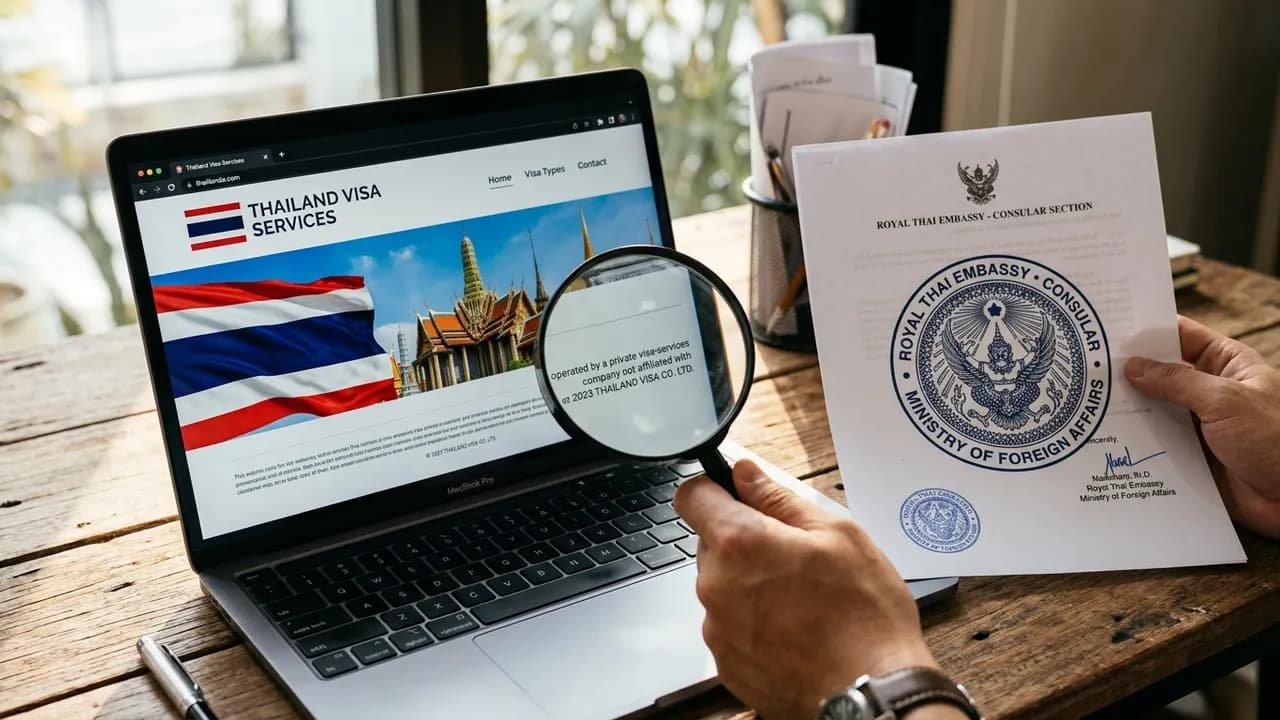
The dominant 2026 scam pattern is sites built to look like official Thai government visa or arrival-card portals, charging for services the Thai government provides for free. Thai Immigration issued a public advisory in late March 2026 warning that an estimated 10% of foreign travellers had registered through fraudulent Thailand Digital Arrival Card (TDAC) websites. The Bureau projected these rip-off sites could generate up to $100 million (3 billion THB) from the scheme by mid-2026, per Bangkok Post (March 2026), Thai Examiner, and Khaosod English.
What the fake sites do:
- Replicate the visual style of the official
tdac.immigration.go.thportal — Thai flag, formal blue-and-white styling, "official" language. - Charge between $10 and $90 for "premium," "fast-track," or "document assistance" services that are pure markup on a form that costs zero baht to submit on the actual government site.
- Collect personal data — passport details, dates of birth, addresses — that may then be misused for downstream identity-related fraud, per the Khaosod English advisory.
- In many cases, never actually submit the data to the real immigration system, leaving the traveller without a valid TDAC at the border.
Domains identified in Thai mainstream press coverage of the Thai Immigration Bureau's 2026 warning: Coverage by Thai Examiner (March 30, 2026) and other outlets reporting on the Bureau's advisory has identified tdac.info (which has described itself as an "independent travel document assistance service") and thailandarrivalform.com among the platforms referenced in the warning ecosystem. Commercial visa-processing companies including ivisa.com are listed in third-party reporting as charging a service fee for the TDAC submission that the Thai government provides without charge. The factual basis for these names is the mainstream-press coverage cited; we are reporting on the reporting. Readers are encouraged to verify the current list of officially-flagged domains directly through immigration.go.th and to use only the official tdac.immigration.go.th portal for TDAC submission.
The single test that defeats this pattern:
- The only official TDAC portal is
tdac.immigration.go.th. Anything else is not the government. - The only official Thailand e-Visa portal is
thaievisa.go.th. Anything else is not the government. - The Royal Thai Embassy network operates on
thaiembassy.org(with country subdomains). For confusion between that and a private.comlookalike, see Is ThaiEmbassy.com the Actual Thai Embassy?.
The rule, simply stated: government Thai domains end in .go.th. Thai business domains end in .co.th or .in.th (which require verified Thai business registration). .com and .info extensions are the giveaway that you are on a private commercial site, however official the styling looks. This rule is stated by the U.S. Embassy in Thailand's common scams advisory.
Scam Pattern 2 — Ghost agents
The classic pattern: the agent takes payment up front, submits nothing, stops responding, and either disappears or rebrands under a different company name. The U.S. Embassy in Thailand's scam advisory documents specific cases — including a late-2020 incident where at least eight foreigners reportedly lost 10,000 to 100,000 THB each to a visa agent who took payment and then disappeared with the funds.
The mechanics:
- Agent advertises competitive pricing on Facebook, Google Ads, or expat-forum direct-message outreach.
- Payment is required up front, often by wire transfer or Promptpay to a Thai bank account, sometimes by cryptocurrency.
- Once payment clears, the agent stops responding to messages and emails. The website goes dark or rebrands under a new company name. The phone number is dropped.
- By the time the client realises the visa was never submitted, the actor has often already rebranded.
Recovery is hard. Wire transfers and Promptpay payments are generally non-reversible once cleared. Cryptocurrency payments are non-reversible by design. Credit card payments may be reversible if the chargeback is filed quickly, which is one reason scam agents discourage card payment.
Red flags that signal ghost-agent risk:
- Payment required entirely up front, in full, before any service is delivered. Legitimate agencies typically take a deposit and bill the remainder against milestones.
- Wire transfer only — no credit card, no escrow, no third-party payment processor that offers chargeback protection.
- No physical office address or an address that does not match the company's DBD registration. The DBD's company-verification portal is the public-record check.
- No Thai business registration (no
.co.thdomain, no DBD record, no Tax ID listed). - Pressure to pay today to "lock in" a price or "secure" an appointment.
If you have been the victim of a ghost agent: call the Thai Tourist Police hotline on 1155 — an English-speaking line documented by Siam Legal's Thailand Law Library. File a report with your local police as well, file a chargeback if you paid by card, and report the actor to the Thai Cyber Crime Suppression Centre. Public reporting on TripAdvisor, Trustpilot, and the relevant expat forums also reduces the next victim's risk.
Scam Pattern 3 — Bait-and-switch pricing
Quoted-fee escalation after the client has committed and provided documents. The pattern is consistent: the initial quote is competitive, sometimes below market; once paperwork is in motion, the price escalates with "your case is complicated" or "embassy requirements changed" or "we need to use the expedited channel" justifications.
Common bait-and-switch triggers:
- "Your case is complicated" — leveraging the client's uncertainty about whether their case actually is complicated.
- "Embassy fees increased" — sometimes true at the margin, sometimes invented.
- "Expedited processing required" — pressure to upgrade to a higher tier because of an invented urgency.
- "Additional document legalisation needed" — for documents the initial quote should have included.
- "VIP appointment booking" — for an appointment that is, in fact, free at the embassy.
Why it works: The client has already paid the deposit, already handed over documents, often already received the application reference number. Walking away means losing the deposit and starting over with another agency. The bait-and-switch agent calculates that most clients will pay rather than restart.
Defence: Get the full price quoted in writing, line-itemised, including all government fees, agency service fees, document legalisation, translation costs, and any expedite premium. If the quote does not break out every line, do not pay it. The Bangkok Post coverage of visa-scam patterns summarises the same pattern as it applies to outbound visa-application fraud against Thai citizens; the inbound version against tourists is structurally identical.
Scam Pattern 4 — Fake review networks
Coordinated 5-star review campaigns, deleted negative reviews, and Trustpilot manipulation. Public discussion of this pattern centres on the agency ecosystem rather than any single actor, but it is well-documented across forums.
Quora discussion of Thai Visa Centre's review history documents users alleging that, in one period, several hundred fake 5-star reviews appeared on a single agency's Trustpilot profile before the platform removed them — with negative reviews subsequently restored. The pattern shape: a burst of generic 5-star reviews from new accounts in a short window, plus a corresponding suppression of detailed negative reviews. Trustpilot's own moderation has flagged and removed such review clusters in several documented instances.
Practical signals that a review profile may be inflated:
- A high overall rating combined with a large number of brief generic reviews ("Great service! Highly recommend!") and very few detailed multi-paragraph reviews.
- Review clusters in tight time windows from accounts with no prior history.
- A pattern of negative reviews being responded to defensively or aggressively, rather than constructively.
- Discrepancy between the on-site review profile and what appears on TripAdvisor or expat-forum threads about the same agency.
Cross-check on multiple platforms. Trustpilot, TripAdvisor, Reddit (especially r/Thailand), ASEAN Now, and the longer-running expat-forum threads each have different manipulation profiles. An agency that looks like 4.8/5 on Trustpilot but appears on TripAdvisor scam-warning threads has a problem the Trustpilot average is not telling you about. The Thai Visa Centre 2026 review on this site is one example of how the discrepancy plays out in practice.
Scam Pattern 5 — "Guaranteed approval" claims
Thai embassies have visa-issuance discretion. No agent can guarantee an embassy outcome. Anyone who promises a guaranteed visa is making a claim they cannot deliver — which is its own red flag. Quoted in Bangkok Post coverage, embassy officials including consular staff at major missions in Bangkok have warned travellers not to trust agents promising guaranteed visas or fast-tracked appointments.
The reality:
- Embassy officers have discretion to refuse a visa on substantive grounds (financial proof, employment letter quality, soft-power category eligibility).
- They also have discretion at the border to refuse entry independently of whether a visa was issued.
- A legitimate agent improves the quality of the application materials; a legitimate agent cannot guarantee the embassy outcome.
The promise to watch for: "100% approval rate," "guaranteed visa," "money back if not approved," and any variant. Some legitimate agencies offer partial refunds on rejection — that is different from a guarantee. A guarantee is the red flag.
The Bangkok Post coverage on visa scams and Travel and Tour World's digital nomad visa scam reporting document the consistent message from Thai authorities and embassies: legitimate agents do not guarantee outcomes.
What Thai authorities have done
Enforcement has stepped up materially since late 2025, even if it remains uneven. Documented actions:
- March–April 2026 — Thai Immigration Bureau formal advisory on fake TDAC sites. The advisory warned travellers that fraudulent TDAC websites had captured approximately 10% of foreign arrival traffic and could net $100 million by mid-2026. The Bureau confirmed
tdac.immigration.go.thas the only official portal. Sources: Bangkok Post, Thai Examiner, Khaosod English. - August 2025 — Bangkok visa-fraud arrests. Thai Immigration arrested two Chinese nationals on charges including forgery of passport stamps and use of a forged stamp in a Non-Immigrant B work visa application, per Thai Examiner (August 5, 2025). The arrests were part of an ongoing Immigration Bureau crackdown.
- November 2025 — Immigration Bureau tightening of tourist visa rules. Thai Examiner reporting documented the Bureau's response to the broader scammer-economy problem with additional document-verification requirements at borders.
- May 2024 — European visa document-fraud arrests. Khaosod English coverage documented the arrest of three Thai-based agencies for European-visa document fraud — a structurally similar pattern affecting outbound traffic. Cited here because it confirms Thai authorities prosecute the agency-side fraud pattern, not just the individual traveller side.
- 2026 — Cyber Crime Suppression Centre prioritisation. The CCSC has flagged scam-syndicate suppression as a 2026 priority, with Bangkok Post coverage documenting cross-border cooperation with China, the US, and Japan on transnational scam networks.
The trajectory: enforcement is real but uneven. Awareness is still the strongest defence.
How to verify an agent is legitimate
Five steps. Run all five before paying anything beyond a refundable consultation fee.
1. Check the domain extension
The simplest test. .go.th is Thai government. .co.th is a registered Thai limited company. .in.th requires verified Thai business registration. .com, .org, .info, .net are unverified. A .com domain is not automatically a scam — many legitimate law firms operate on .com — but the absence of a Thai-business-verified domain means you have to do all your verification yourself.
2. Search the Department of Business Development registry
The Thai Department of Business Development (DBD) maintains the official company registry under the Ministry of Commerce. The English-language verification portal is at encert.dbd.go.th/encert-inter/public/en/checkbyref. Search by company name or registration number. The DBD record shows: registration status, date of registration, registered address, directors, shareholders, business objectives, and current legal status.
What you are looking for:
- An active registration in good standing (not suspended or dissolved).
- A registration objective that includes legal or immigration services (not, e.g., "consulting" only).
- A registered address that matches the address listed on the agency's website.
- A registration date that is reasonably old relative to the agency's claimed history. A 6-month-old company claiming "20 years of experience" is a flag.
3. Verify any "law firm" claim with the Lawyers Council of Thailand
If the agency markets itself as a "law firm" or claims to provide legal services in Thai immigration matters, the lawyer in charge should be registered with the Lawyers Council of Thailand. Court representation in Thai tribunals requires a registered Thai lawyer. Public verification is done through the Lawyers Council directly.
4. Verify the physical office
Legitimate Thai-based agencies have a physical office at a verifiable address. Visit if you are in Thailand. If you are not, ask for a video walk-through, a photo of the reception desk with the day's date visible, or a Google Maps Street View confirmation. The absence of a verifiable office is a flag.
5. Check payment safety
- Credit card is safest — chargeback rights apply.
- Bank transfer to a registered Thai business account (a
co.,ltdaccount) is acceptable for established agencies. - Wire transfer to a personal Thai bank account, Promptpay to a personal phone number, or cryptocurrency are red flags. Legitimate agencies do not require personal-account payments.
The 10-point self-defense checklist
Before paying any Thailand visa agent, all ten:
- Domain extension — agency website on
.co.th,.in.th, or a.comwith a real DBD registration verifiable separately. - DBD registration — confirmed active, registration date plausible, address matches website.
- Lawyers Council registration if "law firm" or legal services are claimed.
- Physical office — verifiable address, photographable, on Google Maps.
- Itemised quote in writing — every government fee, every agency fee, every legalisation cost, every translation cost, broken out. No "we'll let you know" pricing.
- Reasonable deposit structure — partial up-front, balance on milestones. Not 100% up-front.
- Credit card or established Thai-business bank transfer payment — no personal accounts, no crypto, no wire-only.
- No "guaranteed approval" claim — anyone who guarantees the embassy's decision is making a false claim.
- Cross-platform review check — Trustpilot rating cross-checked against TripAdvisor scam-warning forums, Reddit threads, and ASEAN Now. Reviews are consistent in tone and detail across platforms.
- Independence test — agency website not impersonating any Thai government property (no domain or styling that could be confused with
.go.th, no use of "Thai Embassy" or "Thailand Visa Centre" naming that mimics an official entity).
If any of the ten are missing, treat the agency as elevated risk. If three or more are missing, walk away.
What we monitor (without naming)
This article does not name specific agencies as scams. The pattern-level description above is intentional — naming specific agencies as scammers in a published article is a defamation surface that we do not want to maintain at the cornerstone level. Specific agency analysis with sourcing lives in the per-agency review pages, where each claim is footnoted to the underlying source and the framing is calibrated to what is in the public record.
If you are evaluating a specific named agency, the Agency Reviews index is where the honest per-agency analysis lives. Two pages currently in publication:
- Is ThaiEmbassy.com the Actual Thai Embassy? — analyses the most-confused commercial site in the Thailand visa SERP and explains who actually operates it.
- Thai Visa Centre 2026 Review — analyses the agency at the centre of the most-documented agency-related controversy in 2025–2026.
Both are sourced to the public record — court filings, news coverage, immigration advisories, and named third-party forum threads. Both apply the patterns described here to the specific agencies named.
What to do if you have already been scammed
Five steps, in order of urgency:
- Stop payment if possible. If you paid by credit card, file a chargeback immediately — within 60 days of the transaction in most jurisdictions. If you paid by bank transfer, contact your bank's fraud team within 24 hours; some transfers are reversible.
- Call the Thai Tourist Police on 1155. The hotline is staffed 24/7 in English, per the Siam Legal Thailand Law Library scam-reporting guide. File a report. Get the case reference number.
- File a report with the Thai Cyber Crime Suppression Centre (CCSC). Online fraud falls under CCSC jurisdiction. The CCSC has prioritised visa-fraud syndicates in 2026, per Bangkok Post coverage.
- Contact your home-country embassy in Bangkok. They will not recover your funds, but they will log the incident, which contributes to the awareness layer that drives Thai enforcement priorities.
- Public-report the actor on TripAdvisor, Trustpilot, Reddit (
r/Thailand), and ASEAN Now. Public reports reduce the next victim's risk, and Thai authorities track forum reports in their enforcement prioritisation.
FAQ
What is the safest single check before paying a Thailand visa agent?
Verify the company in the Department of Business Development registry at encert.dbd.go.th. Confirm the company is registered, active, and the registered address matches the website. This single check eliminates most ghost-agent and fly-by-night operators because they typically operate without verifiable Thai business registration.
Is the Thai Digital Arrival Card (TDAC) free?
Yes. The only official TDAC portal is tdac.immigration.go.th and submission is free. Anyone charging for TDAC submission is charging for a service the Thai government provides at zero cost. Thai Immigration's March 2026 advisory specifically called out the fee-charging fake TDAC sites — see the Bangkok Post warning coverage.
Is the Thailand e-Visa free?
The e-Visa itself has a government fee (around 2,000–5,000 THB depending on visa type and entry count) that is paid through the official portal at thaievisa.go.th. Any third-party processor charges a service fee on top of the government fee. The government fee is mandatory, the agency service fee is optional. See Thailand e-Visa Guide for the official process.
Are all Thailand visa agencies scams?
No. Many are legitimate operators — registered law firms, established immigration consultancies, and reputable visa-processing services — that provide real value to clients with complicated cases. The point of this article is not that all agencies are scams; it is that the legitimate operators all clear the same set of verification checks (DBD registration, physical office, itemised pricing, no guarantee claims) that the scam operators consistently fail. Run the checklist, and the distinction becomes visible.
Can I get my money back if a Thailand visa agent scammed me?
Sometimes. Credit card chargebacks are the most reliable recovery mechanism if filed quickly. Wire transfers and Promptpay payments are generally non-reversible once cleared. Cryptocurrency is non-reversible by design. Reporting to the Thai Tourist Police on 1155 and the Cyber Crime Suppression Centre creates a record and contributes to enforcement, even if your specific case is not recovered.
Why are fake TDAC websites so common?
Three reasons. First, the TDAC was new in 2025, and travellers had not yet learned which domain is official. Second, the official tdac.immigration.go.th portal is not heavily marketed by the Thai government, so search-engine top results were dominated by commercial sites with stronger SEO. Third, the per-traveller fees ($10–$90 for a free service) made the model lucrative enough to fund aggressive lookalike-site investment. Thai Immigration's March 2026 advisory was a direct response to the model becoming visible at scale.
What is the difference between an agency, a law firm, and an immigration consultancy?
A registered Thai law firm can represent you in immigration tribunals and provide formal legal services — its lawyers are registered with the Lawyers Council of Thailand. An immigration consultancy or visa agency typically handles paperwork, scheduling, and submission but cannot represent you in court. Both can be legitimate; the difference matters when the case escalates beyond paperwork to a legal dispute. A "law firm" claim that is not backed by Lawyers Council registration is a flag.
Does paying more for a visa agency mean better service?
Not reliably. Pricing in the Thailand visa-agency market is dispersed and not strongly correlated with quality. Some of the most expensive agencies have the most documented complaints; some of the cheaper ones provide solid service. Price is not the signal; verification (DBD, physical office, itemised quote, no guarantees) is.
Where to next
For the actual application process — the free path — start with the Thailand e-Visa guide and the list of visa types. For the live record of scam warnings, enforcement actions, and Royal Gazette publications, see the Thailand visa news tracker.
For honest, sourced, per-agency analysis — including the two most-discussed agencies in the 2025–2026 record — see the Agency Reviews index. The reviews currently published include the analysis of ThaiEmbassy.com and the Thai Visa Centre 2026 review.
The pattern is what the article describes. The agencies are what the per-agency reviews describe. Before paying anyone, run the ten checks.
Editorial standards and right of reply
This article is published as fair comment on a commercial market and a Thai Immigration Bureau advisory under Section 329(3) of the Thai Criminal Code, in the public interest of Thailand-bound travellers. Every domain or company name referenced above is attributed to a named public-record source — the Thai Immigration Bureau's March 2026 advisory as reported by Bangkok Post, Thai Examiner, and Khaosod English; the U.S. Embassy in Thailand's common-scams advisory; or Thai Tourist Police and Cyber Crime Suppression Centre coverage in Thai mainstream press. We do not assert that any specific named domain is operated by any specific named individual or company; we report what is in the cited coverage.
Any company, individual, or domain operator named in this article or in the linked source material may request a right of reply through the process documented on our Editorial Standards page. We will review substantive correction requests within fifteen business days and either correct the statement, append the response verbatim, or explain why we believe the existing statement is supported by the cited source.
We do not sell visas. We do not take referral commissions, affiliate fees, or any other payment from visa agencies, law firms, or visa-processing services. Our independence is the foundation of this coverage.
Sources
- Bangkok Post — Immigration warns of scam digital arrival card websites (March 2026)
- Thai Examiner — Immigration Bureau warns rip-off TDAC sites stand to make $100 million (March 30, 2026)
- Khaosod English — 10% of foreign arrivals used fake TDAC sites, immigration warns (March 29, 2026)
- Business Standard — Thailand warns travellers TDAC is free, fake sites charge up to $90
- Fragomen — Thailand Advisory on Fraudulent TDAC Websites
- Thai Examiner — 2 Chinese men arrested in Bangkok for visa fraud (August 5, 2025)
- Thai Examiner — Immigration Bureau tightens tourist visa rules under scammer pressure (November 15, 2025)
- Khaosod English — Three Thai agencies arrested for European visa document fraud (May 2024)
- Bangkok Post — Thai travellers warned over rise of visa scams
- Bangkok Post — Agency to monitor growing scam threat
- Bangkok Post — Thai travellers warned of rising visa scams
- U.S. Embassy in Thailand — Common Scams to Avoid
- Siam Legal — What to Do if You've Been Scammed in Thailand
- Department of Business Development — English company verification portal
- Thai Immigration Bureau — Official TDAC portal
- Quora — Discussion of Thai Visa Centre Trustpilot review history
- Travel and Tour World — Thailand digital nomad visa scam reporting