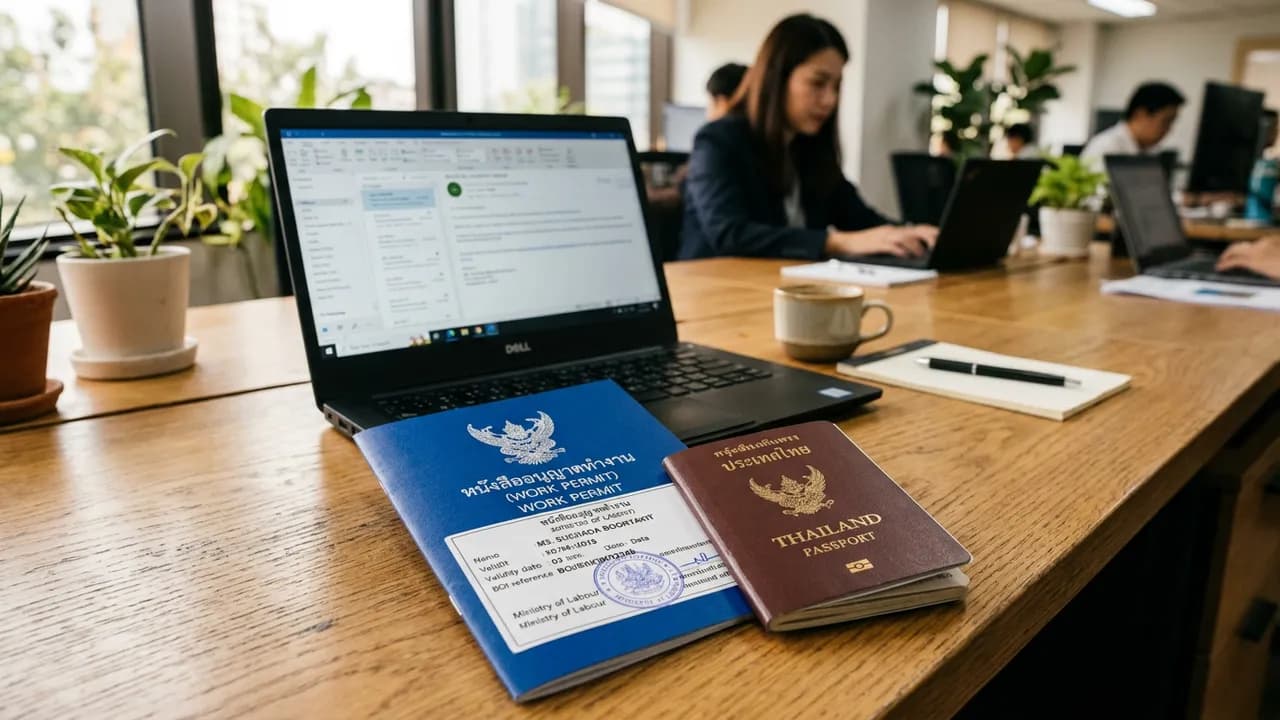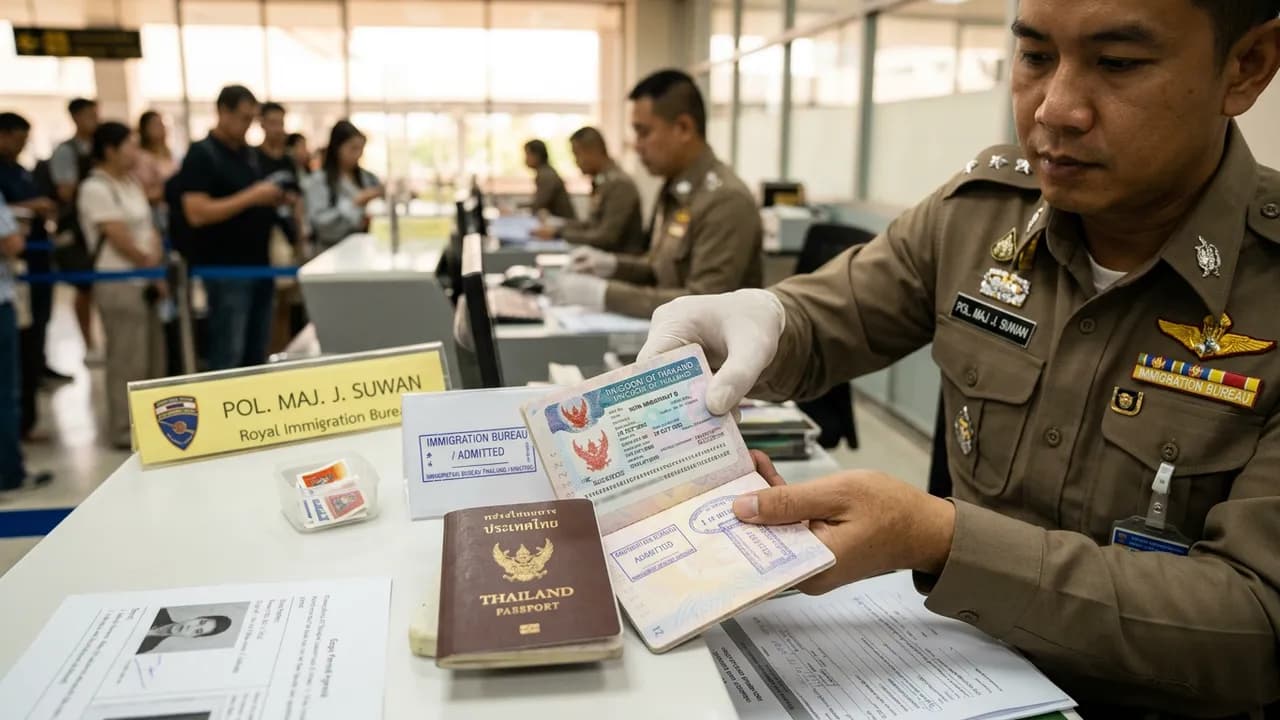
This Thailand work permit guide explains the two separate authorizations needed to work legally in the kingdom: a valid visa that permits employment, and a physical work permit issued by the Ministry of Labour. Many newcomers confuse the two, but they serve different functions. Your visa allows you to enter and remain in the country; your work permit authorizes you to perform specific work for a specific employer at a specific location. Without both documents in order, you risk fines, detention, deportation, and a ban on re-entry.
This guide covers everything foreign nationals need to know about obtaining and maintaining a Thailand work permit in 2026.
What Is a Thailand Work Permit?
A Thai work permit (known formally as a Ror Tor Tor 10 or WP.10 document) is an official booklet issued by the Department of Employment under the Ministry of Labour. It contains your photograph, passport details, employer information, job title, workplace address, and the permitted scope of your employment.
The legal basis for work permits comes from the Foreign Working Management Emergency Decree B.E. 2560 (2017) and its subsequent amendments. Under Thai law, "work" is defined broadly as any activity involving physical or mental effort, regardless of whether compensation is received within Thailand.
Who Needs a Work Permit?
Any foreign national performing work in Thailand needs a work permit, with very limited exceptions:
- Diplomats and consular staff covered by bilateral agreements
- Personnel of international organizations with specific Thai government agreements
- Individuals performing duties under Section 12 of the Emergency Decree (urgent/temporary work up to 15 days)
- Members of trade or cultural missions with government approval
If you fall outside these exceptions and you are doing any form of work in Thailand, you need a permit. This includes volunteer work, consulting, and even attending business meetings beyond a narrowly defined scope. For freelancers and independent workers, see our freelance work permit options guide.
Work Permit vs. Business Visa
| Feature | Non-Immigrant B Visa | Work Permit |
|---|---|---|
| Issuing Authority | Royal Thai Embassy/Consulate or Immigration Bureau | Department of Employment, Ministry of Labour |
| Purpose | Legal right to stay in Thailand for employment purposes | Legal right to perform work for a named employer |
| Format | Visa stamp in passport | Physical blue booklet |
| Validity | Typically 90 days initially (extendable to 1 year) | Up to 2 years, tied to visa validity |
| Application Location | Thai embassy abroad or within Thailand | Within Thailand at the Department of Employment |
You need the visa first, then the work permit. They are linked: if your visa expires or is cancelled, your work permit becomes invalid.
Eligibility Requirements
To qualify for a Thailand work permit, both you and your employer must meet specific criteria.
Requirements for the Foreign Employee
- Valid non-immigrant visa — Typically a Non-Immigrant B (Business) visa, though certain other visa categories also qualify
- Educational qualifications — A bachelor's degree or higher in a field relevant to the position (in most cases)
- Professional experience — Relevant work experience, typically at least 2 years
- Clean criminal record — No convictions that would disqualify you under Thai law
- Medical fitness — No prohibited diseases (leprosy, tuberculosis, drug addiction, alcoholism, elephantiasis)
- The role must not be on the restricted occupations list — Certain jobs are reserved exclusively for Thai nationals
Requirements for the Employer (Sponsoring Company)
Thai employers must meet minimum thresholds to sponsor a foreign worker:
| Requirement | Minimum Threshold |
|---|---|
| Registered capital | 2 million THB per foreign employee |
| Thai-to-foreign employee ratio | 4 Thai employees for every 1 foreign worker |
| Company registration | Must be properly registered with the Department of Business Development |
| Tax compliance | Up-to-date corporate tax filings |
| Social security registration | Active social security contributions for all employees |
Note: BOI-promoted companies and companies operating under other special investment schemes may have reduced requirements. See our BOI Work Permit Guide for details.
Occupations Restricted for Foreigners
Thailand maintains a list of occupations prohibited for foreign workers under the Royal Decree on Occupations and Professions Prohibited for Foreign Workers. As of 2026, the restricted list includes:
- Manual labor and unskilled work
- Farming, animal husbandry, forestry, and fishing (with exceptions for specialized roles)
- Bricklaying, carpentry, and other construction trades
- Wood carving
- Driving motor vehicles (except international pilot licenses)
- Auctioneering
- Hairdressing and barbering
- Cloth weaving by hand
- Mat weaving and lacquerware making
- Thai musical instrument making
- Nielloware and goldsmithing
- Pottery and ceramics
- Thai silk hand-weaving
- Buddha image casting
- Knife making
- Thai-style umbrella and shoe making
- Thai doll making
- Brokerage and agency work (with exceptions)
- Clerical and secretarial work
- Legal services and accounting (with specific exceptions for international firms)
This list is reviewed periodically and can change. Always verify the current list with the Department of Employment before making plans.
Step-by-Step Application Process
Step 1: Secure a Job Offer
Your employer must provide a formal employment contract or offer letter specifying your position, salary, duties, and workplace address. The minimum salary requirement varies by nationality:
| Nationality | Minimum Monthly Salary |
|---|---|
| European, Australian, Canadian, American, Japanese | 50,000 THB |
| South Korean, Taiwanese, Hong Kong, Singaporean | 50,000 THB |
| Asian (other) | 35,000 THB |
| African, Central/South American | 25,000 THB |
These thresholds are guidelines used by the Department of Employment and may vary by position and qualifications.
Step 2: Obtain a Non-Immigrant B Visa
Apply at a Royal Thai Embassy or Consulate in your home country or a third country. You can also use the Thailand e-Visa system where available. Required documents typically include:
- Passport valid for at least 6 months
- Completed visa application form
- Recent passport-sized photographs
- Employment contract or invitation letter from the Thai company
- Company registration documents (certified copies)
- Company financial statements
- List of shareholders
- Map showing workplace location
Processing takes 3-7 business days at most embassies. The initial visa is typically valid for 90 days.
Step 3: Enter Thailand and Apply for Work Permit
Once you arrive in Thailand with your Non-Immigrant B visa, your employer files the work permit application with the Department of Employment office in the province where you will work (or the One Stop Service Center in Bangkok).
Documents required for the work permit application:
From the employee:
- Completed WP.1 application form
- Passport with Non-Immigrant B visa (original and copies)
- Three recent photographs (3 x 4 cm)
- Medical certificate from a Thai-registered hospital (not older than 6 months)
- Educational certificates (originals and certified copies/translations)
- Resume/CV
- Copy of previous work permits (if applicable)
From the employer:
- Company registration certificate
- Shareholder list
- VAT registration (Por Por 20)
- Corporate income tax return (latest filing)
- Social security contribution records
- Map of office location
- Power of attorney (if the signatory is not a director)
- Organizational chart showing the foreign employee's position
Step 4: Receive the Work Permit
Processing typically takes 3-7 business days after submission of a complete application. If approved, you will receive the physical work permit booklet (blue book). You must carry this booklet or a certified copy at all times when working.
Step 5: Extend Your Visa to One Year
After receiving your work permit, you can apply at the Immigration Bureau to extend your Non-Immigrant B visa to a full one-year stay. This requires proof of employment, tax payments, and other supporting documents.
Costs and Fees
| Item | Cost |
|---|---|
| Non-Immigrant B Visa (single entry) | 2,000 THB (approximately) |
| Work permit application fee | 750 THB (for validity up to 3 months) |
| Work permit fee (3-6 months) | 1,500 THB |
| Work permit fee (6-12 months) | 3,000 THB |
| Annual work permit renewal | 3,000 THB |
| Medical certificate | 500-1,500 THB |
| Document translations and certifications | 1,000-5,000 THB |
Most employers cover these costs as part of the hiring process. If you are using a legal service or agency to handle the paperwork, expect additional fees of 15,000-40,000 THB depending on complexity.
Work Permit Renewal
Work permits must be renewed before expiration. The renewal process is similar to the initial application but generally simpler if your employer and position remain the same. Key points:
- Apply for renewal at least 30 days before expiration
- Submit updated company documents (latest tax filings, shareholder lists)
- Provide proof of personal income tax payments (Por Ngor Dor 91)
- Updated medical certificate may be required
Failure to renew on time means your work permit expires, and working without a valid permit is illegal.
Changing Employers
Your work permit is tied to a specific employer. If you change jobs, you must:
- Have your current employer cancel the existing work permit (or cancel it yourself)
- Obtain a new Non-Immigrant B visa (or have the new employer file for a visa transfer)
- Apply for a new work permit with the new employer
There is a grace period, but working for a new employer before your new work permit is issued is technically illegal. Plan transitions carefully with both employers cooperating.
Penalties for Working Without a Permit
Thailand takes illegal employment seriously. Penalties include:
Penalties are set by the Royal Ordinance on the Management of Foreign Workers' Employment B.E. 2560 (2017), as amended in 2018 (official English translation, ILO NATLEX):
| Violation | Penalty |
|---|---|
| Working without a work permit (worker) | Fine of 5,000-50,000 THB, deportation, and a 2-year ban on a new work permit; imprisonment was removed by the 2018 amendment |
| Employing a foreigner without a work permit | Fine of 10,000-100,000 THB per illegal worker; repeat offense: 50,000-200,000 THB, up to 1 year imprisonment, and a 3-year ban on employing foreigners |
| Working outside the scope of your permit | Fine of up to 50,000 THB |
| Failing to carry your work permit | Fine of up to 10,000 THB |
Offenders are typically deported and may be banned from re-entering Thailand for a specified period.
Obligations While Holding a Work Permit
Once you have a work permit, you have ongoing legal obligations:
- Carry your work permit at all times when working (or a certified copy)
- Work only for the named employer at the approved location
- Report changes — any change of employer, location, or job duties requires updating your work permit
- File personal income tax — all work permit holders must file Thai income tax returns
- 90-day reporting — report your address to Immigration every 90 days
- Notify the Department of Employment if your work permit is lost or damaged
Tips for a Smooth Application
- Start early — Begin the visa and work permit process at least 2-3 months before your intended start date
- Ensure document consistency — Your name, passport number, and employer details must match exactly across all documents
- Use certified translations — All non-English and non-Thai documents need certified translations
- Keep copies of everything — Maintain photocopies of all submitted documents
- Choose an experienced employer — Companies that have sponsored foreign workers before understand the process and are less likely to make errors
- Consider professional help — For complex cases, a reputable immigration lawyer or work permit agency can save time and prevent costly mistakes
- Monitor expiration dates — Set reminders for visa and work permit renewals well in advance
Frequently Asked Questions
Can I work remotely for a foreign company while on a tourist visa?
No. Any work performed in Thailand requires a work permit, regardless of where your employer is based or where you receive payment. See our Digital Nomad Guide for legal options for remote workers.
How long does the entire process take?
From initial visa application to receiving the work permit booklet, expect 4-8 weeks if all documents are in order.
Can I work while my work permit application is being processed?
No. You must wait until the physical work permit is issued before starting work.
What happens if my employer goes out of business?
Your work permit becomes invalid. You have 7 days to report the situation to the Department of Employment and must either find a new sponsoring employer or cease working.
Do I need a new work permit if I get promoted?
If your job title or duties change significantly, you should update your work permit to reflect the new position. Minor title changes may not require an update, but it is safer to notify the Department of Employment.
Final Thoughts
The Thailand work permit process is bureaucratic but manageable with proper preparation. The key is ensuring both you and your employer meet all requirements before beginning the application. Working illegally in Thailand carries severe consequences, so invest the time and resources to do it properly. Your employer should be an active partner in the process — any legitimate company hiring foreigners will understand and support the requirements.
For specialized situations, including BOI-promoted companies and teaching positions, see our dedicated guides linked below. For specialized situations, see our BOI work permit guide and our teaching work permit guide.