Thailand 90-day reporting is a legal requirement that applies once you have stayed in the kingdom for more than 90 consecutive days, obligating you to notify your current address to Thai Immigration. This obligation applies to all foreigners regardless of visa type — whether you hold a work permit, retirement visa, marriage visa, or even a Thailand Elite visa.
This guide explains who needs to report, how to do it, and what happens if you miss a deadline.
What Is 90-Day Reporting?
The 90-day reporting requirement (officially called "Notification of Residence for Foreigners Staying in the Kingdom over 90 Days") is an address notification, not a visa extension. It does not affect your visa status or permitted stay. It simply tells Thai Immigration where you are living.
Key facts:
- Required every 90 days of continuous stay in Thailand
- It is an address notification, not a visa renewal
- The 90-day counter resets each time you leave and re-enter Thailand
- Can be done online, in person, by mail, or through an agent
- Uses the TM.47 form
- No fee for the notification itself
Who Needs to Report?
All foreigners who remain in Thailand for 90 or more consecutive days, regardless of visa type. This includes holders of:
- Non-Immigrant B (business/work) visas
- Non-Immigrant O (retirement, marriage, dependent) visas
- Non-Immigrant O-A and O-X (retirement) visas
- Non-Immigrant ED (education) visas
- Tourist visas with extensions
- Thailand Elite visa
- LTR visa holders report annually instead of every 90 days (the only exception)
- Permanent residents
When the 90-Day Counter Resets
Your 90-day counter resets to zero every time you leave Thailand and re-enter. Even a day trip to a neighboring country restarts the clock. After re-entry, your next report is due 90 days from the date of re-entry.
When to Report
You can report your address within the following window:
- Earliest: 15 days before the 90-day deadline
- Deadline: On the 90th day
- Late: After the 90th day (subject to a fine)
Example: If you entered Thailand on January 1, your first 90-day report is due by April 1 (day 90). You can submit it as early as March 17 (15 days before).
Calculating Your Due Date
Count 90 days from:
- Your most recent entry into Thailand, OR
- Your last 90-day report date
Your receipt from the previous report will show your next due date.
How to Report: 4 Methods
Method 1: Online (Recommended)
The easiest method when the system is working.
Steps:
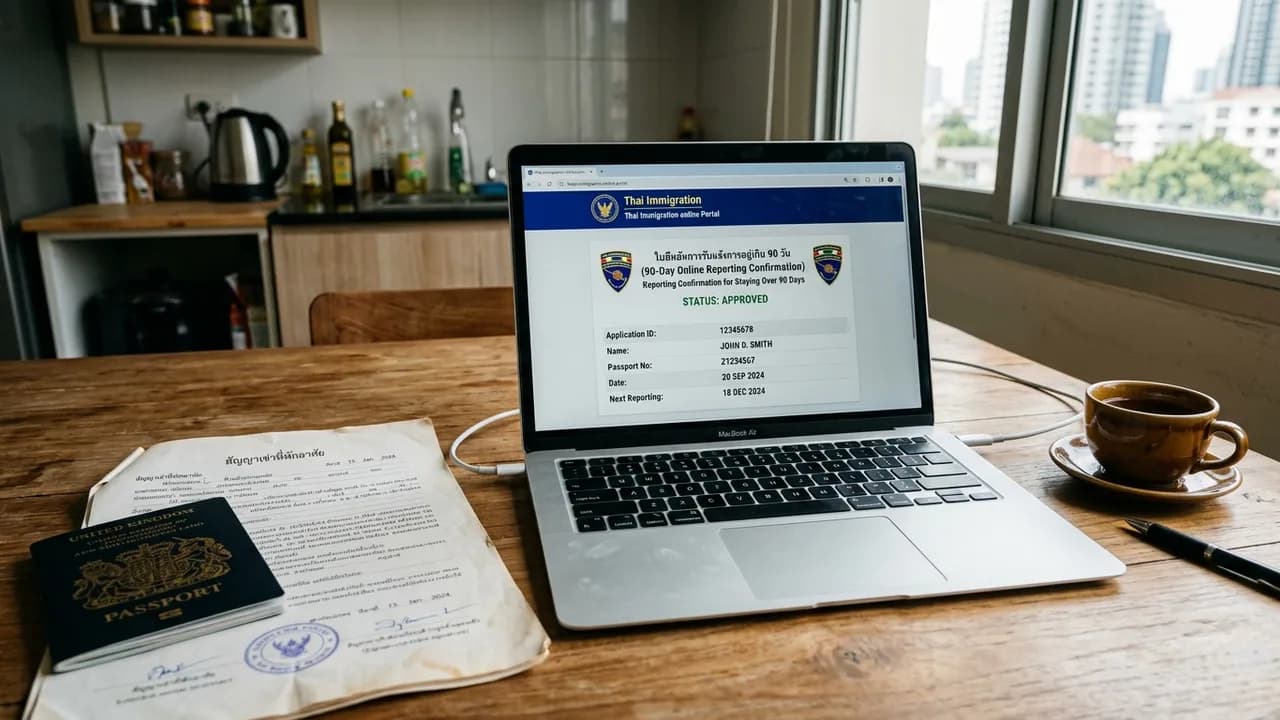
- Visit the Thai Immigration online reporting system at tm47.immigration.go.th
- Log in or create an account (first-time users must register)
- Fill in the required information:
- Passport number
- Current address in Thailand
- Date of last entry
- Submit the form
- Save or print the confirmation receipt
Requirements for online reporting:
- You must have completed your first 90-day report in person (or some offices allow the first online)
- Your passport and visa information must already be in the immigration system
- The system must be operational (it experiences downtime)
Pros: No travel to immigration, no queuing, instant confirmation Cons: The online system is occasionally offline or experiences errors. Not all immigration offices accept the first report online.
Method 2: In Person at an Immigration Office
The most reliable method, especially for your first report.
Steps:
- Visit your nearest immigration office during business hours
- Bring your passport, TM.47 form (or fill one out there), and a copy of your passport's biographical page and current visa/extension stamp
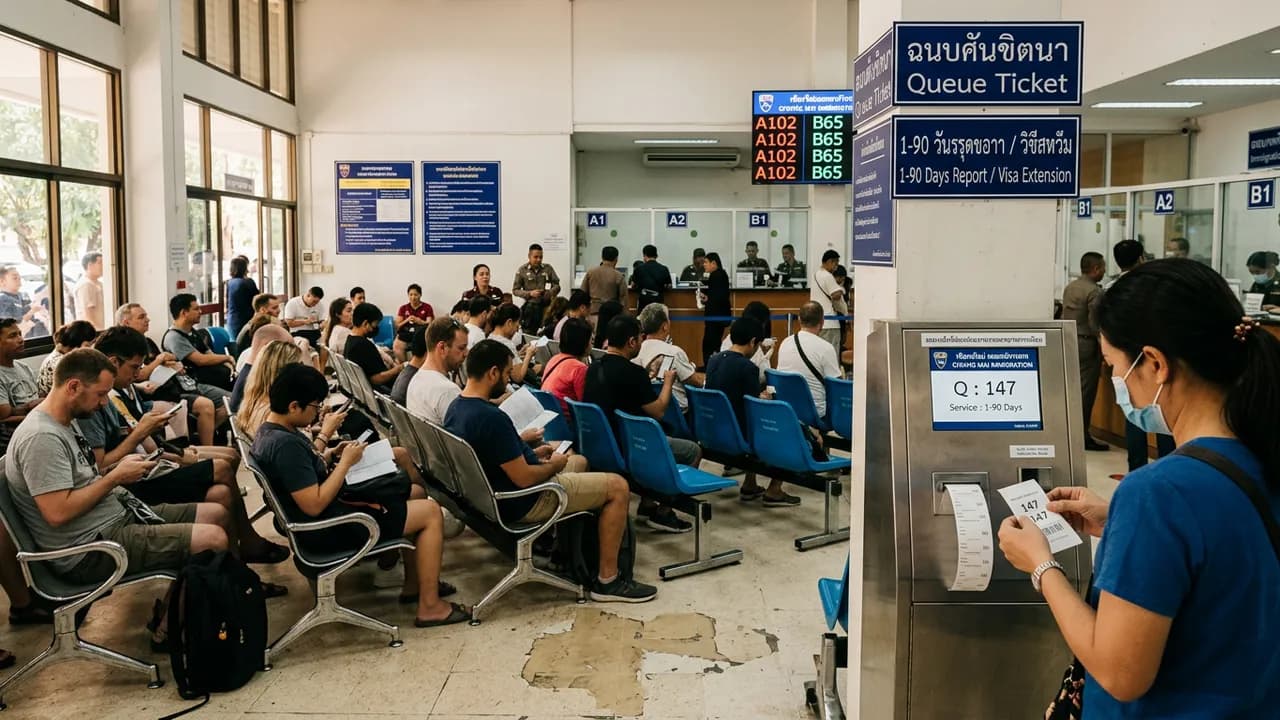
- Take a queue number for 90-day reporting
- Submit your documents at the counter
- Receive a receipt with your next due date
Processing time: 10-60 minutes depending on the queue
What to bring:
- Passport (original)
- Completed TM.47 form
- Photocopy of passport biographical page
- Photocopy of current visa/extension of stay page
- Photocopy of most recent entry stamp (TM stamp page)
- Photocopy of departure card (TM.6, if applicable)
- Previous 90-day reporting receipt (if you have one)
Method 3: By Mail
You can send your report by registered mail to your local immigration office.
Steps:
- Complete the TM.47 form
- Include photocopies of your passport pages (biographical, visa, latest entry stamp)
- Include a self-addressed stamped envelope for the receipt
- Send by registered mail to your local immigration office
- Allow at least 7-10 days before the deadline for delivery
Pros: No need to travel to immigration Cons: Unreliable delivery times, risk of lost mail, some offices are slow to process postal reports
Method 4: Through an Agent
Immigration agents and visa service companies offer 90-day reporting as a service.
Typical cost: 500 - 2,000 THB per report
How it works:
- Provide your passport to the agent (or copies, depending on the agent)
- The agent visits immigration on your behalf
- They return your passport and receipt
Pros: Completely hands-off Cons: Additional cost, need to hand over your passport temporarily
The TM.47 Form
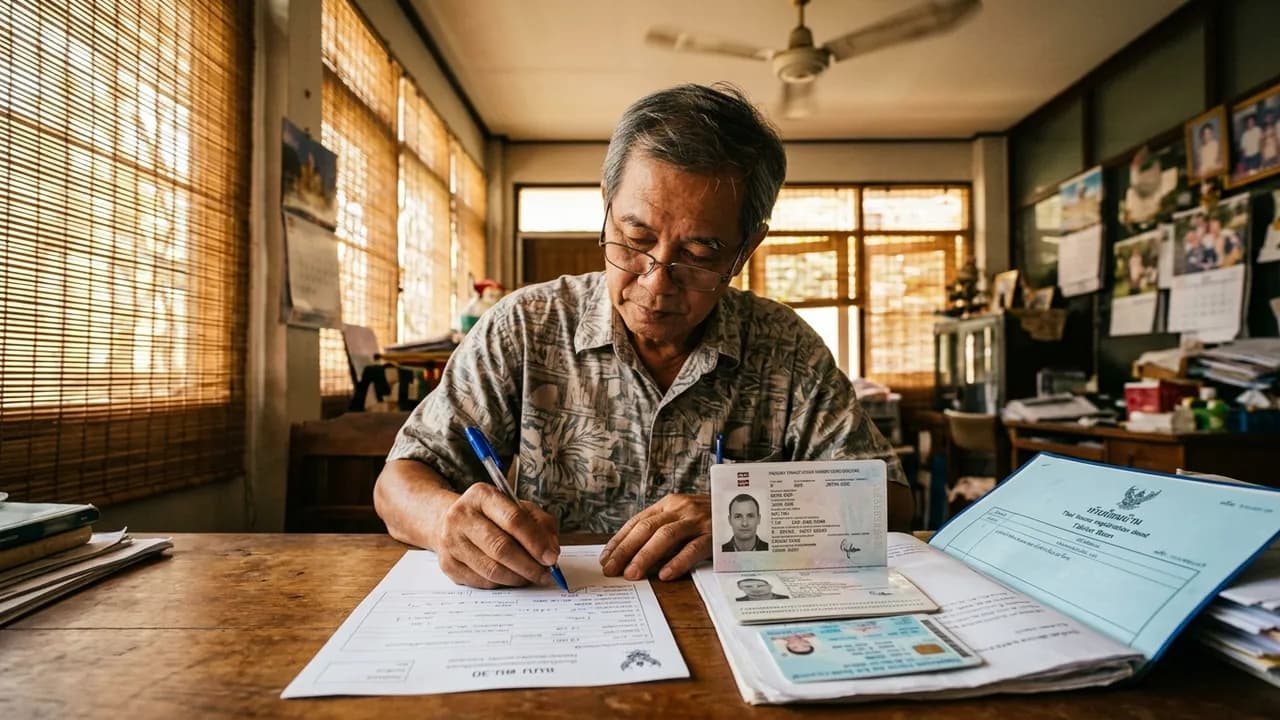
The TM.47 is the official notification form. It is a simple one-page document requiring:
- Full name as shown in passport
- Nationality
- Passport number
- Visa type and number
- Current address in Thailand
- Date of arrival (most recent entry)
The form is available at immigration offices and can be downloaded from the Thai Immigration Bureau website.
Penalties for Late Reporting
Missing your 90-day reporting deadline results in a fine:
| Situation | Penalty |
|---|---|
| Late report (you go to immigration voluntarily) | 2,000 THB fine |
| Caught by police or immigration without valid report | Up to 5,000 THB fine |
| Repeated violations | Potential complications with future visa extensions |
The fine is typically paid on the spot at the immigration office when you go to make your late report. While 2,000 THB is not a large sum, repeated late reporting can create a negative record that may affect future extension of stay applications.
Important: Late reporting does not affect your visa validity. Your visa remains active regardless of whether you have completed your 90-day report. However, it is a legal violation that results in fines and administrative inconvenience.
Tips for Smooth 90-Day Reporting
- Set a calendar reminder — Set an alert 15 days before your due date so you can report within the early window
- Try online first — If the system works, it takes 5 minutes from your sofa
- Go early in the morning — If reporting in person, arrive when the immigration office opens (8:30 AM) to avoid long queues
- Keep your receipts — The receipt shows your next due date. Store a photo on your phone as a backup
- Bring extra photocopies — Immigration offices sometimes request additional copies. Bring 2 sets of everything
- Track the counter after travel — If you leave Thailand for even one day, the 90-day counter resets. Note the new due date based on your re-entry stamp
- Use an agent during peak periods — Near Thai New Year (Songkran) and the end of the year, immigration offices are crowded. An agent can save you hours of waiting
90-Day Reporting vs. TM30
These are two separate requirements and are frequently confused:
| Feature | 90-Day Reporting (TM.47) | TM30 Notification |
|---|---|---|
| Who reports | The foreigner | The landlord/hotel/property owner |
| When | Every 90 days of continuous stay | Within 24 hours of arrival at an address |
| Purpose | Address notification to immigration | Notification that a foreigner is staying at a property |
| Penalty for non-compliance | 2,000-5,000 THB fine | 800-2,000 THB fine |
| Can be done online | Yes | Yes |
You may need to complete both obligations. See our separate TM30 reporting guide for details.
Frequently Asked Questions
Does 90-day reporting cost anything?
The reporting itself is free. You only pay a fine if you report late, or a fee if you use an agent.
Can I do my first 90-day report online?
It depends on the immigration office. Some offices require the first report in person; others accept online submissions from the start. Try online first — if rejected, go in person.
What happens to my 90-day reporting when I extend my visa?
Extending your visa does not reset the 90-day counter. Only leaving and re-entering Thailand resets it.
I left Thailand for a weekend trip. Do I still need to report?
Your 90-day counter resets when you re-enter Thailand. If it has been fewer than 90 days since your re-entry, you do not need to report yet.
Can I report at any immigration office in Thailand?
Generally yes, but some offices prefer that you report at the office covering your residential area. Major offices like Chaeng Wattana in Bangkok accept reports from anyone.
What if the online system is down on my due date?
If you can document that the system was unavailable, most immigration officers will waive the late penalty. Screenshot the error page as evidence, and visit the office in person as soon as possible.
Final Thoughts
The 90-day reporting requirement is one of those small bureaucratic tasks that can cause disproportionate stress if you forget about it. The key is to set a reliable reminder and use the online system whenever possible. It takes minutes to complete and keeps you in good standing with Thai Immigration.