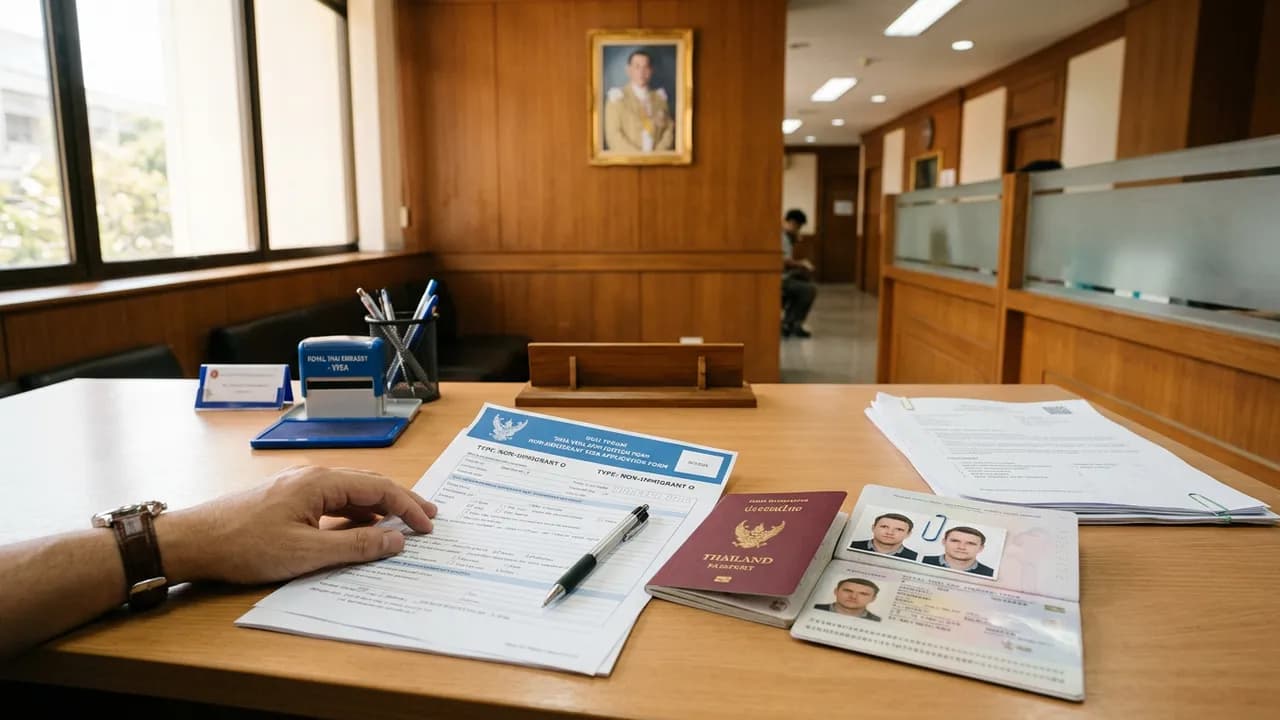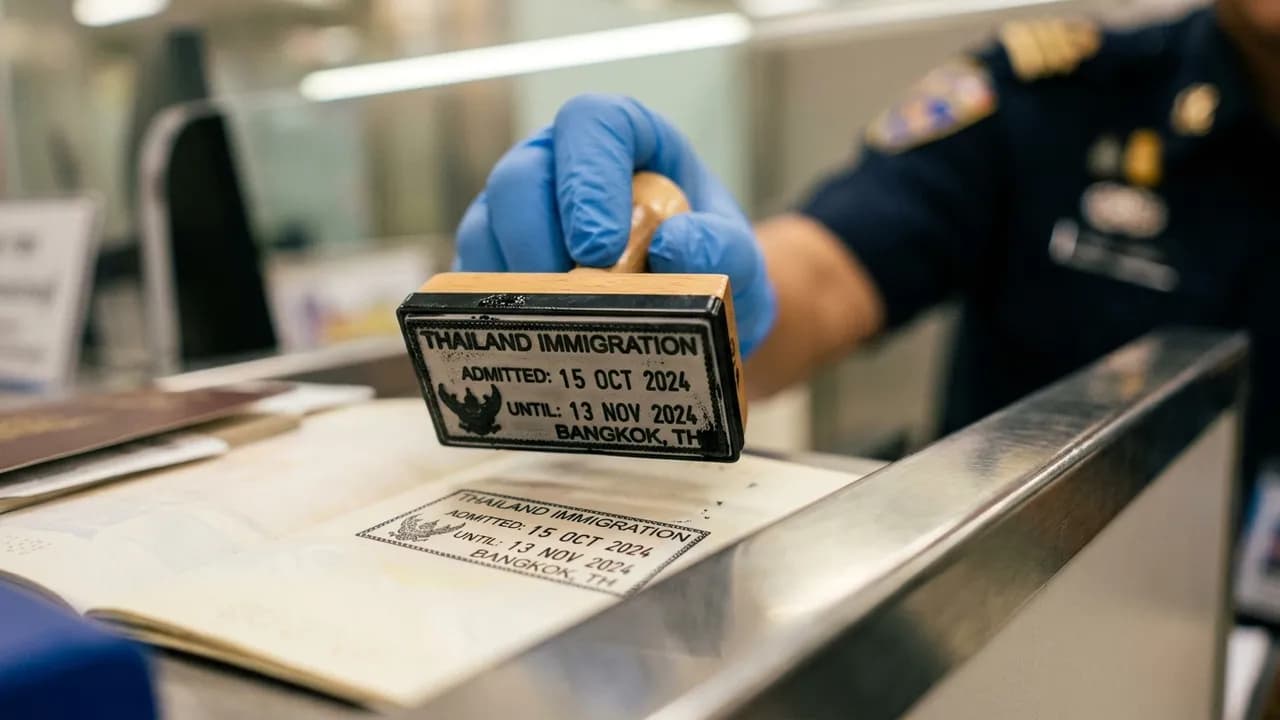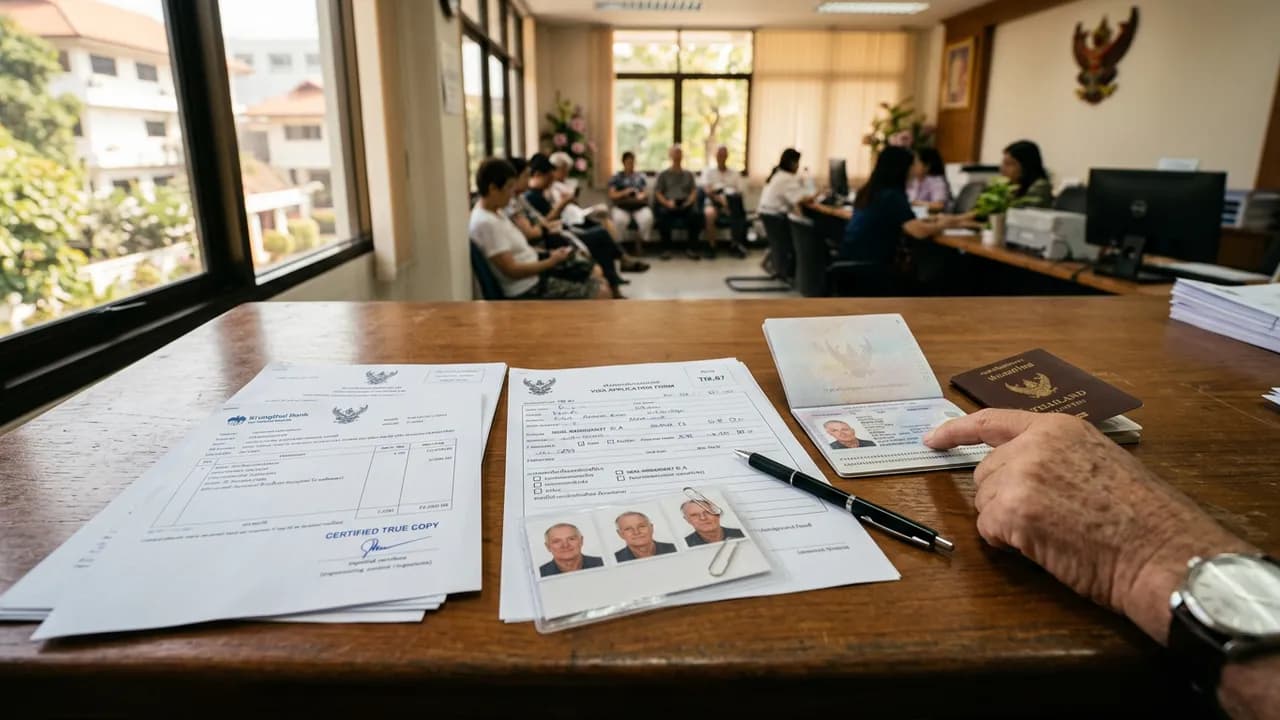
The Thailand Non-Immigrant O-A Visa is a long-stay visa specifically designed for foreign nationals aged 50 and over who wish to retire in Thailand. Often called the "retirement visa" or "long-stay visa," the O-A is unique because it is issued with a full 1-year validity and multiple entries from the outset, allowing you to live in Thailand for an extended period without the need for an immediate extension after arrival.
The O-A visa differs from the standard Non-Immigrant O Visa in several key ways, most notably the mandatory health insurance requirement and the fact that it grants a longer initial stay directly from the consulate.
Quick Facts
| Detail | Information |
|---|---|
| Visa Code | Non-Immigrant O-A (Long Stay) |
| Purpose | Retirement (age 50+) |
| Validity | 1 year (multiple-entry) |
| Length of Stay | 1 year from date of entry |
| Extension | Renewable for 1 additional year at Thai Immigration |
| Cost | 5,000 THB (or equivalent in local currency) |
| Processing Time | 10–15 business days |
| Health Insurance | Mandatory |
| Work Permitted | No |
| Application | Royal Thai Embassy/Consulate abroad only |
Who Qualifies?
To apply for the Non-Immigrant O-A visa, you must meet all of the following criteria:
- Age: You must be 50 years of age or older at the time of application
- Nationality: You must hold a passport from a country whose citizens are eligible for the O-A visa (most Western countries qualify; check with your Thai consulate)
- Financial requirements: You must demonstrate adequate financial resources (see details below)
- Health insurance: You must have a qualifying health insurance policy
- Clean criminal record: You must provide a police clearance certificate
- Good health: You must not have any of the prohibited diseases (leprosy, tuberculosis, drug addiction, elephantiasis, or third-stage syphilis)
Required Documents
- Valid Passport — At least 18 months validity remaining (longer than the standard 6-month requirement), with 2+ blank pages
- Visa Application Form — Completed and signed
- Recent Passport Photos — 4x6 cm, white background (typically 2–3 copies)
- Criminal Background Check — From your country of residence or nationality, issued within 3 months, apostilled or authenticated by the relevant authorities
- Medical Certificate — From a licensed physician, certifying you are free from the prohibited diseases listed above, issued within 3 months
- Financial Proof — One of the following:
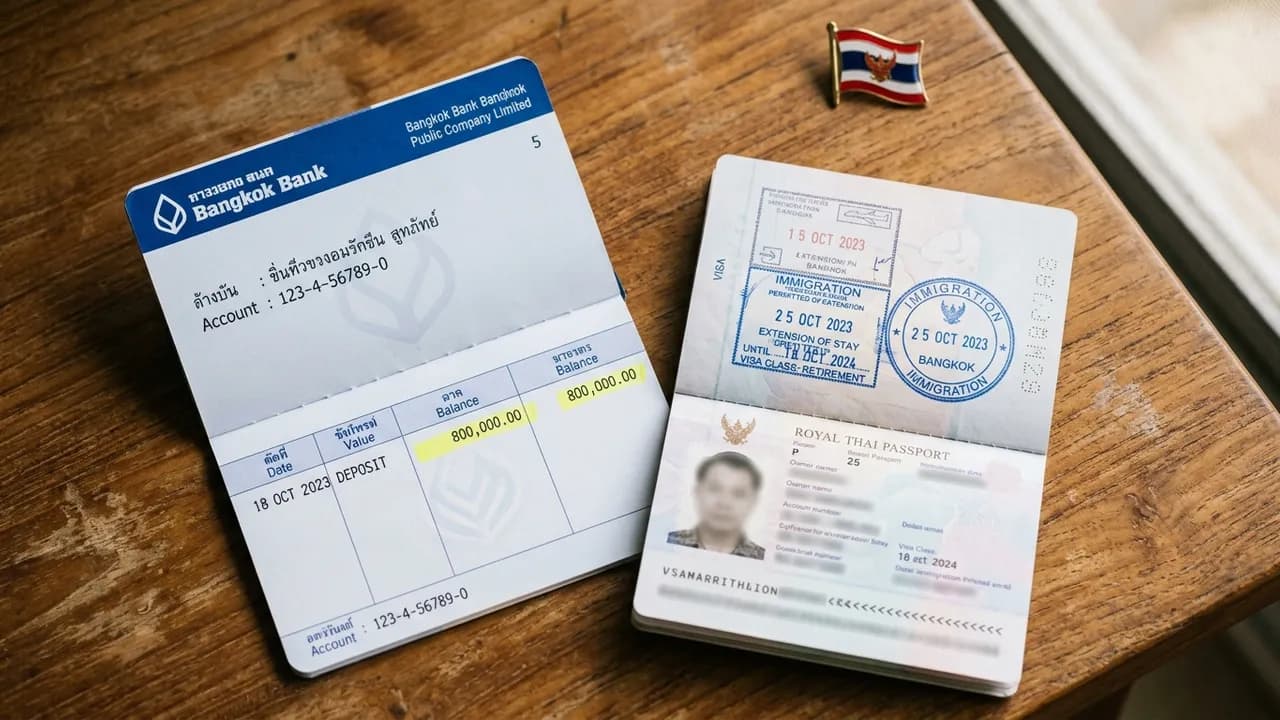
- Bank statement showing a deposit of at least 800,000 THB (or equivalent in foreign currency, approximately $23,000 USD)
- Proof of monthly income/pension of at least 65,000 THB per month (~$1,900 USD)
- Combination of bank deposit and annual income totaling at least 800,000 THB
- Health Insurance Policy — Meeting the mandatory requirements (see section below and our health insurance requirements page)
- Visa Fee — 5,000 THB or equivalent
Financial Documentation Details
The financial proof requirements are strict. Consulates verify the following:
- Bank deposits must be in an account held in your name. Joint accounts may or may not be accepted depending on the consulate.
- Income proof can include pension statements, social security benefit letters, or certified income affidavits from your embassy. The documents must clearly show monthly amounts.
- Bank statements should cover at least the most recent 3 months and show the funds have been maintained consistently — not recently deposited as a one-time transfer.
Mandatory Health Insurance
The O-A visa requires proof of health insurance coverage that meets specific Thai government standards. This requirement was introduced to reduce the burden of uninsured medical costs among elderly foreigners in Thailand.
Minimum Coverage Requirements
| Coverage Type | Minimum Amount |
|---|---|
| Outpatient treatment | 40,000 THB per year |
| Inpatient treatment | 400,000 THB per year |
Acceptable Insurance Policies
- Thai insurance companies — Policies from Thai insurers that meet the government-specified minimums are always accepted. Many Thai insurers offer packages specifically designed for O-A visa applicants.
- International insurance companies — Accepted if the policy explicitly covers medical treatment in Thailand and meets the minimum coverage amounts. The policy must be in English or Thai, or accompanied by a certified translation.
- Government health schemes — Some national health insurance programs may qualify if they provide coverage for medical treatment abroad. Verify with the consulate.
Tips for Insurance
- Purchase insurance before applying for the visa, as you must present the policy with your application
- Ensure the policy has no exclusion for Thailand as a covered territory
- The policy must be valid for the entire duration of the visa (at least 1 year)
- Premiums vary significantly based on age, pre-existing conditions, and coverage level — expect to pay 20,000–80,000+ THB per year depending on your situation
- Compare policies from multiple Thai and international insurers before purchasing
Application Process: Step by Step
Step 1: Confirm eligibility. Verify you are 50+, your nationality qualifies, and you can meet the financial and insurance requirements.
Step 2: Obtain a criminal background check. Apply for a police clearance certificate from your country of residence. This typically takes 2–6 weeks and may need to be apostilled or authenticated by your foreign ministry.
Step 3: Get a medical certificate. Visit a licensed doctor and obtain a certificate confirming you are free from prohibited diseases.
Step 4: Arrange health insurance. Purchase a qualifying health insurance policy that meets the Thai government's minimum coverage requirements.
Step 5: Prepare financial documentation. Gather bank statements, pension letters, or income affidavits showing you meet the financial threshold.
Step 6: Complete the application. Fill out the visa application form and compile all documents.
Step 7: Submit at a Thai Embassy or Consulate. The O-A visa cannot be applied for inside Thailand or online (in most cases). You must apply at a Royal Thai Embassy or Consulate in the country where you hold residence or citizenship. Make an appointment if required.
Step 8: Wait for processing. The O-A typically takes 10–15 business days to process — longer than a standard Non-Immigrant O because of the additional background checks.
Step 9: Collect your passport. Once approved, your passport will contain an O-A visa sticker valid for 1 year with multiple entries.
Step 10: Enter Thailand. You must make your first entry within the validity period marked on the visa. Upon entry, you receive a 1-year stay permit.
After Arrival: What You Need to Know
90-Day Reporting
Even with a 1-year stay, you must report your address to Thai Immigration every 90 days. See our full 90-day reporting guide for step-by-step instructions. This can be done:
- In person at an Immigration office
- Online via the Thai Immigration website
- By registered post
Re-Entry Permits
If you leave Thailand during your 1-year stay, you must obtain a re-entry permit before departure. Without one, your permission to stay is cancelled and you would need to re-enter on a fresh entry (or apply for a new visa).
- Single re-entry permit: 1,000 THB
- Multiple re-entry permit: 3,800 THB (recommended if you travel frequently)
Re-entry permits can be obtained at Immigration offices or at the airport immigration counter before your flight.
Opening a Thai Bank Account
For long-term stay, you will need a Thai bank account — particularly for meeting the financial requirements at renewal time. To open an account:
- Bring your passport with the O-A visa
- Visit a bank branch (Bangkok Bank and Kasikorn Bank are commonly used by foreigners)
- Some branches may require a letter from your embassy or a residence certificate from Immigration
- Minimum opening deposits are typically low (500–1,000 THB)
Extending the O-A Visa
The O-A visa can be extended for 1 additional year at Thai Immigration in Thailand. After that, most retirees switch to extending a Non-Immigrant O visa status annually, which has slightly different requirements.
Extension Requirements
- Financial proof: 800,000 THB in a Thai bank account, maintained for at least 2 months before application and 3 months after approval, or monthly transfers of 65,000 THB, or a combination totaling 800,000 THB
- Health insurance: Must still meet the mandatory minimum coverage
- TM.7 application form
- Passport and photos
- Extension fee: 1,900 THB
After the O-A Extension Expires
After 2 years total (initial O-A + 1-year extension), you can:
- Exit Thailand and apply for a new O-A visa at a consulate abroad
- Convert to a Non-Immigrant O extension inside Thailand (most common approach) — this removes the mandatory health insurance requirement but the financial requirements remain
- Apply for permanent residency if you have been living in Thailand for 3+ consecutive years and meet the eligibility criteria
Cost Breakdown
| Fee Type | Amount |
|---|---|
| O-A Visa Application | 5,000 THB (~$145 USD) |
| 1-Year Extension | 1,900 THB |
| Re-Entry Permit (single) | 1,000 THB |
| Re-Entry Permit (multiple) | 3,800 THB |
| Health Insurance | 20,000–80,000+ THB/year |
| Criminal Background Check | Varies by country |
| Medical Certificate | Varies (500–3,000 THB equivalent) |
O-A vs. O: Which Retirement Visa Should You Choose?
| Factor | Non-Immigrant O-A | Non-Immigrant O |
|---|---|---|
| Applied From | Abroad only | Abroad or inside Thailand (varies) |
| Initial Stay | 1 year | 90 days (then extend to 1 year) |
| Health Insurance | Mandatory | Not required (recommended) |
| Passport Validity | 18 months minimum | 6 months minimum |
| Criminal Check | Always required | Sometimes required |
| Medical Certificate | Always required | Sometimes required |
| Complexity | Higher initial documentation | Simpler initial application |
| Best For | Applicants applying from home country who want 1-year stay immediately | Applicants already in Thailand or who want flexibility |
Many experienced expats and visa advisors recommend the Non-Immigrant O route for its simplicity and lack of mandatory insurance. However, the O-A is preferred by those applying from abroad who want the certainty of a 1-year stay from day one.
Common Mistakes to Avoid
1. Passport validity too short. The O-A requires at least 18 months of passport validity — not the usual 6 months. Many applicants are caught off guard by this higher requirement.
2. Expired criminal background check. The police clearance must be issued within 3 months of your application date. If your application is delayed, the check may expire and need to be reissued.
3. Insurance policy gaps. Ensure your insurance policy covers the full duration of the visa without gaps. A policy that expires mid-stay can jeopardize your extension.
4. Not understanding the bank deposit timing. For extensions, the 800,000 THB must be seasoned in your Thai bank account for 2 months before the application. Plan your finances accordingly.
5. Leaving without a re-entry permit. This mistake is the single most common problem for O-A visa holders. Leaving Thailand — even for a day trip to a neighboring country — without a re-entry permit cancels your entire stay permission.
6. Assuming O-A is available at all consulates. Not every Thai consulate issues O-A visas. Confirm that your specific consulate handles O-A applications before preparing your documents.
Important Notes and Warnings
- No work permitted. The O-A visa strictly prohibits employment of any kind. This includes remote work, freelancing, and volunteer work that could be construed as employment.
- Tax residency. If you stay in Thailand for 180 days or more in a calendar year, you may be considered a Thai tax resident. Consult a tax professional regarding your obligations in both Thailand and your home country — our Thailand tax guide for expats covers the basics.
- Healthcare access. While you have mandatory insurance, the policy minimums may not cover serious medical events fully. Consider supplemental coverage for peace of mind.
- Permanent residency pathway. After 3 consecutive years of legal residence in Thailand, O-A visa holders may apply for permanent residency. The process is competitive with annual quotas, but it eliminates the need for visa renewals.
- Updates to insurance requirements. The health insurance requirements for the O-A visa have been modified several times since their introduction. Always verify the current requirements with your consulate before applying.
Frequently Asked Questions
Can I apply for the O-A visa online?
Some consulates participate in the Thai e-Visa system for certain visa types, but the O-A may not be available online at all consulates due to the additional documentation requirements. Check with your specific consulate.
What if I cannot get health insurance due to pre-existing conditions?
Some Thai insurers offer policies with pre-existing condition exclusions that still meet the O-A minimum coverage requirements. Shop around and consult with an insurance broker experienced in Thai visa requirements.
Can my spouse get an O-A visa too?
If your spouse is also 50+ and meets all requirements independently, they can apply for their own O-A visa. If your spouse is under 50, they would need a different visa type such as a Non-Immigrant O as a dependent.
Is the 800,000 THB locked in the bank?
During the extension process, the money must remain in the account for specific periods (2 months before, 3 months after approval). Outside these windows, you can withdraw down to 400,000 THB. However, the balance must be back to 800,000 THB before the next renewal cycle.
Can I drive in Thailand on an O-A visa?
The O-A visa does not affect your ability to drive. You can drive with a valid Thai driver's license or an International Driving Permit (IDP) issued in your home country. After establishing residency, obtaining a Thai driver's license is recommended.