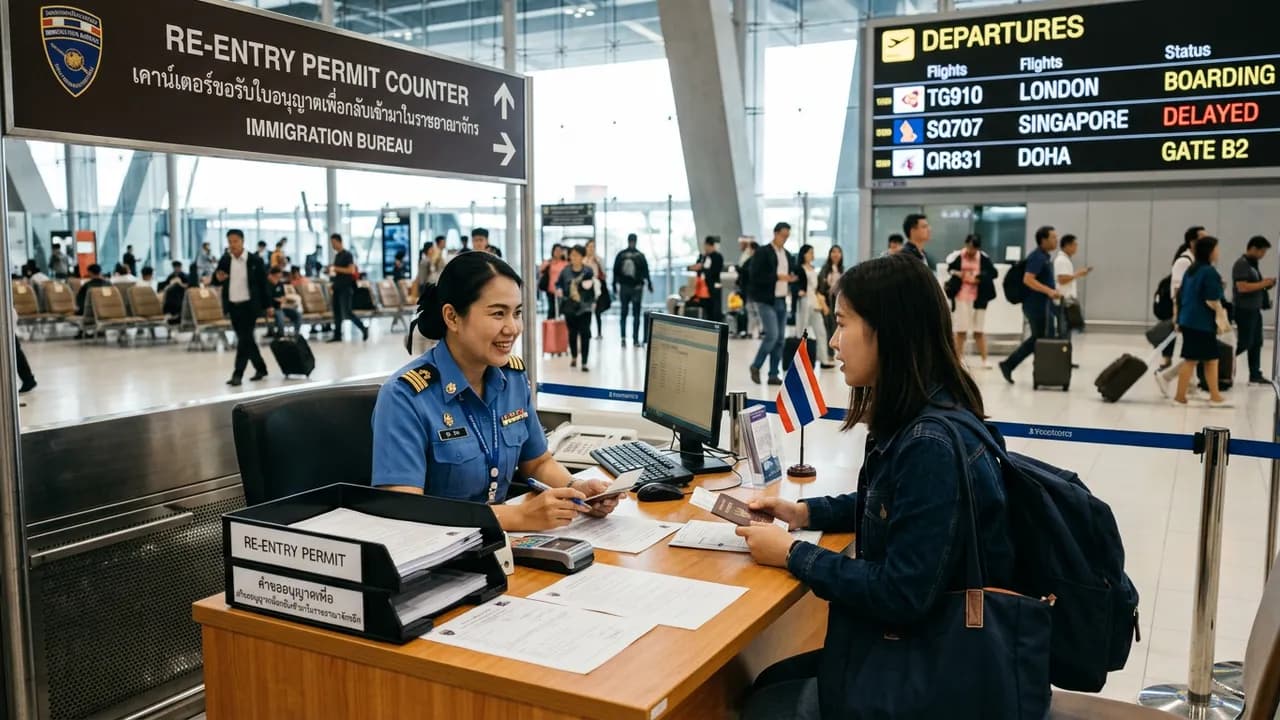
A Thailand re-entry permit is one of the most important documents for anyone living in the country on a long-stay visa. If you leave Thailand without one, your current visa and permission to stay are cancelled — even if you have months or years of validity remaining. This guide explains how re-entry permits work, how to get one, and how to avoid a costly mistake.
Quick Facts
| Detail | Information |
|---|---|
| Purpose | Preserves your visa and stay permit when leaving Thailand |
| Single Re-Entry Permit | 1,000 THB |
| Multiple Re-Entry Permit | 3,800 THB |
| Where to Apply | Thai Immigration offices or at international airports before departure |
| Processing Time | Same day (usually 10–30 minutes) |
| Required For | Any visa holder who wants to leave and return without losing their visa |
| Not Required For | Visa-exempt entries, visa on arrival, SMART Visa, LTR Visa |
What Is a Re-Entry Permit?
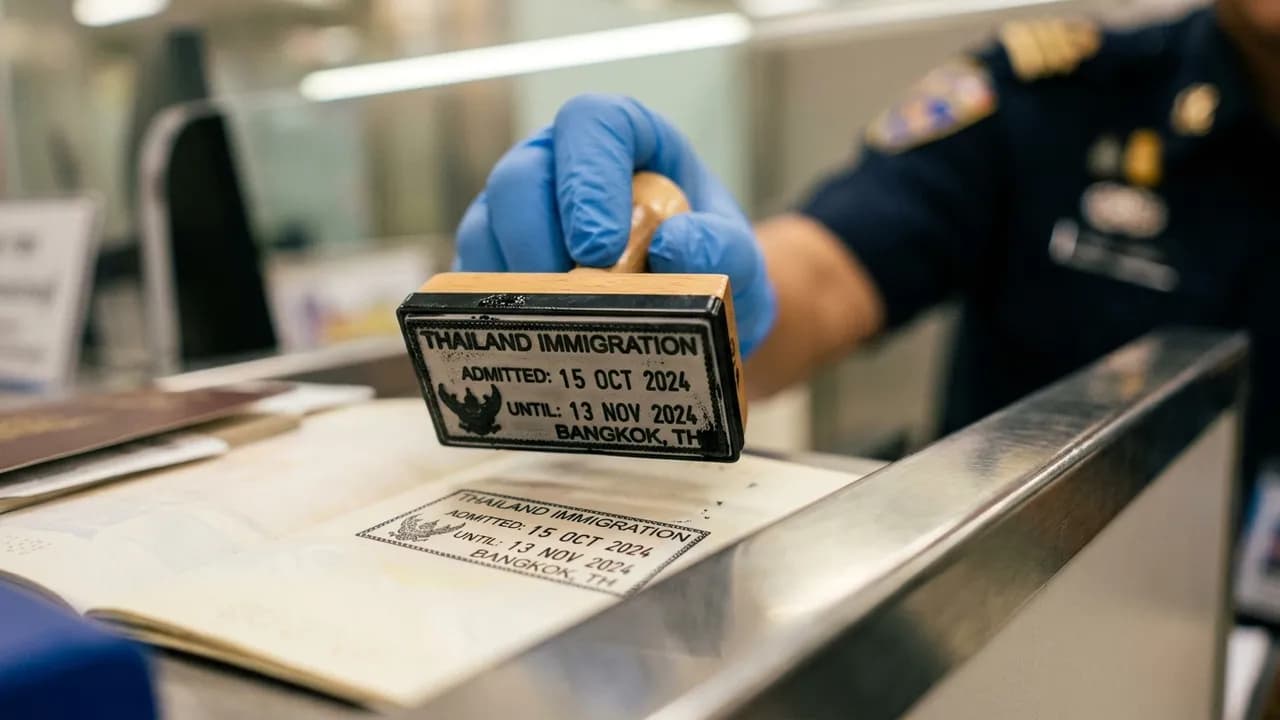
A re-entry permit is a stamp placed in your passport that allows you to leave Thailand and return without voiding your current visa and extension of stay. Without it, the moment you exit the country, Thai immigration cancels your permission to stay and your visa (if it is a single-entry type).
This applies to virtually all Non-Immigrant visa categories, including:
- Non-Immigrant B (business/work)
- Non-Immigrant O (family/retirement)
- Non-Immigrant ED (education)
- Non-Immigrant O-A (retirement)
- Tourist Visa (TR) extensions
- Any visa with an extension of stay granted inside Thailand
Who Does NOT Need a Re-Entry Permit?
- Visa-exempt entries: Your permission to stay ends when you leave regardless. You receive a fresh stamp upon return.
- Visa on arrival: Same as above.
- SMART Visa holders: Multiple re-entry is included automatically.
- LTR Visa holders: Multiple re-entry is included automatically.
- Multiple-entry visa holders (before extension): If you hold an unused multiple-entry visa (e.g., METV) and have not yet extended your stay, each entry is treated as a new use of the visa. Re-entry permits become relevant once you extend your stay inside Thailand.
Single vs. Multiple Re-Entry Permit
Single Re-Entry Permit
- Cost: 1,000 THB
- Allows: One exit and one return to Thailand
- Best for: Travelers making an occasional trip abroad (e.g., a weekend in a neighboring country)
- Expires: After one use, or when your underlying visa/extension expires — whichever comes first
Multiple Re-Entry Permit
- Cost: 3,800 THB
- Allows: Unlimited exits and returns during the validity of your visa/extension
- Best for: Frequent travelers, business professionals, or anyone who regularly leaves Thailand
- Expires: When your underlying visa/extension of stay expires
Which Should You Choose?
If you plan to leave Thailand only once before your next visa renewal, the single re-entry permit at 1,000 THB is sufficient. If you travel internationally more than three times during your visa period, the multiple re-entry permit is more cost-effective and eliminates the need to apply each time.
How to Get a Re-Entry Permit
Option 1: At a Thai Immigration Office
This is the standard method and is available at any Thai Immigration office during business hours.
Documents needed:
- Passport — With your current valid visa and extension stamp
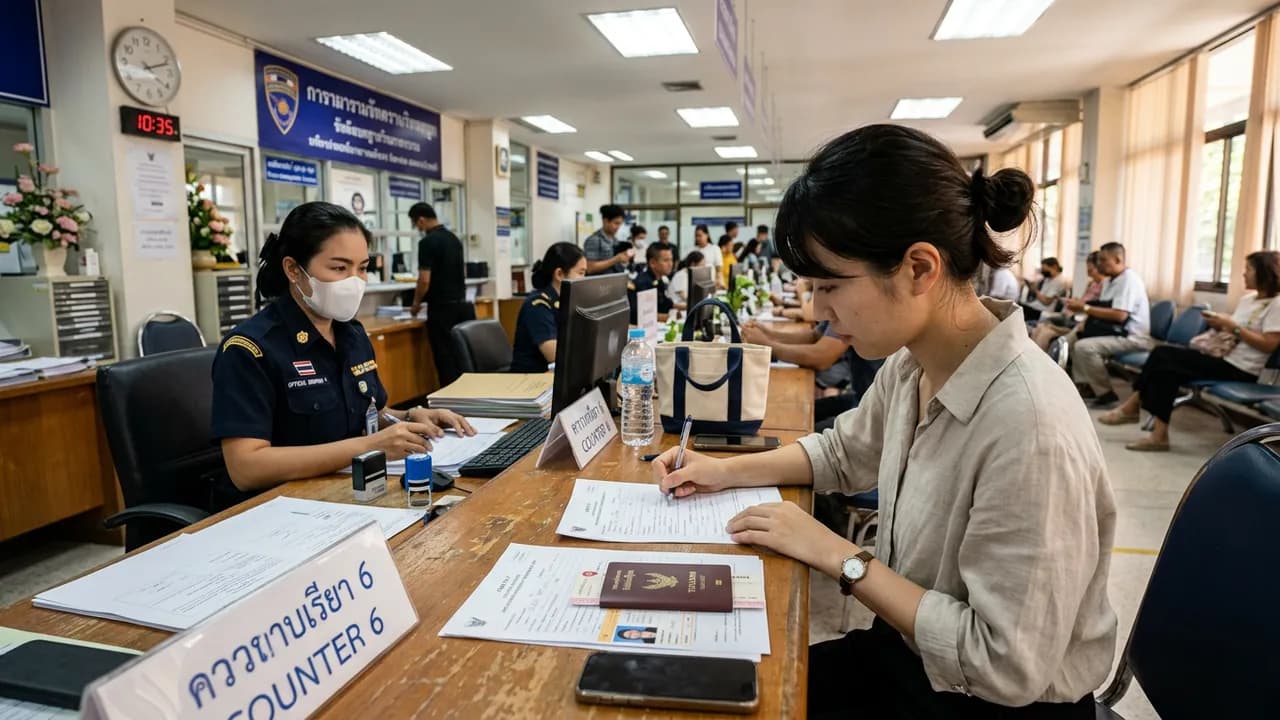
- Completed TM.8 form — Available at the Immigration office or downloadable from the Immigration Bureau website
- One passport photo — 4x6 cm (some offices have photo booths on site)
- Photocopy of passport bio page — The page with your photo and personal details
- Photocopy of current visa/extension stamp — The page showing your current permission to stay
- Photocopy of departure card (TM.6) — If you still have a physical departure card
- Fee — 1,000 THB (single) or 3,800 THB (multiple) in cash
Process:
Step 1: Arrive at the Immigration office and request the TM.8 form from the information desk.
Step 2: Fill in the form. It asks for your personal details, passport number, current visa type, and travel plans.
Step 3: Attach your passport photo to the form.
Step 4: Submit the form along with your passport, photocopies, and fee at the re-entry permit counter.
Step 5: Wait for processing. This typically takes 10–30 minutes.
Step 6: Receive your passport back with the re-entry permit stamp.
Option 2: At the Airport (Before Departure)
You can obtain a re-entry permit at international airports just before you fly out. This is convenient but carries some risk if queues are long or the counter is closed.
Available at:
- Suvarnabhumi Airport (BKK) — Re-entry permit counter is located on the 4th floor (departure level), near the immigration checkpoint. Open daily, typically from 6:00 AM to midnight.
- Don Mueang Airport (DMK) — Re-entry permit counter is located in the departure area before immigration. Hours may vary.
- Chiang Mai Airport (CNX) — Available in the international departure area.
- Phuket Airport (HKT) — Available in the international departure area.
Important tips for airport applications:
- Arrive at the airport at least 2–3 hours before your flight to allow time for the re-entry permit process and immigration
- Bring a passport photo and completed TM.8 form to save time. Some airport counters can take your photo, but at a higher price
- Have exact cash ready. Airport counters do not accept cards
- The airport counter may occasionally be closed or have long queues during peak periods
What Happens If You Leave Without a Re-Entry Permit?
This is the critical mistake that catches many expats off guard:
Your visa and extension of stay are immediately cancelled when you exit Thailand.
This means:
- Your Non-Immigrant visa is voided
- Any extension of stay you obtained (e.g., a 1-year retirement extension) is cancelled
- When you return to Thailand, you enter as a new arrival — either on visa exemption, visa on arrival, or whatever entry method your nationality allows
- You will need to start the entire visa and extension process over from scratch
- Any 90-day reporting cycle resets
There is no grace period, no way to appeal, and no way to reverse this after you have exited. Immigration officers at the departure counter will sometimes verbally warn you, but they are not required to do so.
Real-World Scenarios
Scenario 1: You hold a Non-Immigrant O visa with a 1-year retirement extension. You fly to Singapore for a weekend without a re-entry permit. Upon departure from Thailand, your retirement extension is cancelled. When you return, you enter on a visa exemption (60 days). You must then apply for a new Non-Immigrant O visa and go through the entire retirement extension process again.
Scenario 2: You hold a Non-Immigrant B visa with a work permit. You travel to a neighboring country for a business meeting without a re-entry permit. Your visa and extension are cancelled. Your work permit becomes invalid because it is tied to your visa. You face potential work authorization issues upon return.
Cost Breakdown
| Item | Cost |
|---|---|
| Single re-entry permit | 1,000 THB (~$29 USD) |
| Multiple re-entry permit | 3,800 THB (~$110 USD) |
| Passport photo (at Immigration office) | 100–200 THB |
| Photocopies (at Immigration office) | 5–20 THB |
| TM.8 form | Free |
Practical Tips
1. Get a multiple re-entry permit when you extend your visa. The most convenient approach is to apply for a multiple re-entry permit on the same day you receive your visa extension. This way, you are always covered for the full duration of your stay.
2. Keep a spare passport photo in your passport. Many Immigration offices and airport counters require a photo. Having one ready saves time and avoids paying inflated prices at airport photo booths.
3. Carry a completed TM.8 form when traveling. Download and fill out the form in advance if you plan to get a re-entry permit at the airport.
4. Set a reminder to renew. When you renew your extension of stay, you also need a new re-entry permit. The old one expires with the old extension.
5. Do not assume the airline will warn you. Airlines are not responsible for checking whether you have a re-entry permit. This is entirely your responsibility.
6. Verify the stamp. After receiving your re-entry permit, check that the stamp in your passport shows the correct type (single or multiple) and the correct expiry date. Errors are rare but costly.
Where to Get a Re-Entry Permit
Major Immigration Offices
| Location | Address | Notes |
|---|---|---|
| Bangkok | Immigration Bureau, Chaeng Wattana Rd | Largest office, can be busy. Arrive early. |
| Chiang Mai | Chiang Mai Immigration, near Promenada Mall | Smaller, generally faster |
| Phuket | Phuket Immigration, Phuket Town | Serves Phuket and nearby islands |
| Pattaya | Pattaya Immigration, Jomtien | Serves Pattaya and eastern seaboard |
| Koh Samui | Koh Samui Immigration, Nathon | Limited hours, arrive early |
At International Airports
- Suvarnabhumi (BKK) — Most reliable airport option
- Don Mueang (DMK) — Available but verify counter hours
- Chiang Mai (CNX) — Available for international departures
- Phuket (HKT) — Available for international departures
Common Mistakes to Avoid
1. Forgetting entirely. This is the number one mistake. Expats who have lived in Thailand for years still occasionally forget to get a re-entry permit before an international trip.
2. Confusing re-entry permit with visa validity. Having a valid visa sticker in your passport does not protect you. The re-entry permit is a separate requirement.
3. Getting a single when you need a multiple. If you have even a slight chance of traveling internationally more than once during your visa period, the multiple re-entry permit is a safer and more economical choice.
4. Waiting until the last minute at the airport. While airport re-entry permit counters exist, relying on them exclusively is risky. Long queues, counter closures, or missing documents can cause you to miss your flight or leave without a permit.
5. Not checking the stamp. Always verify the re-entry permit stamp shows the correct type and expiry date before leaving the Immigration counter.
Frequently Asked Questions
Does a re-entry permit extend my stay?
No. A re-entry permit only preserves your existing visa and permission to stay when you travel abroad. It does not add any additional days. Your permitted stay date remains the same.
Getting a Re-Entry Permit Before Extension
Yes. You can apply for a re-entry permit at any time while your visa and permission to stay are valid. However, the re-entry permit expires on the same date as your current permission to stay, so timing matters.
What if I have a multiple-entry visa and have not extended yet?
If you hold an unused multiple-entry visa (e.g., a Non-Immigrant B multiple-entry), each entry uses one of your visa entries. You do not need a re-entry permit in this case. Re-entry permits become necessary once you extend your stay inside Thailand, as the extension converts your status.
Can I apply for a re-entry permit online?
As of 2026, re-entry permits cannot be applied for online. You must apply in person at an Immigration office or airport counter.
Does my family need separate re-entry permits?
Yes. Each person traveling on their own visa and passport needs their own re-entry permit. This includes spouses and children who hold dependent visas.
I left without a re-entry permit. Is there anything I can do?
Unfortunately, no. Once you have exited Thailand without a re-entry permit, your visa and extension are cancelled. You must start the visa process from the beginning upon your return.