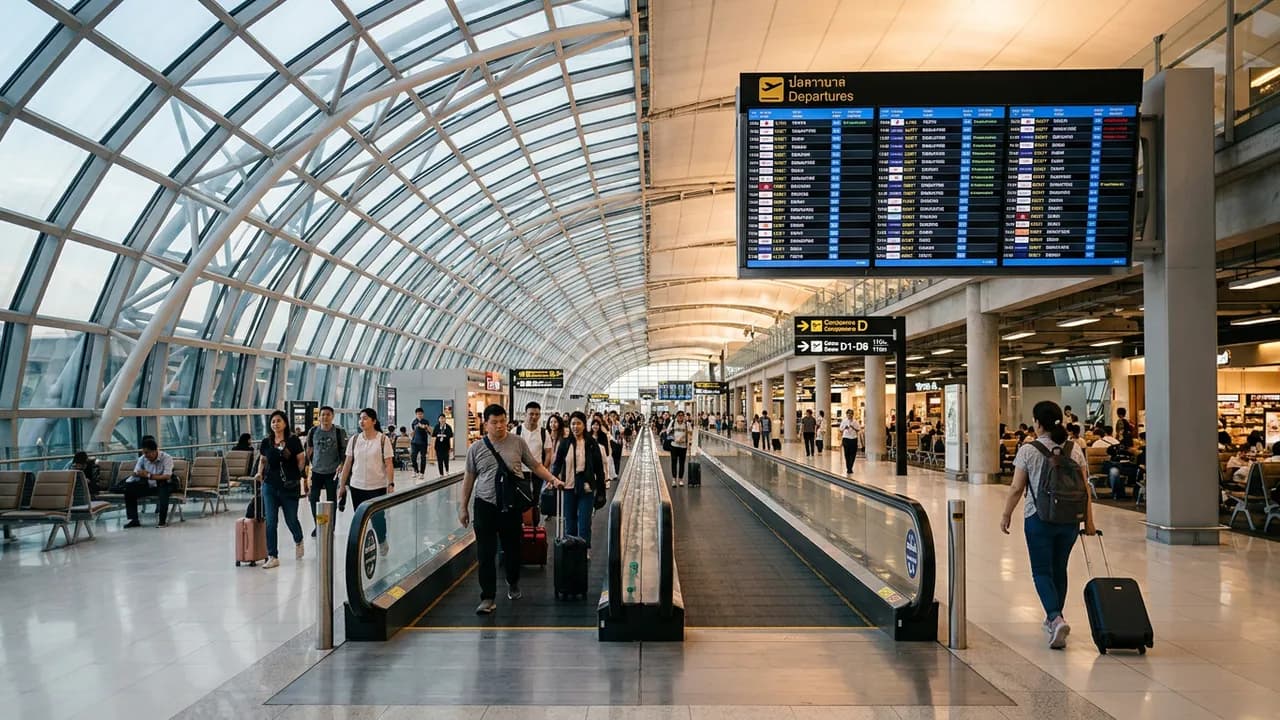
If you are passing through Thailand on your way to another destination, you may need a Thailand Transit Visa. However, many travelers can transit through Thai airports without one, depending on their nationality, the length of their layover, and whether they need to leave the international transit zone. This guide covers everything you need to know about transiting through Thailand.
Quick Facts
| Detail | Information |
|---|---|
| Visa Code | TS (Transit Visa) |
| Validity | 3 months from date of issue |
| Length of Stay | 30 days per entry |
| Cost | 800 THB (or equivalent in local currency) |
| Processing Time | 3–5 business days |
| Application | At a Royal Thai Embassy or Consulate abroad |
| Work Permitted | No |
| Entries | Single transit |
Do You Need a Transit Visa?
Most travelers transiting through Thailand do not need a Transit Visa. Whether you need one depends on three key factors:
Factor 1: Will You Leave the International Transit Zone?
If your connecting flight departs from the same terminal and you remain in the international transit area (airside), you generally do not need any Thai visa, regardless of your nationality. You will not pass through Thai immigration.
Factor 2: How Long Is Your Layover?
- Under 12 hours, staying airside: No visa required for any nationality
- Over 12 hours, staying airside: No visa typically required, but facilities are limited. Some travelers prefer to clear immigration and wait in the landside area
- Any duration, if you leave the airport: You must clear Thai immigration and will need either a visa exemption, visa on arrival, or a Transit Visa depending on your nationality
Factor 3: What Is Your Nationality?
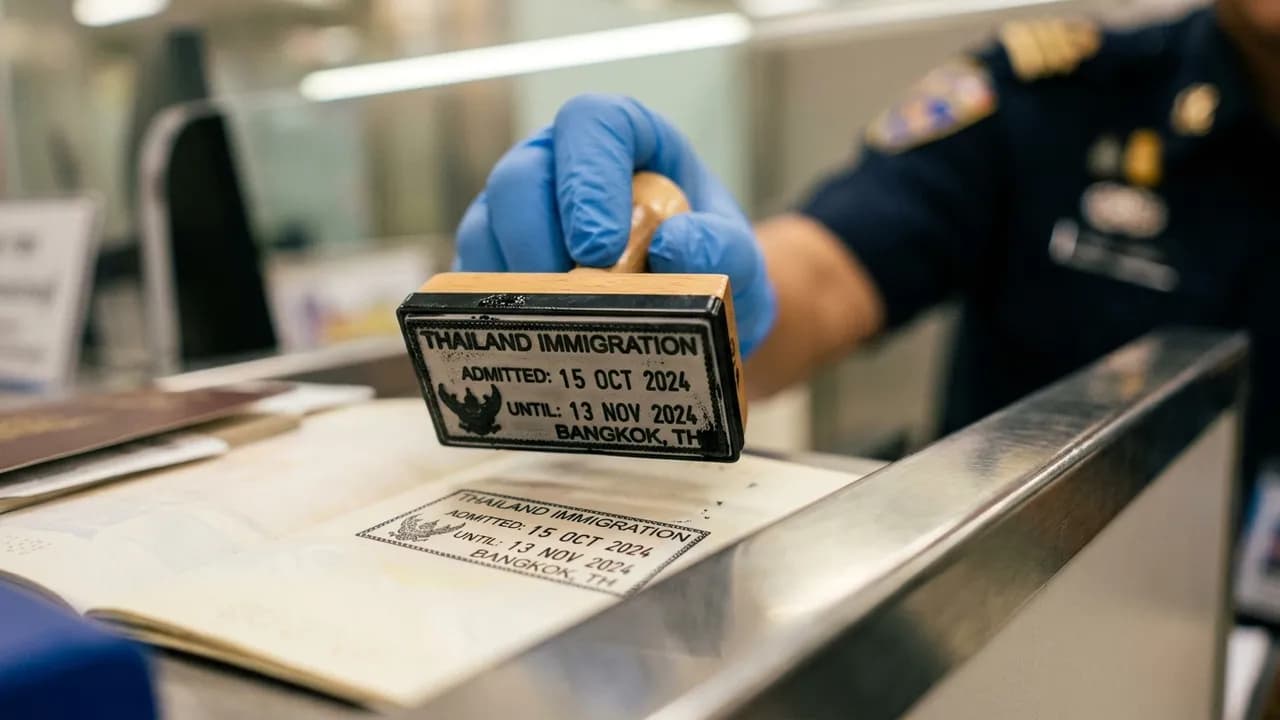
If your nationality qualifies for Thailand's visa exemption or visa on arrival, you do not need a Transit Visa even if you leave the airport during a layover. You will simply receive a standard entry stamp.
You need a Transit Visa if:
- You must leave the international transit zone (e.g., to change terminals, collect luggage, or explore Bangkok)
- Your nationality does not qualify for visa exemption or visa on arrival
- You want formal permission to enter Thailand briefly during your journey
Transit Without Visa (TWOV)
Thailand allows Transit Without Visa for passengers who meet all of the following conditions:
- You hold a confirmed onward ticket departing Thailand within the same calendar day or within 12 hours of arrival
- You remain within the international transit area of the airport
- You do not pass through Thai immigration
This applies to all nationalities. As long as you stay airside and have a confirmed connecting flight, you do not need to interact with Thai immigration at all.
Important TWOV Limitations
- You cannot leave the international transit zone
- You cannot access airport hotels located outside the transit area
- If your flight is cancelled or significantly delayed, you may be required to clear immigration
- Not all Thai airports have extensive transit facilities. Suvarnabhumi Airport (BKK) has the best international transit area. Don Mueang (DMK) has more limited transit options.
Entering Thailand During a Layover
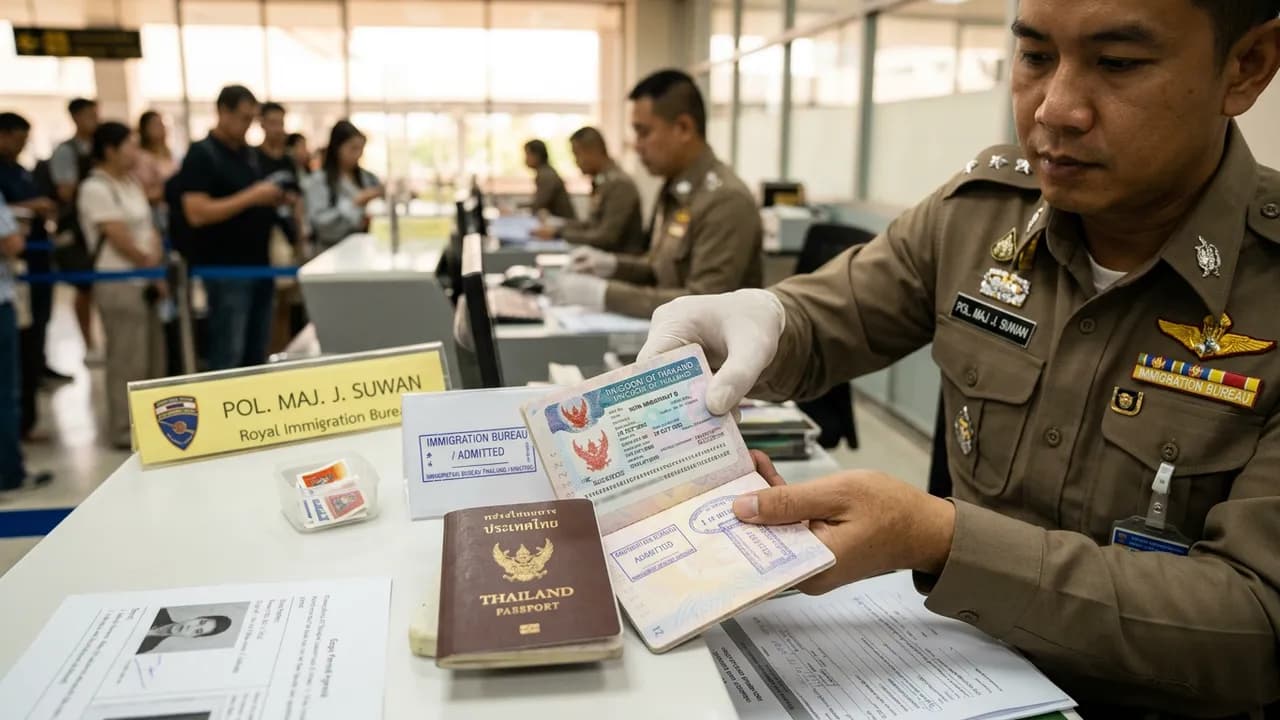
If you want to leave the airport during your layover — whether to visit Bangkok, stay at an airport hotel outside the transit zone, or simply wait in a more comfortable landside area — you must clear Thai immigration. Your options are:
Option 1: Visa Exemption (Most Common)
If your nationality is on Thailand's visa-exempt list, you can enter Thailand for up to 60 days (or 30 days for some nationalities) without any visa. Simply clear immigration as normal, explore during your layover, and return to the airport for your onward flight.
Option 2: Visa on Arrival
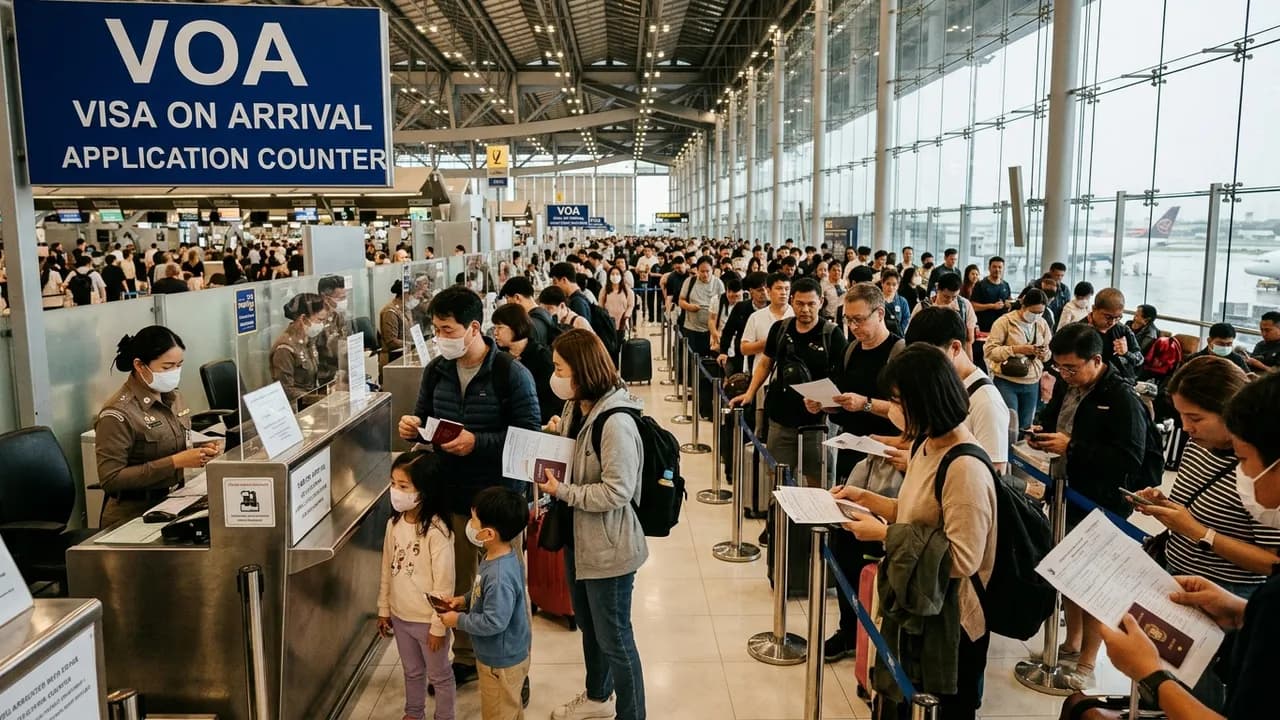
If your nationality qualifies for visa on arrival, you can obtain one at the airport immigration counter for 2,000 THB. This grants a 15-day stay.
Option 3: Transit Visa (TS)
If your nationality does not qualify for either visa exemption or visa on arrival, you will need to apply for a Transit Visa in advance at a Royal Thai Embassy or Consulate.
How to Apply for a Transit Visa
Required Documents
- Passport — Valid for at least 6 months beyond your date of entry, with at least 2 blank pages (see passport requirements)
- Completed visa application form — Available at the embassy or via the Thai e-Visa portal
- Recent passport photo — 4x6 cm, white background, taken within the last 6 months (see photo requirements)
- Confirmed onward flight ticket — Showing your departure from Thailand to your final destination
- Visa for your destination country — If your final destination requires a visa, you must show proof you hold one
- Proof of financial means — Bank statement or cash equivalent to at least 10,000 THB per person
- Visa fee — 800 THB (or equivalent in local currency)
Application Steps
Step 1: Locate the nearest Royal Thai Embassy or Consulate. Check the Thai Ministry of Foreign Affairs website for a list of diplomatic missions.
Step 2: Gather all required documents. Ensure your onward ticket and destination visa (if applicable) are confirmed and ready.
Step 3: Submit your application. Visit the consulate in person or submit by post where accepted. Some consulates require an appointment.
Step 4: Pay the visa fee. The fee is 800 THB or the equivalent in local currency. Payment methods vary by consulate.
Step 5: Wait for processing. Standard processing takes 3–5 business days.
Step 6: Collect your passport. Your passport will include the Transit Visa sticker if approved.
Airport Transit Guide by Airport
Suvarnabhumi Airport (BKK)
- Thailand's main international hub with the largest transit area
- International transit zone has shops, restaurants, lounges, and rest areas
- Transfers between international flights within the same terminal do not require immigration clearance
- If transferring between Terminal 1 (international) and the domestic terminal, you must clear immigration
- Airport hotel (Miracle Transit Hotel) is available airside inside the transit zone
Don Mueang Airport (DMK)
- Primarily serves low-cost carriers and domestic flights
- International transit area is smaller and has fewer facilities than Suvarnabhumi
- If connecting between two international flights on the same airline, transit may be possible without clearing immigration
- Transfers between airlines or between international and domestic flights typically require clearing immigration
Connecting Between BKK and DMK
If your itinerary requires connecting between Suvarnabhumi and Don Mueang airports, you must clear Thai immigration at your arrival airport, travel between airports (approximately 30–45 minutes by shuttle or taxi), and check in again at the departing airport. This requires a visa or visa exemption.
Cost Breakdown
| Fee | Amount |
|---|---|
| Transit Visa (TS) | 800 THB (~$23 USD) |
| Visa on Arrival (alternative) | 2,000 THB (~$58 USD) |
| Visa exemption (alternative) | Free |
| Airport shuttle (BKK to DMK) | Free (available for connecting passengers) |
What Happens If Your Flight Is Cancelled?
If your connecting flight is cancelled while you are in the transit zone and no same-day alternative is available, the airline and airport authorities will typically arrange one of the following:
- Rebooking on the next available flight: You remain in the transit area if possible
- Hotel accommodation: If you must leave the transit area, the airline will coordinate with immigration. You may be given a temporary entry stamp
- Emergency immigration clearance: In unusual circumstances, immigration may grant temporary entry. This is handled on a case-by-case basis
It is wise to have documentation ready (passport, onward ticket, accommodation proof) in case you are unexpectedly required to clear immigration.
Tips for Smooth Transit Through Thailand
1. Check your routing carefully. Confirm whether your connection requires changing terminals or airports. BKK-to-DMK transfers always require immigration clearance.
2. Allow enough connection time. For same-airport international connections at Suvarnabhumi, a minimum of 90 minutes is recommended. For connections involving Don Mueang or inter-airport transfers, allow at least 4 hours.
3. Verify your visa situation before booking. If your nationality requires a visa and your layover requires leaving the transit zone, apply for the Transit Visa well in advance.
4. Carry proof of onward travel. Whether or not you plan to clear immigration, having your onward ticket accessible avoids complications.
5. Consider a longer layover intentionally. If your nationality qualifies for visa exemption, a Bangkok layover can become a mini-holiday. The city center is roughly 30–45 minutes from Suvarnabhumi by rail or taxi. Check our first-time Thailand visa guide if you are unsure which entry option suits you best.
6. Know the transit zone facilities. Suvarnabhumi's transit area has lounges (accessible with airline status or lounge passes), convenience stores, restaurants, and sleeping pods. Plan accordingly for long layovers.
Common Mistakes to Avoid
1. Assuming you do not need a visa to leave the airport. If your nationality is not visa-exempt, you cannot leave the transit zone without a visa. Check your eligibility before your trip.
2. Not having a destination visa. If your final destination requires a visa and you do not have it, the airline may deny boarding entirely, regardless of your transit plans.
3. Booking tight connections between BKK and DMK. This transfer requires immigration, transport, and re-check-in. Missing your connection is a real risk with less than 4 hours.
4. Forgetting to reconfirm onward flights. Some airlines require reconfirmation for continuing flights. Check with your carrier, especially for less common routes.
5. Arriving without cash. If you need to clear immigration unexpectedly, having Thai baht on hand for visa on arrival fees or financial proof checks is helpful.
Transit Visa vs. Other Entry Options
| Feature | Transit Visa (TS) | Visa Exemption | Visa on Arrival | Tourist Visa (TR) |
|---|---|---|---|---|
| Purpose | Short transit stop | Tourism | Short visit | Extended tourism |
| Stay Duration | 30 days | 60 days | 15 days | 60 days |
| Cost | 800 THB | Free | 2,000 THB | 1,000 THB |
| Pre-Application | Required | None | At airport | Required |
| Extension | Not standard | +30 days | +15 days | +30 days |
| Best For | Travelers not eligible for other entry types | Visa-exempt nationals | Eligible nationalities, short stops | Planned holidays |
Frequently Asked Questions
Can I leave the airport on a long layover without a visa?
Only if your nationality qualifies for visa exemption or visa on arrival. If it does, you can clear immigration, leave the airport, and return for your next flight. If not, you need a Transit Visa.
Is there a time limit for airside transit?
There is no strict time limit for remaining in the international transit zone. However, for very long layovers (overnight or longer), the limited facilities may be uncomfortable. If you anticipate a layover exceeding 12 hours, consider whether entering Thailand would be more practical.
Can I get a Transit Visa on arrival?
No. The Transit Visa must be obtained in advance at a Royal Thai Embassy or Consulate. At the airport, your only on-arrival option is the visa on arrival (if your nationality qualifies).
Transit Visa With a Visa for Your Destination
If you are staying airside and not clearing Thai immigration, you do not need a Thai visa. If you must clear immigration (to change airports, collect bags, or leave the airport), you need a Thai visa, visa exemption, or visa on arrival.
Can children transit without a visa?
The same rules apply to passengers of all ages. Children must meet the same transit requirements as adults. Ensure minors have valid passports and any required visas for both Thailand (if clearing immigration) and their final destination.