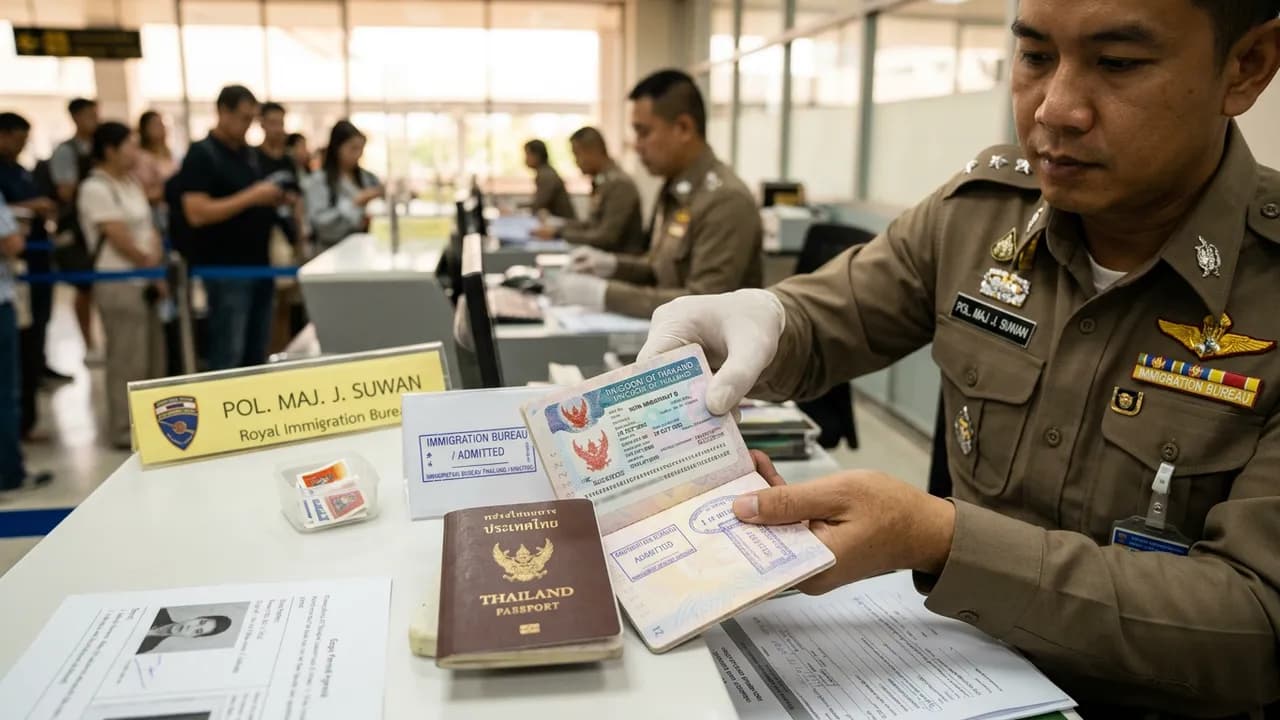
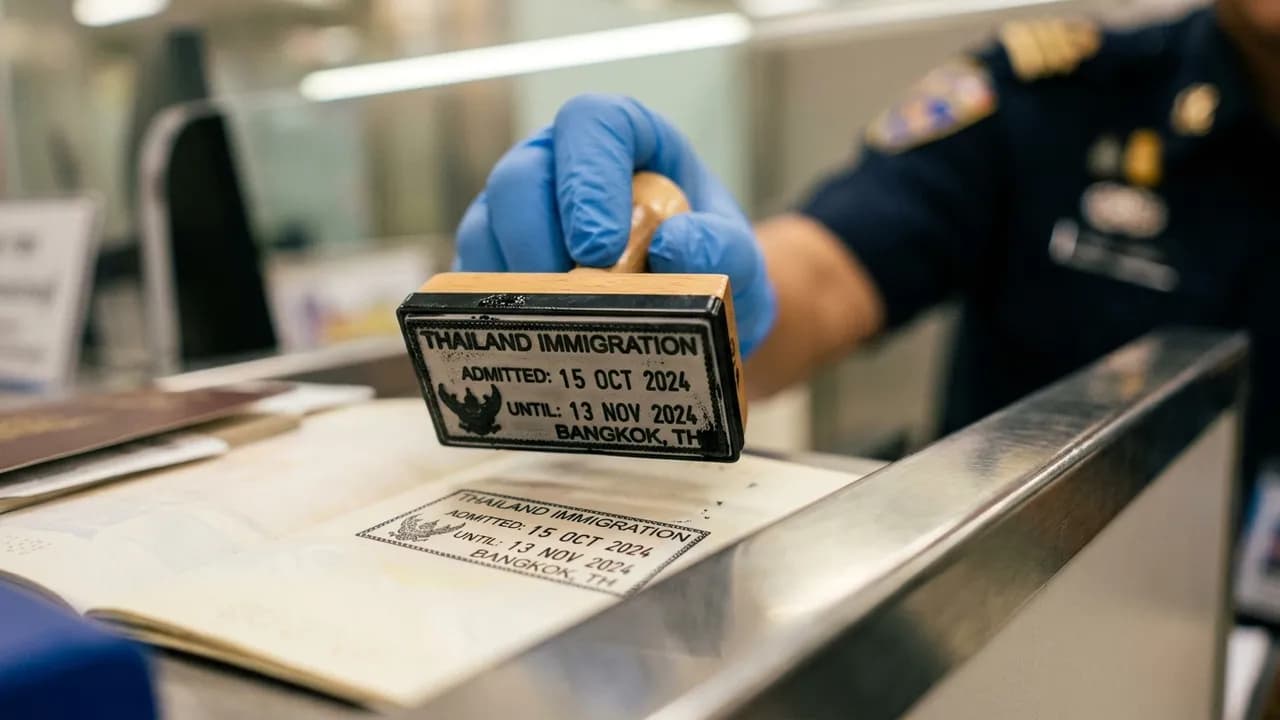
The Thailand Digital Nomad Visa (DTV), officially called the Destination Thailand Visa, is Thailand's answer to the global rise of remote work and digital nomadism. Launched in mid-2024, the DTV allows foreign nationals who work remotely for employers or clients outside Thailand to live and work legally in the country for up to 180 days per entry, with a total visa validity of 5 years and multiple entries permitted.
The DTV represents a significant shift in Thai immigration policy. Previously, digital nomads working remotely in Thailand occupied a legal gray area — technically not permitted to work on tourist visas or visa exemptions. The DTV provides a legitimate, long-term pathway for remote workers, freelancers, and their families.
Quick Facts
| Detail | Information |
|---|---|
| Visa Code | DTV (Destination Thailand Visa) |
| Purpose | Remote work, digital nomadism, workcation, cultural activities |
| Validity | 5 years (multiple-entry) |
| Stay per Entry | 180 days |
| Extension | 180-day extension available per entry |
| Total Maximum Stay | 360 days per entry (180 + 180 extension) |
| Cost | 10,000 THB |
| Processing Time | 10–20 business days |
| Work Permitted | Remote work for non-Thai employers/clients only |
| Dependents | Spouse and children can apply |
| Application | Thai Embassy/Consulate abroad or e-Visa |
Who Qualifies for the DTV?
The DTV is available to several categories of applicants:
Digital Nomads and Remote Workers
- Freelancers, consultants, and self-employed professionals who work remotely
- Employees of companies registered outside Thailand who work remotely
- Entrepreneurs running businesses registered outside Thailand
Key requirement: Your work must be for non-Thai entities. You cannot use the DTV to work for a Thai-registered company — that requires a Non-Immigrant B Visa and work permit.
Workcation Travelers
- Professionals who want to combine vacation travel with remote work
- Anyone seeking a temporary change of scenery while maintaining their remote career
Cultural and Skill-Based Activities
The DTV also covers individuals coming to Thailand for:
- Muay Thai training at registered camps
- Thai cooking courses at accredited schools
- Medical or wellness retreats at certified facilities
- Attending seminars, workshops, or conferences in Thailand
- Cultural exchange activities
Dependents
- Spouses of DTV holders can apply for their own DTV
- Children under 20 of DTV holders can apply as dependents
- Each family member must submit a separate application
Required Documents
For Remote Workers / Digital Nomads
- Valid Passport — At least 6 months validity remaining
- Visa Application Form — Completed via the Thai e-Visa portal or embassy form
- Recent Passport Photo — 4x6 cm, white background
- Proof of Remote Employment or Freelance Work — One or more of the following:
- Employment contract with a foreign company confirming remote work arrangement
- Client contracts or invoices (for freelancers)
- Business registration documents (for entrepreneurs)
- Portfolio or evidence of professional work
- Proof of Income — Bank statements or tax returns showing an annual income of at least $24,000 USD (approximately 840,000 THB) or equivalent
- Proof of Accommodation — Hotel booking or rental agreement in Thailand (at least for the initial period)
- Health Insurance — Covering medical treatment in Thailand for the duration of stay (recommended minimum coverage of $50,000 USD; see health insurance requirements for guidance)
- Visa Fee — 10,000 THB or equivalent
For Cultural / Skill-Based Activities
- All standard documents listed above (items 1–3, 6–8)
- Enrollment confirmation from a Thai training camp, school, or retreat facility
- Program details including duration, schedule, and fees
- Financial proof — Evidence of sufficient funds to support your stay (amount varies)
For Dependents
- All standard documents (items 1–3)
- Marriage certificate (for spouses) or birth certificate (for children)
- Copy of primary applicant's DTV approval or application
- Visa fee — 10,000 THB per dependent
Application Process: Step by Step
Step 1: Confirm your eligibility. Ensure you meet the remote work, income, and documentation requirements. The DTV is not for those seeking local employment in Thailand.
Step 2: Gather your documents. Compile all required paperwork. For remote workers, the proof of employment/freelance work and income documentation are the most critical elements.
Step 3: Apply through the Thai e-Visa system. The DTV is primarily processed through the online e-Visa portal. Create an account, select "Destination Thailand Visa (DTV)," and upload all documents.
Alternatively, apply at a Royal Thai Embassy or Consulate in person, depending on the consulate's procedures.
Step 4: Pay the visa fee. 10,000 THB or equivalent, payable online by credit/debit card (e-Visa) or at the consulate (cash/bank draft).
Step 5: Wait for processing. The DTV typically takes 10–20 business days. Processing times vary by consulate and application volume. You can track your application status through the e-Visa portal.
Step 6: Receive approval. Once approved, you will receive a DTV e-Visa or visa sticker in your passport. Print the approval notification if received electronically.
Step 7: Enter Thailand. Present your DTV at immigration. You will receive a 180-day stay permit.
Step 8: Register your address. Within 24 hours of arrival (though enforcement varies), your accommodation provider should register your stay with Immigration (TM.30). For long-term rentals, ensure your landlord handles this.
Understanding the 5-Year / 180-Day Structure
The DTV has a unique validity structure that is important to understand:
- Visa validity: 5 years from the date of issue
- Stay per entry: 180 days
- Extension: Each 180-day entry can be extended by an additional 180 days at Thai Immigration (total 360 days per entry cycle)
- Multiple entries: You can exit and re-enter Thailand as many times as you wish during the 5-year validity period; each entry grants a fresh 180-day stay
- No re-entry permit needed: Unlike Non-Immigrant visas, the DTV is a multiple-entry visa by default. Leaving Thailand does not cancel your visa — it simply ends your current stay, and you can re-enter for a new 180-day period.
Example Scenario
You receive a DTV valid from January 2026 to January 2031:
- You enter Thailand in February 2026 and receive a stay until August 2026 (180 days)
- In June 2026, you extend for 180 more days (until December 2026)
- In October 2026, you fly to Japan for 2 weeks and return to Thailand — you receive a fresh 180-day stay upon re-entry
- You can repeat this pattern for the full 5-year visa validity
Cost Breakdown
| Fee Type | Amount |
|---|---|
| DTV Visa Application | 10,000 THB (~$290 USD) |
| 180-Day Extension | 10,000 THB |
| Dependent Application | 10,000 THB per person |
| Total (single + extension) | 20,000 THB (~$580 USD) |
| Health Insurance | Varies (15,000–60,000+ THB/year) |
Cost Comparison with Alternatives
| Visa Type | Cost per Year | Stay per Year | Remote Work Legal? |
|---|---|---|---|
| DTV | 20,000 THB | Up to 360 days | Yes |
| Tourist Visa | 1,000–5,000 THB | 60–90 days | No |
| Visa Exemption | Free | 60–90 days | No |
| Non-Immigrant B | 2,000–5,000 THB | 1 year | Yes (Thai employer) |
Tax Implications
The DTV introduces important tax considerations that digital nomads should understand:
Thai Tax Residency
If you spend 180 days or more in Thailand during a calendar year, you are considered a Thai tax resident. This means:
- Income remitted to Thailand (including transfers to Thai bank accounts) may be subject to Thai income tax — see our Thailand tax guide for expats for details
- Thailand has been expanding its enforcement of tax on foreign-sourced income for tax residents
- Tax treaty provisions between Thailand and your home country may provide relief from double taxation
Recommendations
- Consult a tax professional familiar with both Thai tax law and the tax laws of your home country
- Keep detailed records of your income sources, where work is performed, and money transfers
- Understand your home country's tax obligations — holding a DTV does not exempt you from taxes in your country of tax residence
- Do not assume the DTV creates a tax-free environment — it provides legal residency and work authorization, not tax exemption
90-Day Reporting
DTV holders who stay in Thailand for 90 consecutive days or more must report their address to Thai Immigration every 90 days, just like holders of other long-stay visas. See our 90-day reporting guide for instructions on how to report online, by post, or in person.
- Report in person, online, or by post
- Failure to report on time results in a 2,000 THB fine
Common Mistakes to Avoid
1. Insufficient income documentation. The income requirement (approximately $24,000 USD/year) must be clearly documented. Bank statements, tax returns, or employment contracts should explicitly show your income level. Vague or incomplete documentation leads to rejection.
2. Working for Thai clients or companies. The DTV permits remote work for non-Thai entities only. If you take on local Thai clients or provide services to Thai-registered companies, you are in violation of your visa conditions and Thai employment law. For work involving Thai entities, you need a Non-Immigrant B Visa and work permit.
3. Ignoring tax obligations. Many digital nomads assume they have no tax liability in Thailand. If you are a tax resident (180+ days in-country), you may have Thai tax obligations, particularly on income remitted to Thailand.
4. Not obtaining adequate health insurance. While health insurance requirements for the DTV are less rigid than for the Non-Immigrant O-A, having proper coverage is strongly recommended and may be required by some consulates. Thailand's hospitals are excellent but expensive for uninsured patients.
5. Letting the 180-day stay expire without extending or leaving. Unlike some visa types where a small overstay fine seems manageable, any overstay creates an immigration record that can affect future visa applications and entry to Thailand. Set calendar reminders.
6. Assuming the DTV covers local employment. The DTV is not a work permit. It does not authorize employment by Thai companies, physical labor in Thailand, or providing in-person services to Thai customers/businesses.
Important Notes and Warnings
- The DTV is relatively new. As a visa category introduced in 2024, implementation details, documentation requirements, and consulate interpretations may evolve. Stay informed through official Thai government channels.
- Not all consulates process DTV applications identically. Requirements and processing times can vary between consulates. If one consulate requires additional documentation, do not assume others will have the same requirements.
- Coworking spaces are fine. Working from coworking spaces, cafes, hotels, or your rental accommodation on a DTV is legal — provided your work is for non-Thai entities.
- Dependent applications are processed separately. Each family member needs their own application and fee. Apply simultaneously with the primary applicant when possible for smoother processing.
- The DTV does not lead to permanent residency. Time spent in Thailand on a DTV does not count toward permanent residency eligibility, which requires consecutive years on a Non-Immigrant visa type.
DTV vs. Other Long-Stay Options
| Feature | DTV | Non-Imm B | Non-Imm O | Non-Imm ED |
|---|---|---|---|---|
| Purpose | Remote work | Thai employment | Family/retirement | Education |
| Validity | 5 years | 3 months–1 year | 3 months–1 year | 3 months–1 year |
| Stay per Entry | 180 days | 90 days | 90 days | 90 days |
| Remote Work Legal | Yes | N/A (local work) | No | No |
| Work Permit Needed | No | Yes | No | No |
| Age Restriction | None | None | 50+ (retirement) | None |
| Cost | 10,000 THB | 2,000–5,000 THB | 2,000–5,000 THB | 2,000–5,000 THB |
Frequently Asked Questions
Can I open a Thai bank account with a DTV?
This depends on the bank and branch. Some Thai banks accept DTV holders with a valid passport and proof of Thai address (e.g., rental contract). Others may require additional documentation. Bangkok Bank and Kasikorn Bank are generally the most foreigner-friendly. Read our guide on opening a bank account in Thailand for step-by-step instructions.
Do I need to show proof of work for every re-entry?
You do not need to re-apply for the visa each time you enter Thailand — the 5-year multiple-entry visa covers all entries. However, immigration officers at the border may ask about your purpose of visit.
Can I study Thai language on a DTV?
The DTV is not designed for full-time study (that would be the Non-Immigrant ED Visa), but taking casual language lessons or short courses while on a DTV is not a problem.
What if my freelance income is irregular?
Document your income as thoroughly as possible. Include contracts, invoices, bank deposits, and tax returns. Showing an average annual income that meets the threshold across 12 months, even if individual months vary, is generally acceptable.
Can I apply for a DTV from inside Thailand?
As of 2026, the DTV must generally be applied for at a Thai Embassy or Consulate abroad or through the e-Visa system. In-country conversion from other visa types is not standard practice, though policies may evolve. Check with your nearest Immigration office for the latest guidance.
Is the DTV better than doing border runs on visa exemptions?
Absolutely. Border runs on visa exemptions or tourist visas create an unstable legal situation, risk denial of entry, and technically do not authorize work. The DTV provides legal status, a long validity period, and peace of mind. For any digital nomad planning to spend significant time in Thailand, the DTV is the correct choice.