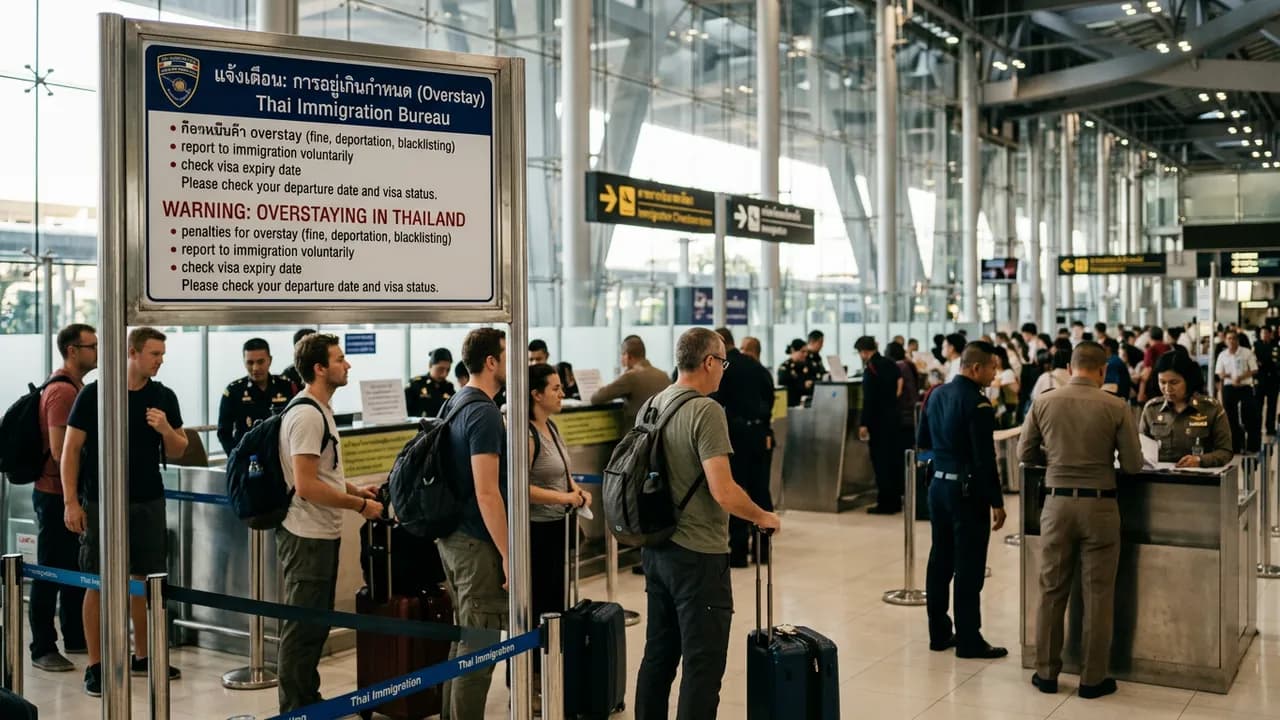
Thailand overstay penalties escalate quickly, because overstaying your permitted time in the kingdom is a serious immigration violation with mounting consequences. Whether you missed your deadline by one day or one year, there are financial penalties, potential entry bans, and in extreme cases, criminal prosecution and detention.
This guide covers the full scope of Thailand's overstay penalties so you understand exactly what is at stake and how the system works in 2026.
How Overstay Works
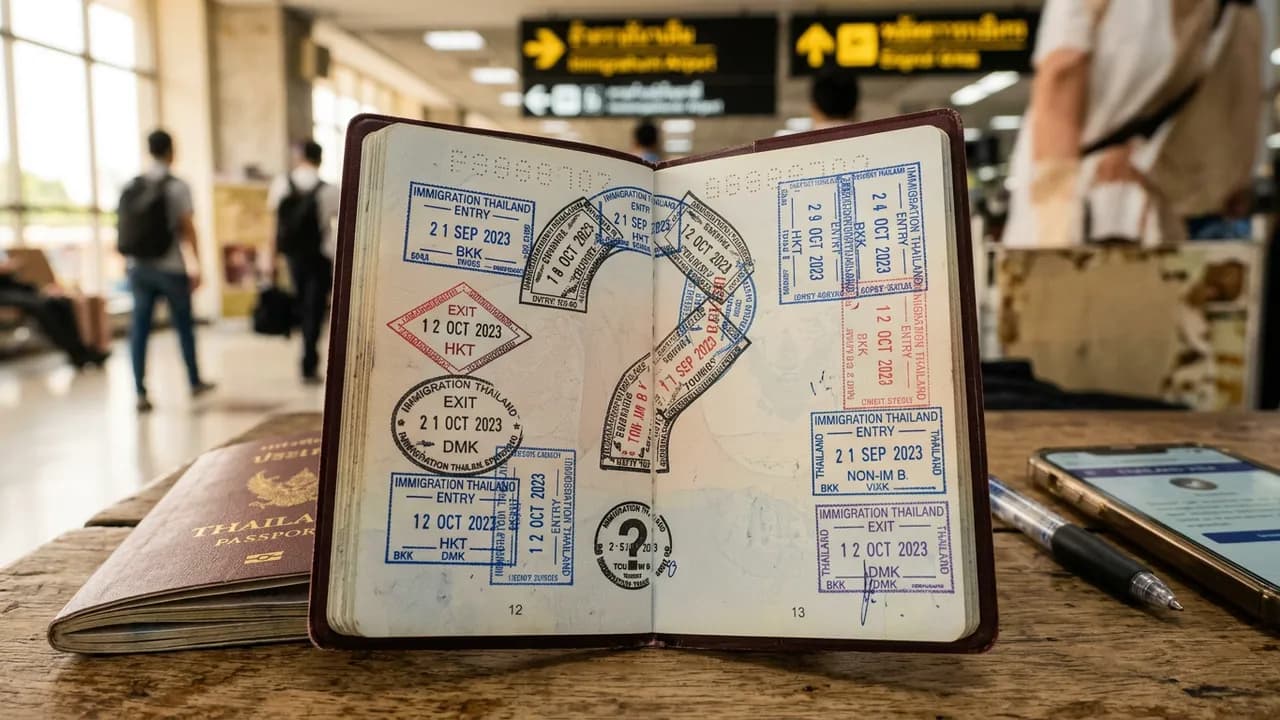
Your permitted stay in Thailand is defined by the date stamped in your passport by immigration. This stamp shows the last day you are legally allowed to remain in the country. Staying beyond this date — even by a single day — constitutes an overstay.
Examples of when overstay begins:
- You entered visa-free and received a 60-day stamp. Day 61 is overstay day 1.
- You have a Non-Immigrant visa extended until March 31. April 1 is overstay day 1.
- Your re-entry permit expired and you did not extend your visa. The day after your permitted stay date is overstay day 1.
The Fine: 500 THB Per Day
The base penalty for overstaying is a fine of 500 THB per day of overstay, with a maximum cap of 20,000 THB.
| Overstay Duration | Fine |
|---|---|
| 1 day | 500 THB |
| 1 week | 3,500 THB |
| 2 weeks | 7,000 THB |
| 1 month (30 days) | 15,000 THB |
| 40+ days | 20,000 THB (maximum) |
The fine is calculated from the day after your permitted stay expired up to and including the day you present yourself at immigration or are apprehended.
Important: The maximum fine of 20,000 THB applies regardless of whether you overstayed for 40 days or 4 years. However, longer overstays carry far more serious consequences beyond the fine.
Entry Bans (Blacklist)
Thailand operates a tiered blacklist system that imposes re-entry bans based on the length of overstay and how you were caught.
Voluntary Surrender
If you go to immigration on your own to report your overstay and leave the country voluntarily:
| Overstay Duration | Entry Ban |
|---|---|
| Less than 90 days | No ban |
| 90 days to 1 year | 1-year ban |
| 1 year to 3 years | 3-year ban |
| 3 years to 5 years | 5-year ban |
| Over 5 years | 10-year ban |
For the full procedure, see our voluntary departure overstay guide.
Caught by Authorities (Arrested/Apprehended)
If you are caught by police, at a checkpoint, or during an immigration raid:
| Overstay Duration | Entry Ban |
|---|---|
| Less than 1 year | 5-year ban |
| Over 1 year | 10-year ban |
The difference between voluntary surrender and being caught is enormous. A person who overstays for 6 months and surrenders voluntarily faces no entry ban, while the same person caught by police faces a 5-year ban.
What "Caught" Means
You are considered "caught" if:
- Police stop you for any reason and discover your overstay
- You are found during an immigration raid or checkpoint
- You are arrested for any offense and your visa status is checked
- You attempt to leave Thailand at a border and the overstay is discovered at departure (this is generally treated as voluntary in practice, but it is at the officer's discretion)
How the Blacklist Works
- Your name and passport details are entered into the Thai immigration database
- You will be denied entry to Thailand for the duration of the ban
- The ban applies to your passport number and biometric data — getting a new passport does not circumvent it
- The ban starts from the date you leave Thailand
- There is no appeal process for blacklist entries related to overstay
Criminal Penalties
For extreme cases, overstay can lead to criminal prosecution under Thai immigration law:
- Section 81 of the Immigration Act: Foreigners who remain in Thailand without permission may be imprisoned for up to 2 years and/or fined up to 20,000 THB
- Detention: Overstayers who cannot pay fines or who are being processed for deportation may be held at the Immigration Detention Center (IDC) in Bangkok or at provincial holding facilities
- Deportation: Serious overstayers are formally deported at their own expense. Deportation carries additional consequences including extended bans
Immigration Detention Center (IDC)
Thailand's Immigration Detention Center at Suan Phlu, Bangkok, and the newer facility at Chaeng Wattana hold foreigners awaiting deportation. Conditions are notoriously overcrowded and basic. Detainees may be held for weeks or months while embassy coordination and travel arrangements are completed.
Real-World Scenarios
Scenario 1: A Few Days Over
Situation: You missed your flight and overstayed by 3 days. Consequences: 1,500 THB fine at the airport. No entry ban. No blacklist. This is the most common scenario and is resolved quickly at the departure immigration counter.
Scenario 2: A Few Months Over, Voluntary Surrender
Situation: You overstayed for 2 months and go to immigration to leave voluntarily. Consequences: 20,000 THB fine (capped). No entry ban (under 90 days, voluntary). You can return to Thailand immediately.
Scenario 3: 6 Months Over, Caught by Police
Situation: You overstayed for 6 months and are stopped at a police checkpoint. Consequences: 20,000 THB fine. 5-year entry ban. Possible detention at IDC while deportation is arranged.
Scenario 4: Multiple Years Over
Situation: You overstayed for 2 years and are caught. Consequences: 20,000 THB fine. 10-year entry ban. Likely detention. Possible criminal prosecution. Deportation at your own expense.
Factors That Make Things Worse
Certain circumstances compound the severity of overstay consequences:
- Criminal activity during overstay — Any criminal offense committed while on overstay dramatically increases penalties, including longer detention and permanent blacklisting
- Working illegally — Working without a work permit during overstay adds a separate fine of 5,000-50,000 THB under the Royal Ordinance on Foreign Workers, and makes deportation and blacklisting near-certain
- Previous overstay history — Repeat offenders face harsher treatment and greater scrutiny
- Failure to cooperate — Resisting arrest, providing false information, or attempting to flee increases penalties
- Unable to pay fines — Inability to pay the overstay fine results in detention until arrangements can be made
How to Check Your Permitted Stay Date
Your permitted stay date is shown:
- In your passport — The immigration stamp shows the date in DD/MM/YYYY format (Thai dates sometimes use Buddhist calendar year = Gregorian + 543)
- On your extension of stay stamp — If you extended your visa, the new permitted stay date is stamped or written in your passport
- On your TM.6 departure card — If still in use at your port of entry
Always double-check this date immediately after receiving any immigration stamp. Misreading the date is one of the most common causes of accidental overstay.
How to Avoid Overstay
- Set multiple calendar reminders — Set alerts at 30 days, 14 days, and 7 days before your permitted stay expires
- Photograph your passport stamp — Take a clear photo of every immigration stamp for easy reference
- Extend early — If you want to stay longer, apply for an extension before your current stay expires. See our guides on extending a tourist visa or visa exemption. Most extensions can be applied for 30-45 days in advance.
- Understand your re-entry permit — If you have a re-entry permit and leave Thailand, verify that it is still valid. An expired re-entry permit while abroad can invalidate your extension.
- Keep your passport safe — A lost or stolen passport does not excuse overstay, but it creates significant additional complications
- Know the Buddhist calendar — Some Thai stamps use Buddhist Era dates. 2569 BE = 2026 CE. Make sure you are reading the right year.
What to Do If You Are Overstaying
If you realize you are already in overstay, take action immediately:
- Calculate your overstay duration — This determines the severity of consequences
- If under 90 days — Go to the nearest immigration office or the airport and leave voluntarily. You will pay the fine but face no entry ban.
- If over 90 days — Consider consulting an immigration lawyer before presenting yourself. The entry ban thresholds matter.
- Prepare funds — Bring enough cash to cover the 20,000 THB maximum fine plus your departure travel costs
- Contact your embassy — They can provide consular assistance, particularly if you are in financial difficulty or face detention
See our detailed guide on what to do if you overstay in Thailand for step-by-step advice.
Frequently Asked Questions
Can I pay the fine at the airport when leaving?
Yes. For short overstays, you can pay the fine at the immigration counter at the airport during departure. Have cash ready (THB preferred). Be prepared for questioning if the overstay is significant.
Does a new passport clear my blacklist entry?
No. Thailand uses biometric data (fingerprints, photos) collected at entry. A new passport number does not bypass a blacklist entry.
Can I get the blacklist entry removed?
There is no standard process for removing overstay-related blacklist entries. In rare cases, an immigration lawyer may be able to petition on your behalf, but success is not guaranteed and the process is lengthy and expensive.
Will I be arrested at the airport for overstay?
For short overstays (days or a few weeks), you will typically pay the fine and be allowed to depart. For longer overstays, the immigration officer has discretion. Very long overstays may result in detention and formal processing before departure.
Is overstay a criminal offense?
It is a violation of the Immigration Act, which carries both administrative penalties (fines, bans) and potential criminal penalties (imprisonment). Whether criminal prosecution is pursued depends on the severity and circumstances.
My visa agent told me not to worry about overstay. Should I trust them?
No. Only trust official immigration sources. Some unscrupulous agents downplay overstay risks. The penalties described in this article are real and consistently enforced.
Final Thoughts
Thailand's overstay penalties are designed to be proportional but unforgiving. A few days over is a minor hassle and a small fine. A few months or more can result in bans that last years or a decade. The single most important thing to remember is the difference between voluntary surrender and being caught — it can mean the difference between walking away fine-free and being banned for 5-10 years.
Track your dates, set your reminders, and never assume that no one will notice. Thai immigration has increasingly sophisticated systems, and random police checks are common throughout the country.