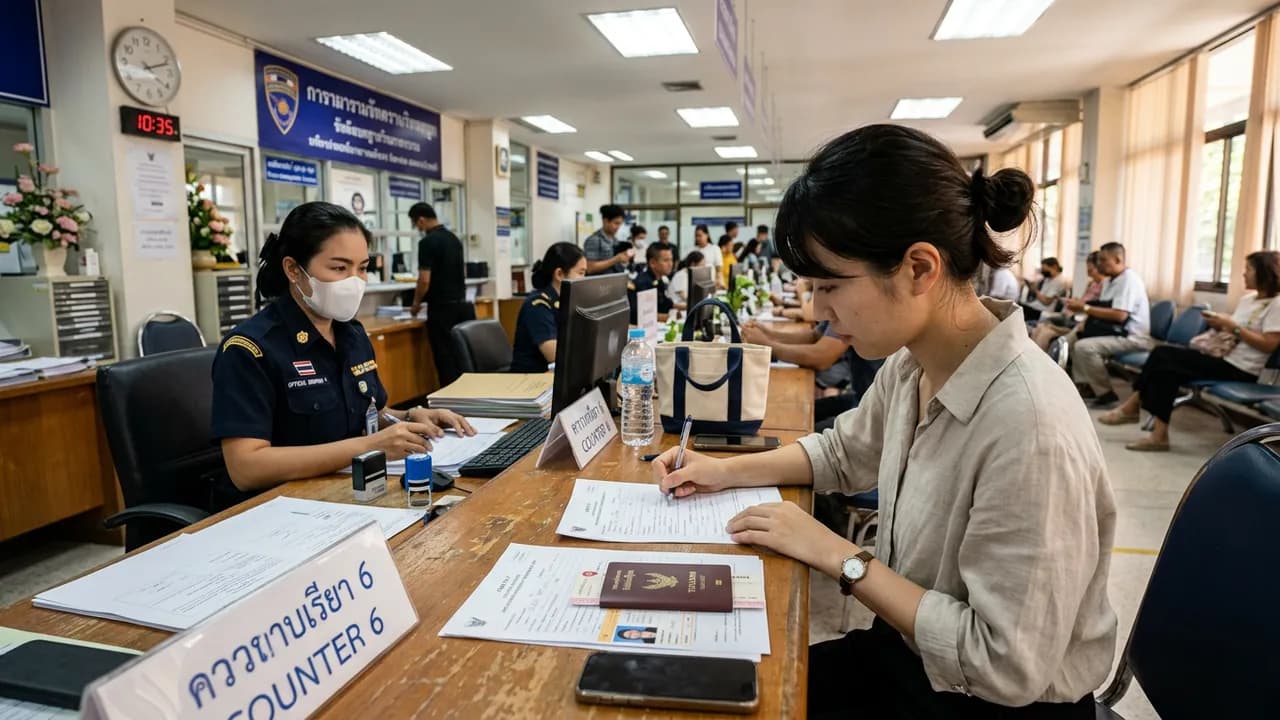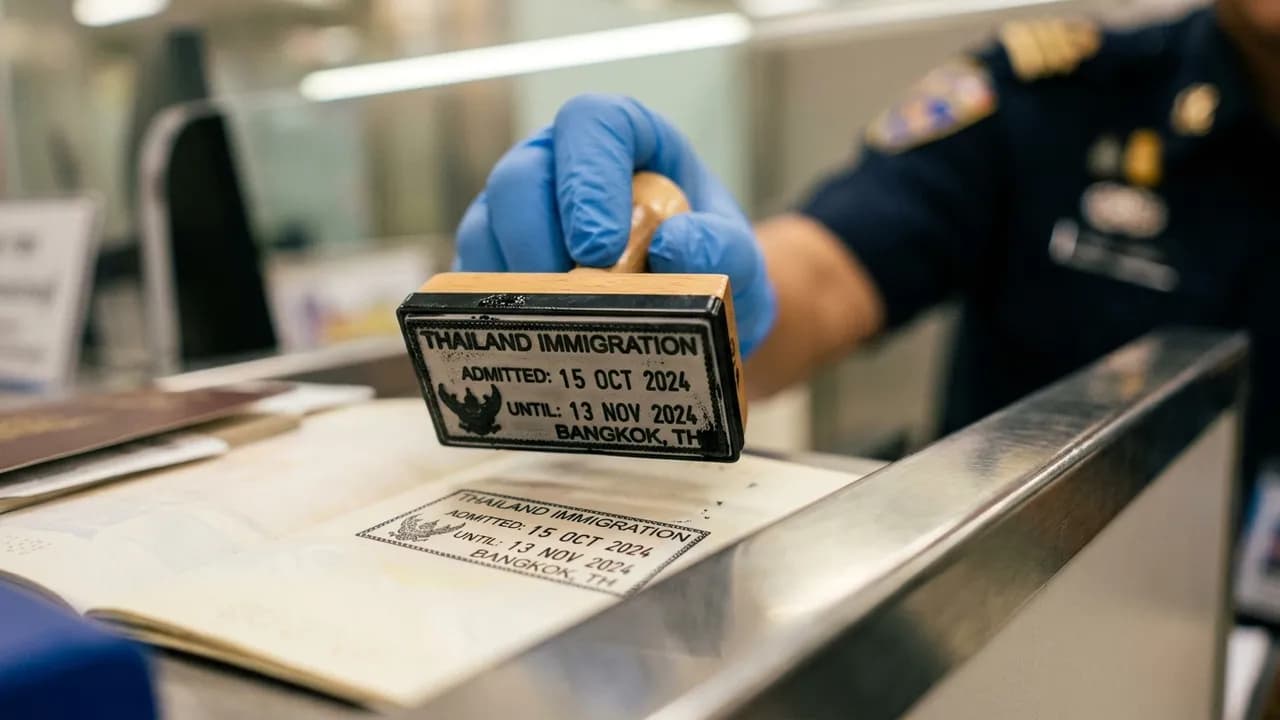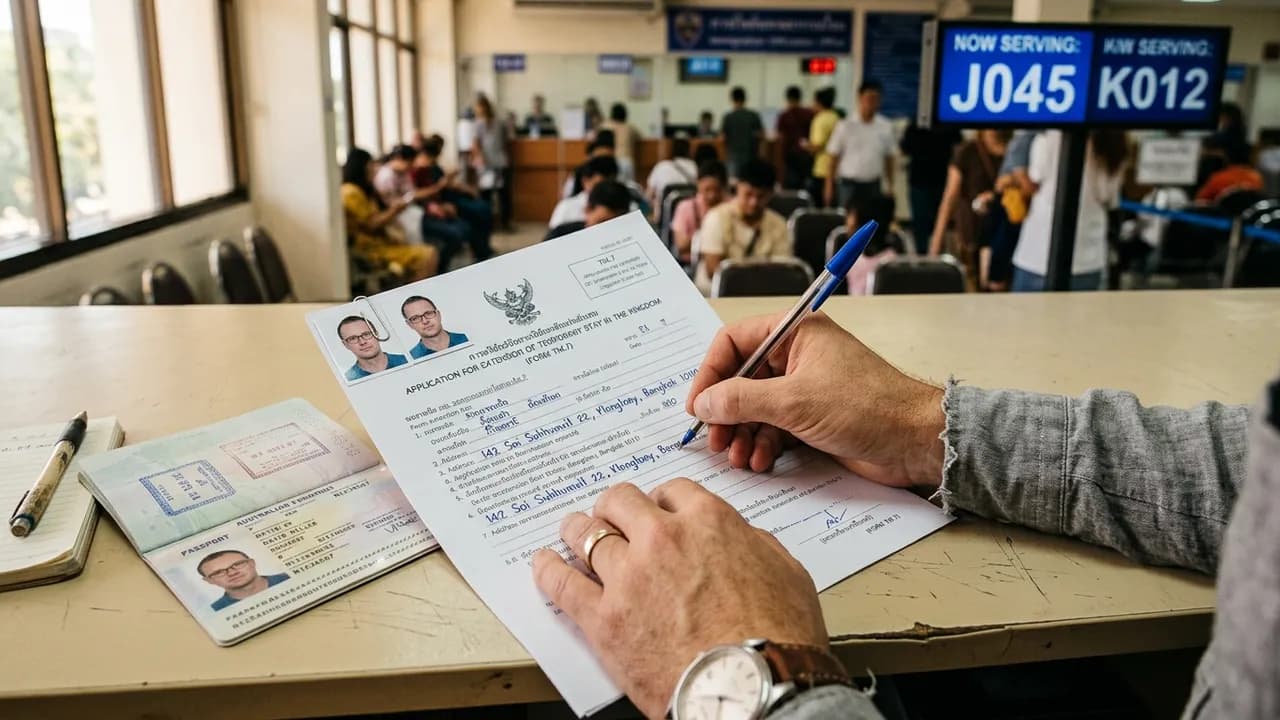
You can extend a Thailand visa exemption once, by 30 days, at any Thai Immigration office. The fee is 1,900 THB, the form is the TM.7, and processing is same-day at most offices. The extension is added to your current expiry date, so applying early costs you nothing. This guide covers the documents, the process office by office, and the July 2026 rule changes that affect how many days you get at the border in the first place.
Understanding the Visa Exemption
Before diving into the extension process, it is important to understand what a visa exemption actually is and how it differs from a tourist visa. For a detailed comparison, see our Tourist Visa vs Visa Exemption guide.
Visa Exemption vs. Tourist Visa
| Feature | Visa Exemption | Tourist Visa (TR) |
|---|---|---|
| How obtained | Automatic stamp at entry | Applied for at embassy/consulate before travel |
| Initial stay (by air) | 60 days | 60 days |
| Initial stay (by land) | 30 or 60 days (varies by nationality) | 60 days |
| Extension available | 30 days | 30 days |
| Maximum stay with extension | 90 days (air) or 60–90 days (land) | 90 days |
| Cost to extend | 1,900 THB | 1,900 THB |
2026 Entry Rules Update — 60 days today, 30 days coming
As of July 21, 2026, the 60-day visa exemption introduced in July 2024 is still in force at the border. But it is on its way out:
- On May 19, 2026 the Thai Cabinet approved rolling the exemption back from 60 to 30 days (full coverage and country list).
- On July 14, 2026 the Cabinet approved a revised framework covering 65 countries and territories: 59 countries get 30-day visa-free entry (including all 27 EU states and India, which was moved back up from visa-on-arrival), while Mauritius and Seychelles drop to 15 days (Nation Thailand, July 14, 2026; TAT Newsroom).
- The new rules take effect 15 days after publication in the Royal Gazette, which has not happened yet. Until then, eligible nationalities keep receiving 60 days. Track the status on our Thailand visa news tracker.
What this means for the extension: nothing changes about the extension itself — it remains +30 days for 1,900 THB under both the old and new frameworks. But once the 30-day tier takes effect, the extension becomes more valuable: 30 + 30 = 60 days maximum, versus today's 60 + 30 = 90 days. Check the number of days printed on your entry stamp — that stamp, not the news, is what immigration extends.
Key nationalities eligible for 60-day visa exemption (by air, until the Gazette change): USA, UK, Canada, Australia, New Zealand, most EU countries, Japan, South Korea, Singapore, Hong Kong, and many more. The full list includes over 90 countries and territories; see who keeps and who loses visa-free entry under the new framework.
Extension at a Glance
| Detail | Information |
|---|---|
| Extension length | 30 days added to current expiry |
| Fee | 1,900 THB (cash only) |
| Where to apply | Any Thai Immigration office |
| Processing time | Same day (30 minutes – 3 hours) |
| Application window | Up to 30 days before expiry; recommended at least 7 days before |
| How many times | Once per entry |
Required Documents
Gather these before heading to Immigration. All documents should be neat, legible, and accurate.
Mandatory
-
Passport (original) — Must be valid for at least 6 months. Bring photocopies of:
- Bio/photo page
- Page with the visa exemption entry stamp
- All pages with previous Thai stamps (some offices request this)
Note: the paper TM.6 departure card was phased out and replaced by the online Thailand Digital Arrival Card (TDAC), which every foreign visitor completes at tdac.immigration.go.th within 3 days before arrival. You do not need a paper card for the extension; some offices may ask for your TDAC confirmation number, so keep the confirmation email.
-
TM.7 Application Form — The standard extension application. Available at the immigration office, from photocopy shops near the office, or downloadable from the Thai Immigration Bureau website (Forms section).
-
Passport photo (4x6 cm) — One recent photo, white background. Glue or staple it to the TM.7 form.
-
1,900 THB cash — The non-refundable government fee.
-
Proof of address in Thailand — One of the following:
- Hotel booking confirmation (printed)
- Lease or rental agreement
- Letter from your accommodation host
- TM.30 notification receipt
Good to Have
- Extra photocopies — Bring spares of every document. Some offices request unexpected copies.
- Proof of onward travel — A flight booking showing you plan to leave Thailand. Not always requested, but some officers ask.
- Evidence of funds — A bank statement or cash showing you have sufficient money for your stay. Rarely checked for extensions but worth having.
Step-by-Step Process
Step 1: Find Your Nearest Immigration Office
Every Thai province has at least one immigration office. Major locations include:
| City | Office Location | Notes |
|---|---|---|
| Bangkok | Chaeng Watthana Government Complex, Building B | Largest and busiest in Thailand |
| Bangkok (temporary) | IT Square Laksi (overflow facility) | Opens during peak seasons |
| Chiang Mai | Promenada Mall, 3rd Floor | Moderate wait times |
| Phuket | Phuket Town, Phuket Rd | Can be busy in high season |
| Pattaya | Soi 5, Jomtien | Relatively efficient |
| Koh Phangan | Thong Sala | Small office, short waits |
| Koh Samui | Nathon area | Walk-in, usually quick |
| Krabi | Krabi Town | Small and fast |
| Hua Hin | Near Bluport Hub | Quiet outside holidays |
| Chiang Rai | City center | Very low wait times |
Step 2: Arrive Early and Take a Queue Number
Offices open at 08:30 and close at 16:30, Monday through Friday. They close on Thai public holidays. Arrive by 08:00 if possible, especially in Bangkok, Phuket, and Chiang Mai.
Most offices use a numbered queue system. Take a ticket from the machine or reception desk when you arrive.
Step 3: Fill Out the TM.7 Form
If you have not already completed the form, fill it out in the waiting area. Key fields include:
- Full name (as in passport)
- Nationality
- Passport number
- Current address in Thailand
- Reason for extension (write "tourism" or "travel")
- Requested number of days (write "30 days")
Attach your passport photo to the designated area on the form.
Step 4: Submit Documents at the Counter
When your number is called, present:
- Completed TM.7 form with photo attached
- Passport (original)
- All photocopies
- 1,900 THB
The officer will review your documents, stamp and sign the form, and may ask basic questions about your stay. Common questions include:
- "Where are you staying?"
- "When will you leave Thailand?"
- "What is the purpose of your visit?"
Keep answers simple and honest. This is routine, not an interrogation.
Step 5: Wait for Processing
You will be directed to a waiting area. Processing time depends on the office:
| Office | Typical Wait |
|---|---|
| Bangkok Chaeng Watthana | 1–3 hours |
| Chiang Mai | 45 min – 2 hours |
| Island offices (Samui, Phangan) | 15–45 minutes |
| Small provincial offices | 15–30 minutes |
Step 6: Collect Your Passport
When your name or number is called, collect your passport. Check the new stamp immediately. Verify:
- The new expiry date is correct (30 days from your original expiry)
- Your name and passport number match
- The stamp is clear and legible
If anything is wrong, point it out to the officer before leaving.
How the Extension Date Is Calculated
Your 30-day extension is added to your current expiry date, not the date you apply. This means applying early does not cost you days.
Example 1 — Arrived by air with 60-day exemption:
- Entry date: January 10
- Original expiry: March 10
- Extension applied: February 20
- New expiry: April 9 (30 days from March 10)
Example 2 — Arrived by land with 30-day stamp:
- Entry date: January 10
- Original expiry: February 8
- Extension applied: February 1
- New expiry: March 10 (30 days from February 8)
What You Cannot Do
- Extend twice. You get one 30-day extension per entry. After that, you must leave Thailand or change your visa type.
- Extend after expiry. If your stamp has already expired, you are overstaying. Go to Immigration immediately to pay the fine (500 THB/day, max 20,000 THB) and depart.
- Work on a visa exemption. Employment of any kind is illegal without a valid work permit, regardless of your immigration status.
- Extend at the airport. Extensions are only processed at immigration offices, not at border checkpoints or airport immigration counters.
After Your Extension Expires
When your extended stay runs out, you have several paths forward:
Option 1: Leave Thailand
The simplest option. Depart by air or land before your new expiry date.
Option 2: Visa Run
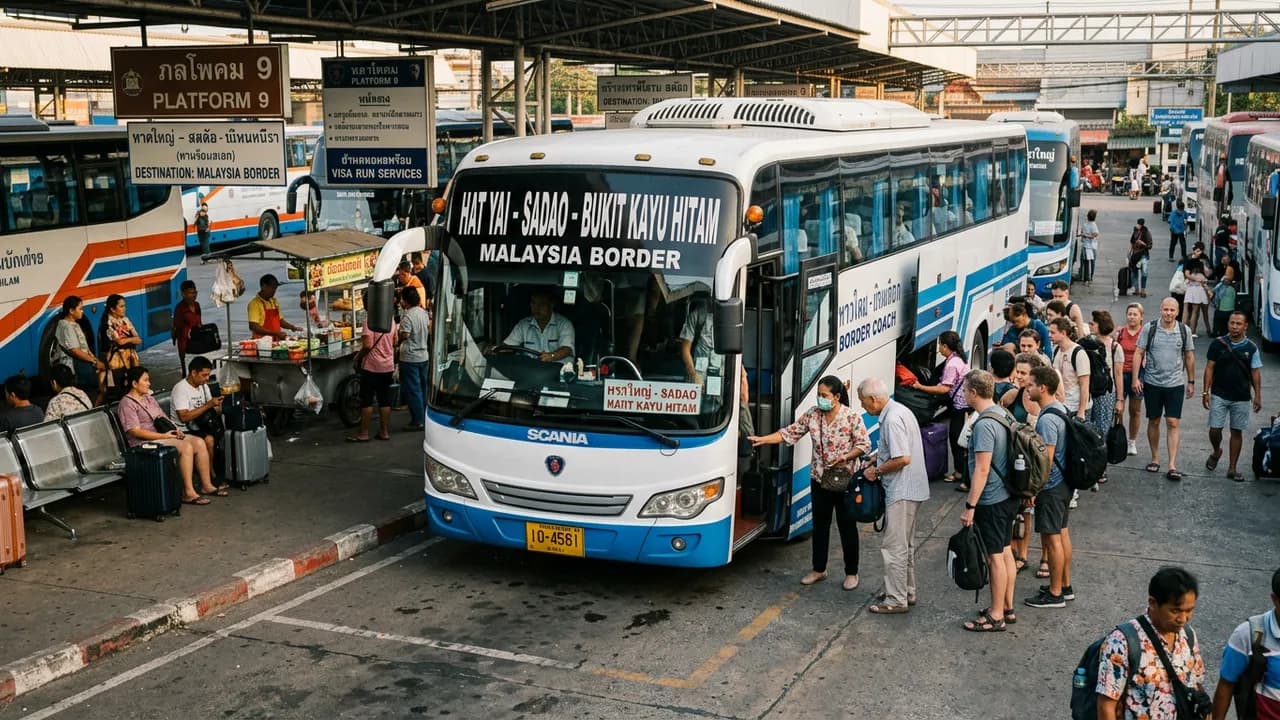
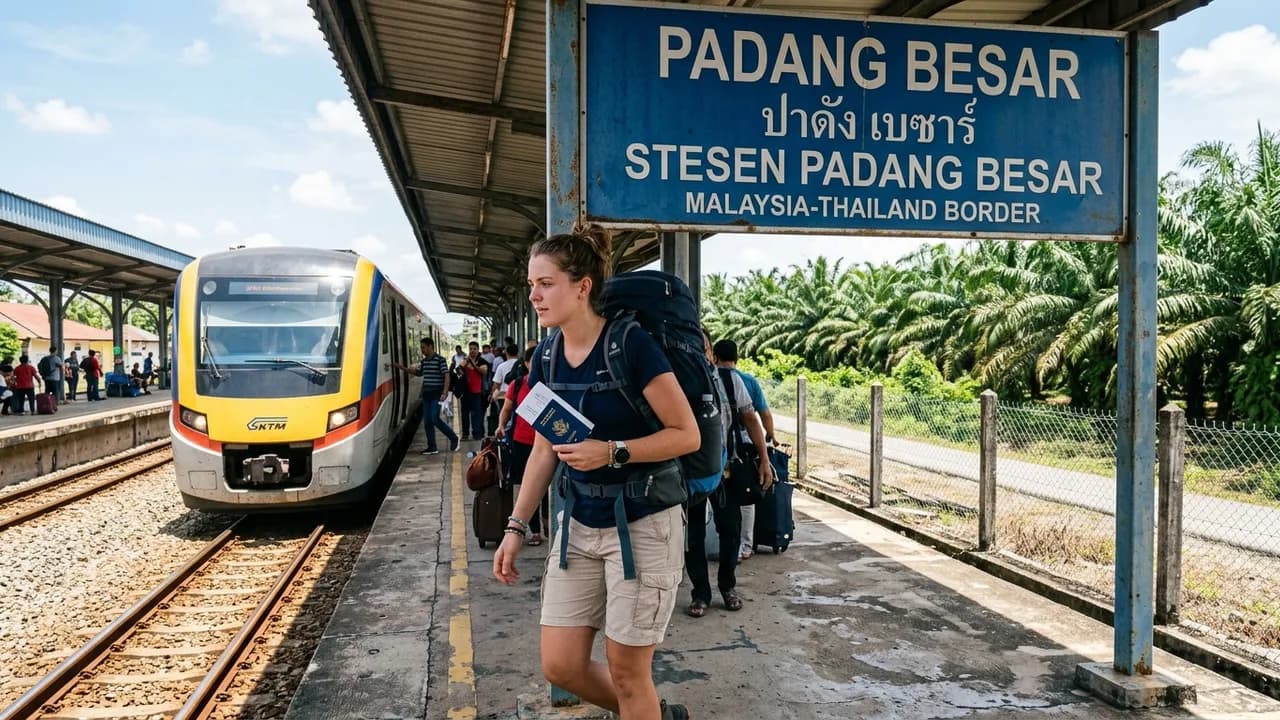
Exit Thailand and re-enter to receive a new visa-exemption stamp. This resets your stay period. Popular visa run destinations include Cambodia (Poipet), Laos (Vientiane), and Malaysia (Sadao/Penang).
Be aware that immigration officers may question frequent visa runs. If you have multiple back-to-back entries, you may be denied entry at the discretion of the officer.
Option 3: Apply for a Longer Visa
If you plan to stay in Thailand long-term, consider applying for:
- Tourist Visa (TR) at a Thai embassy abroad — 60 days + 30-day extension
- Non-Immigrant Visa — For education, business, retirement, or marriage
- Thailand Elite Visa — Long-term visa program (5–20 years) with premium fees
- Destination Thailand Visa (DTV) — For digital nomads and remote workers
Common Mistakes to Avoid
-
Not checking your entry stamp. Some travelers assume they have 60 days but actually received 30 days (especially at land borders). Always count the days from your stamp.
-
Arriving without photocopies. Some offices have copy machines; many do not. Photocopy shops near immigration offices charge 2–5 THB per page but may have long queues.
-
Forgetting the TM.30. While not every office checks, several (especially Bangkok and Chiang Mai) have begun requiring proof that your accommodation has filed TM.30 notification. Ask your hotel or landlord to confirm.
-
Applying too late in the day. If you arrive at 15:00 at a busy office, the staff may not accept new applications because processing would extend past closing time.
-
Not carrying cash. The 1,900 THB fee must be paid in Thai baht, in cash. No cards, no foreign currency, no transfers.
Frequently Asked Questions
Can I extend my visa exemption online?
No. As of 2026, all visa-exemption extensions must be done in person at an immigration office.
Do I need to show proof of funds?
It is rarely checked during extension applications, but Thai immigration law requires visitors to carry 10,000 THB (individual) or 20,000 THB (family) in cash or equivalent. Carry some cash as a precaution.
Can I leave and re-enter Thailand during my extension?
If you leave Thailand, your extension is void. Upon re-entry, you will receive a fresh visa-exemption stamp and the cycle starts again.
Is the extension guaranteed?
Extensions are granted at the discretion of the immigration officer. In practice, they are almost always approved for tourists with complete documentation. Denials are extremely rare.
What about the 90-day reporting rule?
The 90-day reporting requirement applies to people staying in Thailand for 90 consecutive days or more. If your total stay (exemption + extension) reaches 90 days, you technically need to report, but since your stay maxes out at 90 days and you must leave on day 90, this usually does not apply. It becomes relevant only if you change to a longer visa.
Summary
Extending a visa exemption in Thailand is a routine procedure that grants you an extra 30 days of stay. Prepare your documents in advance, arrive early at your local immigration office, pay 1,900 THB, and you will have your new stamp within hours. Plan ahead for what you will do when the extension expires, whether that is departing Thailand, doing a visa run, or transitioning to a longer-term visa.
Sources
- Thai Immigration Bureau — official extension rules and TM.7 form
- Thailand Digital Arrival Card (TDAC) — mandatory online arrival card, official portal
- TAT Newsroom — Cabinet approves revision of the 60-day visa exemption scheme (May 2026)
- Nation Thailand — Thailand revamps visa rules for 65 countries (July 14, 2026)