The Non-O vs Non-O-A retirement visa comparison covers Thailand's two retiree-focused categories — the Non-Immigrant O Visa (applied for based on retirement) and the Non-Immigrant O-A Visa (Long Stay) — in one of the world's most popular retirement destinations. Both allow you to live in Thailand if you are 50 years or older, but they differ significantly in where you apply, insurance requirements, and long-term logistics.
Choosing the wrong one can cost you thousands of baht in unnecessary insurance or create complications during your annual extensions. This guide explains every difference so you can pick the path that works best for your situation.
Quick Comparison Table
| Feature | Non-Immigrant O (Retirement) | Non-Immigrant O-A (Long Stay) |
|---|---|---|
| Where to apply | Thai embassy abroad OR inside Thailand | Thai embassy abroad ONLY |
| Initial visa duration | 90 days (single entry) | 1 year (multiple entry) |
| Stay per entry | 90 days (extendable to 1 year) | 1 year |
| Multiple entry | Optional (5,000 THB) | Included |
| Application fee | 2,000 THB (single) / 5,000 THB (multi) | 2,000 THB |
| Health insurance required? | No (for initial application) | Yes (mandatory) |
| Financial requirement | 800,000 THB in Thai bank OR 65,000 THB/month income | 800,000 THB in Thai bank OR 65,000 THB/month income |
| Extension available | Yes (1 year at a time) | Yes (1 year at a time) |
| Insurance at extension | Required since 2024 (at many offices) | Yes (mandatory from day one) |
| Criminal background check | Not required | Required (from home country) |
| Medical certificate | Not required | Required |
Non-Immigrant O Visa for Retirement: In Detail
The Non-Immigrant O is a general-purpose visa category that covers several reasons for staying in Thailand, including retirement, marriage to a Thai national, and supporting Thai family members. When used for retirement, it is sometimes informally called the "retirement visa," though technically it is a Non-Immigrant O issued on the basis of retirement.
Non-O: How to Obtain It
From a Thai embassy abroad:
- Visit your nearest Thai embassy or consulate
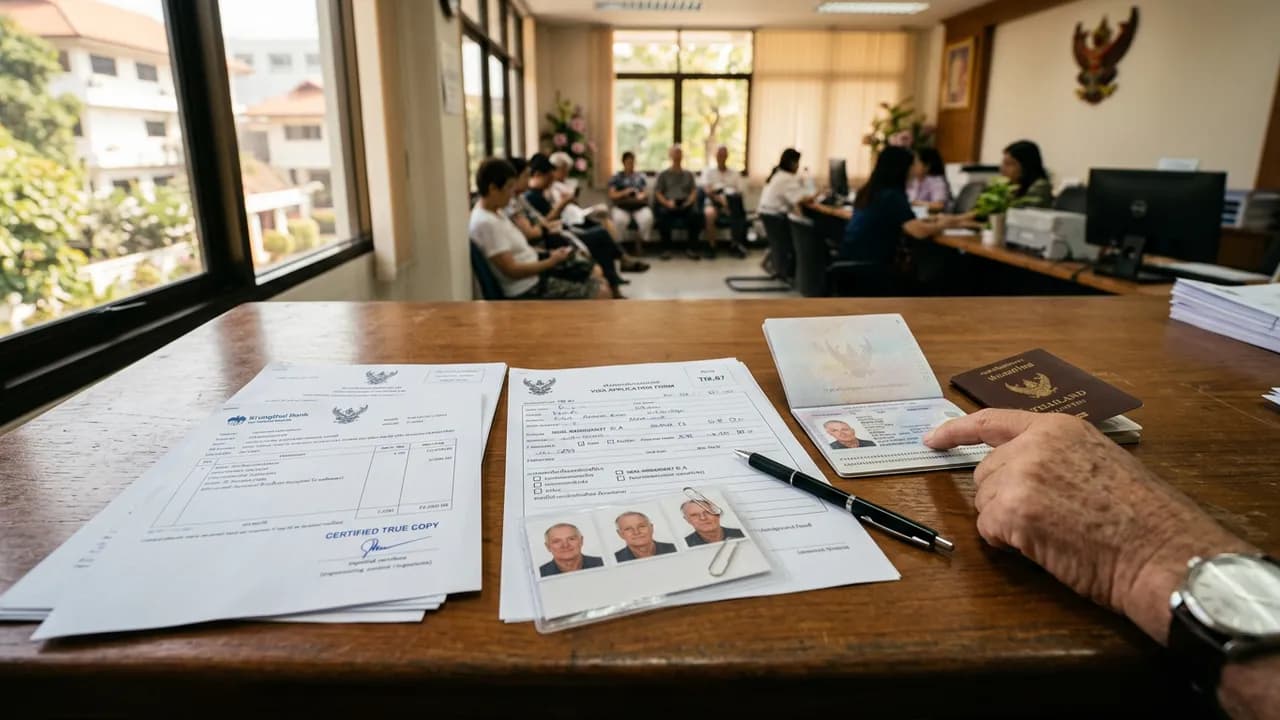
- Submit your passport, application form, photo, and proof of finances
- Pay 2,000 THB (single entry) or 5,000 THB (multiple entry)
- Receive a 90-day visa within 3-5 business days
- Enter Thailand and apply for a 1-year extension at Immigration
From inside Thailand (visa conversion):
- Enter Thailand on any valid visa or visa exemption
- Visit a Thai Immigration office
- Apply to change your status to Non-Immigrant O (retirement basis)
- Pay 2,000 THB
- Receive a 90-day Non-Immigrant O stamp
- Before it expires, apply for a 1-year extension
Non-O: Financial Requirements
You must demonstrate one of the following:
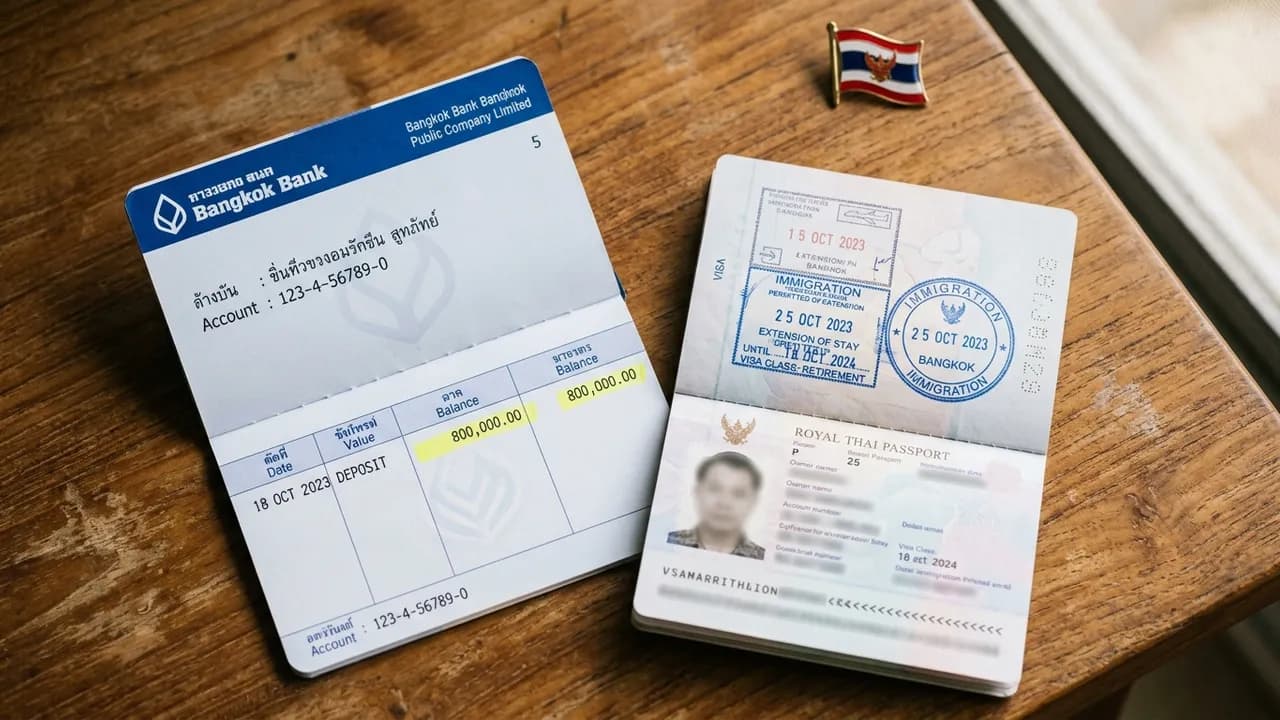
- 800,000 THB deposited in a Thai bank account in your name, held for at least 2 months before the extension application and maintained at or above 400,000 THB for the remaining 10 months of the year
- Monthly income of at least 65,000 THB (approximately USD 1,800) from pensions, Social Security, or other verifiable sources
- A combination of bank deposit and annual income totaling at least 800,000 THB
Insurance requirements
Historically, the Non-O retirement visa did not require health insurance. However, starting in recent years, many immigration offices have begun requesting proof of health insurance at the time of annual extension. Requirements vary by office, but the trend is clearly moving toward mandatory insurance. It is wise to have coverage regardless.
Key advantages of the Non-O route
- Can be obtained inside Thailand. This is the biggest practical advantage. You can enter on a visa exemption, convert to Non-O at immigration, and then extend for a year — all without leaving the country.
- No criminal background check. Unlike the O-A, no police clearance certificate is required.
- No medical certificate. No doctor's letter needed for the initial application.
- Flexibility. The Non-O category also covers marriage, so if your circumstances change, the same visa framework applies.
Non-O: Key Disadvantages
- Shorter initial validity. The embassy issues a 90-day visa, meaning you need to apply for an extension relatively soon after arriving.
- Single entry (unless you pay extra). Without paying for multiple entry or buying a re-entry permit, leaving Thailand cancels your visa.
- Annual extensions in person. You must visit Immigration each year to extend.
Non-Immigrant O-A Visa for Retirement: In Detail
The Non-Immigrant O-A is specifically designed for retirees and is sometimes called the "Long Stay" visa. It can only be obtained from a Thai embassy or consulate outside Thailand.
Non-O-A: How to Obtain It
- Visit the Thai embassy or consulate in your home country or country of residence
- Submit an extensive application package including:
- Passport and application form
- Criminal background check from your home country (less than 3 months old)
- Medical certificate (less than 3 months old)
- Proof of financial requirements
- Health insurance documentation
- Pay 2,000 THB (or local currency equivalent)
- Receive a 1-year multiple entry visa within 5-10 business days
- Enter Thailand — your 1-year stay begins from the date of entry
Non-O-A: Financial Requirements
The financial requirements are identical to the Non-O:
- 800,000 THB in a Thai bank account, OR
- Monthly income of 65,000 THB, OR
- Combination totaling 800,000 THB
Some embassies accept proof of equivalent funds in your home country bank account for the initial application (since you may not yet have a Thai bank account). The Thai bank deposit requirement applies at extension time.
Mandatory health insurance
This is the defining difference of the Non-O-A visa. You must have health insurance that meets these minimums:
| Coverage Type | Minimum Coverage |
|---|---|
| Outpatient (OPD) | 40,000 THB |
| Inpatient (IPD) | 400,000 THB |
The insurance must be from a Thai insurance company or an international insurer approved by the Office of Insurance Commission (OIC). A list of approved insurers is available from the OIC website.
Cost of qualifying insurance:
| Age Group | Approximate Annual Premium |
|---|---|
| 50-59 | 15,000 – 30,000 THB |
| 60-69 | 25,000 – 50,000 THB |
| 70-74 | 40,000 – 80,000 THB |
| 75+ | 60,000 – 120,000+ THB (if available) |
For retirees over 70, finding affordable qualifying insurance becomes increasingly difficult, and some insurers will not provide coverage at all.
Key advantages of the O-A route
- 1-year visa from the start. No need to apply for an extension within the first 90 days.
- Multiple entry included. You can leave and re-enter Thailand freely during your visa's validity period without purchasing re-entry permits.
- Clear, standardized process. Requirements are well-documented and consistent across embassies.
Non-O-A: Key Disadvantages
- Must apply from outside Thailand. You cannot obtain or convert to an O-A inside Thailand.
- Mandatory insurance from day one. This adds significant annual cost, especially for older retirees.
- Criminal background check required. Obtaining a police clearance certificate from your home country can be time-consuming (4-8 weeks in some countries).
- Medical certificate required. Must be from a licensed physician and less than 3 months old.
- Insurance at extension too. When you extend your O-A, you must again show valid qualifying insurance.
Extension Process Compared
Both visas can be extended annually at a Thai Immigration office. The extension fee is 1,900 THB for both, and both require financial proof (800,000 THB bank deposit or 65,000 THB/month income), a TM.30 receipt, and one 4x6 cm photo. Processing is usually same-day.
The key difference at extension: Non-O-A extensions always require OIC-approved insurance (OPD 40,000 / IPD 400,000 THB minimum). Non-O extensions increasingly require insurance too, but enforcement varies by office. After the first extension, the two paths converge — the main ongoing difference is stricter insurance enforcement for O-A holders.
Important note on switching paths
Many retirees start with a Non-O-A visa from abroad, then switch to extending on a Non-O basis after their first year. This is done by:
- Letting the O-A visa expire (or not extending it)
- Converting status inside Thailand to Non-O (retirement basis)
- Extending the Non-O annually going forward
This strategy is used primarily to avoid the mandatory O-A insurance requirement, though as noted, many immigration offices are now requesting insurance for Non-O extensions as well.
Cost Comparison: First Year and Ongoing
First Year Costs
| Cost Element | Non-O Route | Non-O-A Route |
|---|---|---|
| Visa application fee | 2,000 THB | 2,000 THB |
| Extension fee (1 year) | 1,900 THB | Not needed first year |
| Re-entry permit (if traveling) | 1,000 – 3,800 THB | Included |
| Health insurance | Optional (0 – 30,000 THB) | Mandatory (15,000 – 80,000 THB) |
| Criminal background check | Not required | 500 – 3,000 THB (varies by country) |
| Medical certificate | Not required | 500 – 2,000 THB |
| Total (approximate) | 3,900 – 37,700 THB | 18,000 – 87,000 THB |
Annual Ongoing Costs (Extensions)
| Cost Element | Non-O Extension | Non-O-A Extension |
|---|---|---|
| Extension fee | 1,900 THB | 1,900 THB |
| Re-entry permit | 1,000 – 3,800 THB | 1,000 – 3,800 THB |
| Health insurance | Varies (0 – 30,000 THB) | Mandatory (15,000 – 80,000 THB) |
| Total | 1,900 – 35,700 THB | 16,900 – 85,700 THB |
The Non-O route is substantially cheaper, primarily because of the insurance difference. However, if you plan to carry health insurance regardless (which is strongly advisable for anyone over 50 living abroad), the cost gap narrows.
Pros and Cons Summary
Non-Immigrant O (Retirement)
| Pros | Cons |
|---|---|
| Can apply inside Thailand | 90-day initial visa only |
| No mandatory insurance (historically) | Single entry unless you pay extra |
| No criminal background check | Must extend within first 90 days |
| No medical certificate needed | Insurance increasingly required at extension |
| Lower initial cost | Less standardized process |
Non-Immigrant O-A (Long Stay)
| Pros | Cons |
|---|---|
| 1-year visa from the start | Must apply from outside Thailand |
| Multiple entry included | Mandatory expensive insurance |
| Clear standardized process | Criminal background check required |
| No extension needed first year | Medical certificate required |
| More "official" retirement visa | Higher overall annual cost |
Which Should You Choose?
Choose the Non-O if:
- You are already in Thailand and want to convert your current visa or exemption to a retirement visa without leaving the country
- You want to minimize costs and are willing to navigate the extension process early
- You are over 70 and finding affordable qualifying O-A insurance is difficult or impossible
- You do not want to deal with criminal background checks and medical certificates
- You prefer flexibility in your insurance choices
Choose the Non-O-A if:
- You are applying from your home country before moving to Thailand
- You want the longest initial stay without needing to visit immigration early
- You value a simple, well-documented process with clear requirements
- You plan to travel in and out of Thailand frequently (multiple entry included)
- You already carry qualifying health insurance so the mandate does not add cost
Common Strategy: Start O-A, Switch to Non-O
Many experienced retirees recommend:
- Apply for the Non-O-A from your home country to get a clean 1-year entry
- Use that first year to establish banking, housing, and routines in Thailand
- At extension time, convert to a Non-O basis to gain flexibility on insurance requirements
This gives you the smooth entry experience of the O-A with the long-term cost savings of the Non-O. Discuss this strategy with your local immigration office, as procedures may vary.
Frequently Asked Questions
Can I work on either retirement visa?
No. Neither the Non-O (retirement) nor the Non-O-A permits any form of employment in Thailand. You need a Non-Immigrant B visa and work permit for legal employment.
What happens if my bank balance drops below 800,000 THB?
Your extension may be denied at renewal time. The money must remain in your Thai bank account — at least 800,000 THB for two months before extension, and at least 400,000 THB for the remainder of the year. Immigration officers check updated bank statements.
Can my spouse get a visa based on my retirement visa?
Your Thai spouse does not need a visa. If your spouse is a foreign national, they would need to apply for their own visa independently.
Do I need to stay in Thailand the entire year?
No. You can travel freely as long as you have a valid re-entry permit (Non-O) or are within your multiple-entry validity (Non-O-A). Extended absences may raise questions at extension time.
Understanding the differences between these two retirement visa paths helps you avoid unnecessary costs and paperwork. Both achieve the same goal — a comfortable, legal retirement in Thailand — through slightly different routes.