A teaching work permit in Thailand remains one of the most accessible paths for foreigners to live and work legally in the kingdom. Whether you are a certified educator with years of classroom experience or a recent graduate looking to teach English abroad, Thailand's schools, language centers, and universities offer opportunities across the spectrum. However, working legally requires navigating a specific set of visa and work permit requirements that differ in important ways from the standard employment process. For the full overview of work permits in Thailand, see our Thailand work permit guide.
This guide covers the complete process for obtaining a teaching work permit in Thailand in 2026, including the different types of teaching positions, qualification requirements, and practical tips for avoiding common problems.
Types of Teaching Positions in Thailand
The type of institution you work for affects your visa process, salary, and working conditions. Understanding the differences is essential before you begin.
Government Schools
Thai government schools (public schools) employ foreign teachers primarily for English-language instruction, though positions in other subjects exist at international program schools. These are the most common teaching positions for foreigners.
| Aspect | Details |
|---|---|
| Typical salary | 30,000-45,000 THB/month |
| Contract period | 1 academic year (May to March) |
| Visa support | School handles most paperwork |
| Qualifications | Bachelor's degree + TEFL/teaching certificate |
| Class sizes | 30-50 students |
| Working hours | Monday to Friday, 7:30 AM - 4:00 PM |
Private Schools
Private Thai schools generally offer better compensation and facilities than government schools. International program schools within the private system often pay significantly more.
| Aspect | Details |
|---|---|
| Typical salary | 35,000-80,000 THB/month |
| Contract period | 1-2 academic years |
| Visa support | School handles paperwork, often more efficiently |
| Qualifications | Bachelor's degree + TEFL; licensed teachers preferred |
| Class sizes | 15-35 students |
| Working hours | Varies by school |
International Schools
International schools following curricula such as British, American, IB, or other systems offer the highest salaries and most comprehensive benefits packages. They also have the strictest qualification requirements.
| Aspect | Details |
|---|---|
| Typical salary | 80,000-200,000+ THB/month |
| Contract period | 2-year contracts common |
| Benefits | Housing allowance, flights, health insurance, retirement contributions |
| Qualifications | Teaching license from home country, relevant degree, 2+ years experience |
| Class sizes | 15-25 students |
| Accreditation | ISAT, CIS, WASC, or other international bodies |
Language Schools and Tutoring Centers
Private language schools such as ECC, Wall Street English, and smaller independent schools hire foreign teachers for conversation classes, test preparation, and corporate training.
| Aspect | Details |
|---|---|
| Typical salary | 30,000-50,000 THB/month (or hourly rates) |
| Contract period | Rolling contracts, often month-to-month |
| Visa support | Varies — larger chains handle it; smaller schools may not |
| Qualifications | Bachelor's degree + TEFL minimum |
| Class sizes | 5-15 students |
| Schedule | Often evenings and weekends |
Universities
Thai universities hire foreign lecturers for various departments, with English-language positions being most common. Salaries and requirements sit between private schools and international schools.
| Aspect | Details |
|---|---|
| Typical salary | 40,000-90,000 THB/month |
| Contract period | Semester or annual contracts |
| Qualifications | Master's degree preferred; PhD for senior positions |
| Class sizes | 20-60 students |
| Additional duties | Research, curriculum development, administrative tasks |
Qualification Requirements
Minimum Requirements for All Teaching Positions
To obtain a teaching work permit in Thailand, you generally need:
- Bachelor's degree — In any field, though education-related degrees are preferred
- TEFL/TESOL/CELTA certificate — A minimum of 120 hours is the standard expectation
- Clean criminal background check — From your home country, apostilled or authenticated
- Valid passport — At least 12 months remaining validity
- No prohibited health conditions — Medical certificate from a Thai hospital
Teachers Council of Thailand (TCT) License
A critical requirement that many new teachers overlook is the Teachers Council of Thailand (Khurusapha) license. Legally, all teachers working in Thai schools (government and private) must hold a TCT teaching license. The reality is more nuanced:
Full Teaching License — Issued to teachers who hold a teaching degree or teaching license from their home country. This requires:
- Degree in Education, or
- Valid teaching license/certification from your home country, or
- Completion of a TCT-approved teacher training program in Thailand
Temporary Teaching License (Letter of Permission) — For teachers who do not hold a teaching degree but have a TEFL/TESOL certificate. This is valid for 2 years and renewable.
| License Type | Validity | Requirements | Processing Time |
|---|---|---|---|
| Full TCT License | 5 years (renewable) | Teaching degree or foreign teaching license | 2-4 months |
| Temporary License | 2 years (renewable) | Bachelor's degree + TEFL certificate | 1-3 months |
Important: Your school typically handles the TCT license application on your behalf. However, the processing time can be significant, and you may need to provide apostilled or authenticated copies of your degree and background check.
TEFL/TESOL Certificate Details
Not all TEFL certificates are created equal. For Thailand, consider the following:
- 120-hour minimum — This is the de facto standard. Shorter certificates may not be accepted.
- Accredited providers — Certificates from recognized providers carry more weight. CELTA and Trinity CertTESOL are the gold standard.
- Online vs. in-person — Both are generally accepted, but in-person courses with observed teaching practice are preferred by better schools.
- Thailand-based TEFL courses — Several providers offer in-country TEFL courses that include job placement assistance. These can be advantageous because they offer local networking and practical familiarity with the Thai education system.
Step-by-Step Work Permit Process for Teachers
Step 1: Secure a Teaching Position
Begin your job search before arriving in Thailand. Key resources include:
- Ajarn.com — The longest-running teaching job board for Thailand
- TeachAway — International teaching positions including Thailand
- School websites — International schools post openings on their own sites
- Recruitment agencies — Some specialize in placing teachers in Thai schools
- Job fairs — International school recruitment fairs (Search Associates, ISS)
Your school will provide an employment contract specifying your position, salary, teaching hours, and contract duration. Review this carefully before signing.
Step 2: Gather and Prepare Documents
You will need the following documents, many of which require advance preparation. For a printable overview, see our work permit checklist.
From your home country (get these before leaving):
- Bachelor's degree certificate (original)
- Degree transcript (original)
- Criminal background check (FBI check for Americans, DBS for British, RCMP for Canadians, etc.)
- Teaching license from home country (if applicable)
- TEFL/TESOL certificate (original)
Authentication requirements: All educational documents and background checks must be:
- Notarized by a notary public
- Apostilled by the appropriate government authority (for Hague Convention countries) or authenticated by the Ministry of Foreign Affairs (for non-Hague countries)
- Verified by the Royal Thai Embassy in your home country (recommended)
This process can take 2-6 weeks, so start early.
Step 3: Obtain a Non-Immigrant B Visa
Apply at the Royal Thai Embassy or Consulate nearest to you. For tips on the visa interview process, see our Thailand Visa Interview Tips guide. Your school should provide:
- Official invitation letter
- School registration certificate
- School license
- List of directors/administrators
- Copy of the school administrator's ID
You submit these along with your passport, photographs, completed application form, and the visa fee (approximately 2,000-2,500 THB equivalent in local currency).
Processing time: 3-7 business days at most embassies.
The initial Non-Immigrant B visa is typically valid for 90 days single entry.
Step 4: Arrive in Thailand and Complete the Medical Certificate
Upon arrival, visit a Thai hospital or clinic for a medical examination. This is a straightforward process:
- Cost: 500-1,500 THB
- Tests: Basic physical examination, chest X-ray
- Results: Usually same day or next day
- Validity: 6 months
Step 5: School Submits Work Permit Application
Your school's administrative staff will handle the work permit application at the provincial Department of Employment office. You will need to provide:
- Passport with Non-Immigrant B visa (original and copies of every page)
- Three passport-sized photographs (3 x 4 cm)
- Medical certificate
- Educational documents (originals and copies)
- TEFL/TESOL certificate
- Criminal background check
- Employment contract
- Resume/CV
The school provides all employer-side documents, including the school license, registration, and tax records.
Step 6: Receive Your Work Permit
Processing typically takes 7-14 business days for teaching work permits. Some provinces are faster; others take longer, especially at the start of the academic year when applications surge.
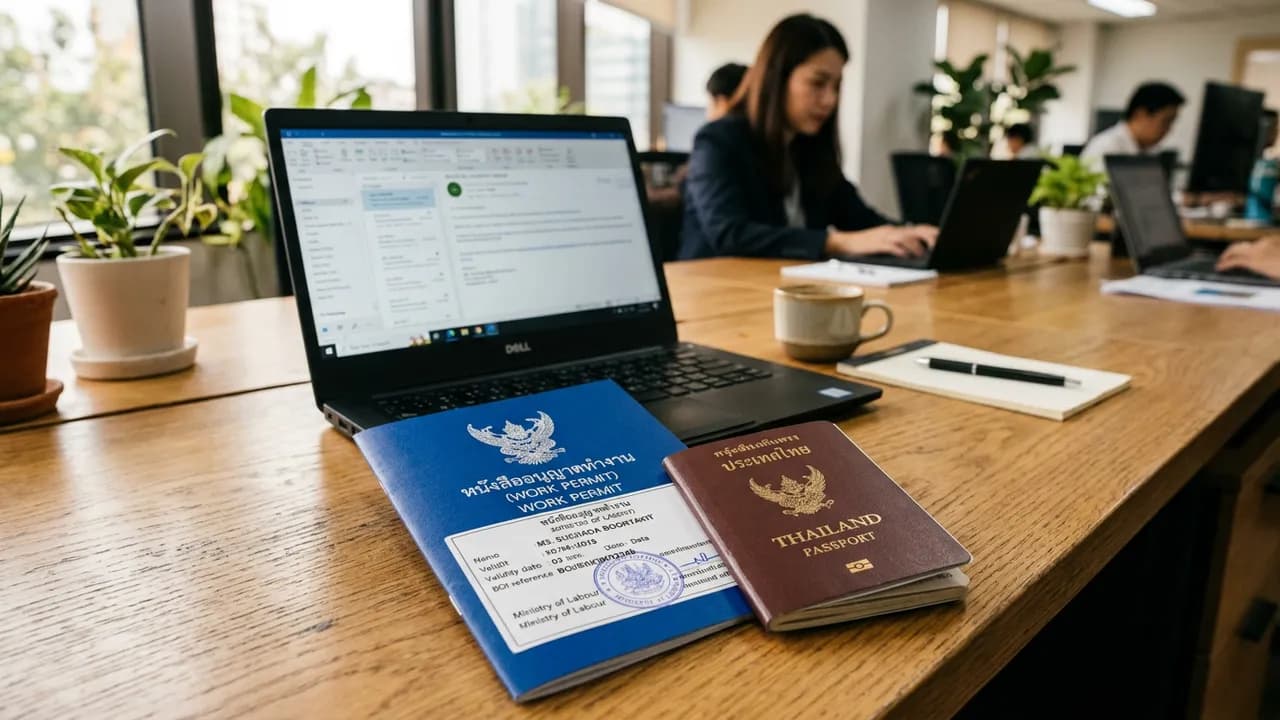
You will receive the standard blue work permit booklet. It will list your school as employer, your position as "teacher" or "foreign language teacher," and the school's address as your workplace.
Step 7: Apply for TCT License
If you have not already begun this process, your school will submit your TCT teaching license application to the Teachers Council of Thailand. This runs in parallel with your work permit and does not need to be completed before you start teaching (the temporary permission allows you to teach while the application is processed).
Step 8: Extend Your Visa to One Year
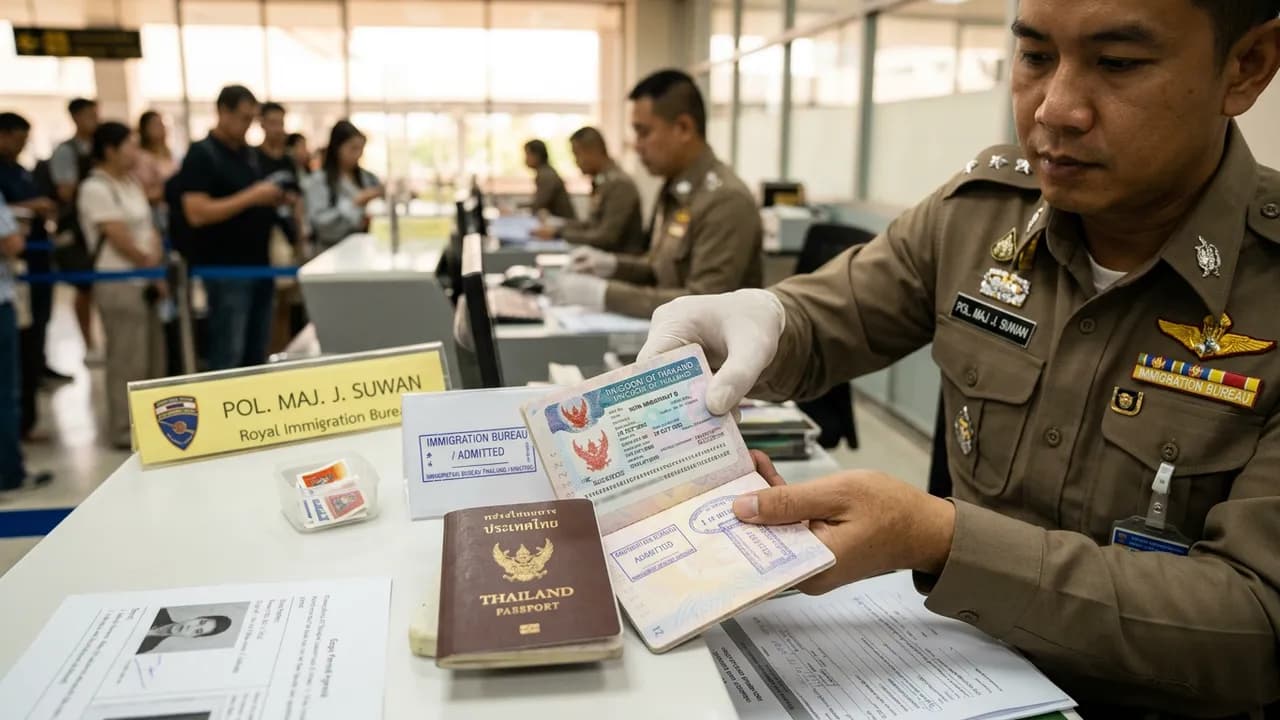
With your work permit in hand, visit the Immigration Bureau to extend your Non-Immigrant B visa to a full one-year stay. Required documents include:
- Passport
- Work permit
- TM.7 application form
- Photographs
- School letter confirming employment
- Employment contract
- Fee: 1,900 THB
Salary and Tax Considerations
Minimum Salary Thresholds for Teachers
The minimum salary for a teaching work permit depends on nationality:
| Nationality Group | Minimum Monthly Salary |
|---|---|
| North American, European, Australian, NZ, Japanese | 50,000 THB |
| South Korean, Taiwanese, Singaporean | 50,000 THB |
| Filipino, Indian, other Asian | 35,000 THB |
| African, South American | 25,000 THB |
Reality check: Many government schools pay 30,000-35,000 THB per month, which is below the official 50,000 THB threshold for Western teachers. In practice, the Department of Employment often grants work permits at these lower salaries for government school positions, but this is not guaranteed and depends on the province. Private schools and language centers sometimes pad the official salary figure to meet the threshold.
Income Tax
All teachers with work permits must file Thai personal income tax returns. Thailand uses a progressive tax system:
| Annual Taxable Income (THB) | Tax Rate |
|---|---|
| 0 - 150,000 | 0% |
| 150,001 - 300,000 | 5% |
| 300,001 - 500,000 | 10% |
| 500,001 - 750,000 | 15% |
| 750,001 - 1,000,000 | 20% |
| 1,000,001 - 2,000,000 | 25% |
| 2,000,001 - 5,000,000 | 30% |
| Over 5,000,000 | 35% |
Your school should withhold income tax from your monthly salary. You file an annual tax return (PND 91) by March 31 of the following year. Keeping your tax receipts is essential for work permit renewal.
Common Problems and How to Avoid Them
Problem: School Delays the Work Permit Application
Some schools, particularly smaller government schools, are slow to process work permit paperwork. This can leave you working illegally for weeks or months.
Solution: Discuss the timeline explicitly before signing your contract. Get a written commitment on when the work permit process will begin. If the school has a history of delays, consider other options.
Problem: Degree Authentication Takes Too Long
The apostille and embassy authentication process can take months if you start it after arriving in Thailand.
Solution: Complete all document authentication before leaving your home country. Budget 4-6 weeks for the full process.
Problem: Criminal Background Check Expires
Most Thai embassies require background checks issued within the past 6 months. If your hiring process takes longer, your check may expire.
Solution: Time your background check request carefully. Some countries offer expedited processing for an additional fee.
Problem: Mid-Year Job Changes
Switching schools mid-year means canceling your current work permit and starting the process over. There may be a gap period where you are technically not authorized to work.
Solution: Coordinate with both the departing and incoming schools. Ideally, the transition happens during school breaks. Some teachers exit Thailand briefly and re-enter on a new visa to reset the process.
Problem: Working at Multiple Locations
Your work permit specifies one employer and one workplace. Teaching at a second school, tutoring privately, or working at a language center on weekends is technically illegal without an additional work permit or an amendment to your existing one.
Solution: If you want to work at additional locations, your primary school can apply for a workplace addition to your work permit. This is uncommon but possible.
90-Day Reporting and Other Obligations
While holding a teaching work permit, you must:
- Report your address every 90 days to Immigration (online, by mail, or in person)
- Carry your work permit at all times (or a certified copy)
- Notify the Department of Employment if you change address, school, or position
- File annual tax returns by March 31
- Renew your TCT license before it expires
- Renew your work permit and visa before they expire (apply 30 days in advance)
Teaching in Thailand Without Proper Documents
A reality of the teaching industry in Thailand is that some teachers work without proper documentation — teaching on tourist visas, doing "visa runs" to maintain their stay, and hoping they will not be caught. This is risky and not recommended for several reasons:
- Fines up to 100,000 THB and potential imprisonment for working without a permit
- Deportation and re-entry ban (typically 1-5 years depending on the violation)
- No legal protections — If your school does not pay you, you have no legal recourse
- No access to social security or health insurance through your employer
- Periodic crackdowns — Thai authorities conduct random inspections of schools
The legal process is manageable with a cooperative school. If a school is unwilling to support your work permit, that is a red flag about the institution itself.
Tips for Success
- Research your school thoroughly — Talk to current and former teachers about their experience with work permit support
- Prepare documents before arriving — Authentication, apostille, and background checks take time
- Budget for the gap — You may teach for 2-4 weeks before your first paycheck arrives and additional weeks before your work permit is processed
- Build relationships with Thai staff — The administrative staff handling your paperwork are your most important allies
- Learn basic Thai — Even minimal Thai language skills improve your daily life and show respect for the culture
- Join teaching communities — Facebook groups and forums like Ajarn.com provide current, practical advice from teachers on the ground
- Keep every document — Photocopies of everything, organized by type and date. You will need them for renewals.
Frequently Asked Questions
Can I teach English in Thailand without a degree?
Legally, a bachelor's degree is required for a work permit. Some language centers hire teachers without degrees, but they typically cannot provide legal work permits. This puts you at legal risk.
Is TEFL certification mandatory?
It is not legally required by the Department of Employment, but it is required by the Teachers Council of Thailand for the temporary teaching license. In practice, nearly all schools require it, and it is needed for TCT registration.
Can I teach subjects other than English?
Yes. International schools and bilingual programs hire teachers for math, science, social studies, and other subjects. The work permit process is the same, but you typically need qualifications specific to the subject.
What if my degree is not from an English-speaking country?
Your degree documents will need certified English translations in addition to authentication. The process is the same, but allow extra time for translation and verification.
Can I teach online from Thailand?
Teaching online for a foreign company while physically in Thailand is technically work and requires a work permit. See our Digital Nomad Guide for information on the DTV visa and other options for remote workers.
Conclusion
Teaching in Thailand offers a rewarding experience, but working legally requires patience and preparation. Start the document authentication process months in advance, choose a school that actively supports the work permit process, and maintain all your paperwork meticulously. The bureaucratic effort is front-loaded — once your work permit and visa are established, annual renewals are relatively straightforward. The investment in doing things properly gives you legal protection, peace of mind, and the ability to focus on what you came to do: teach.