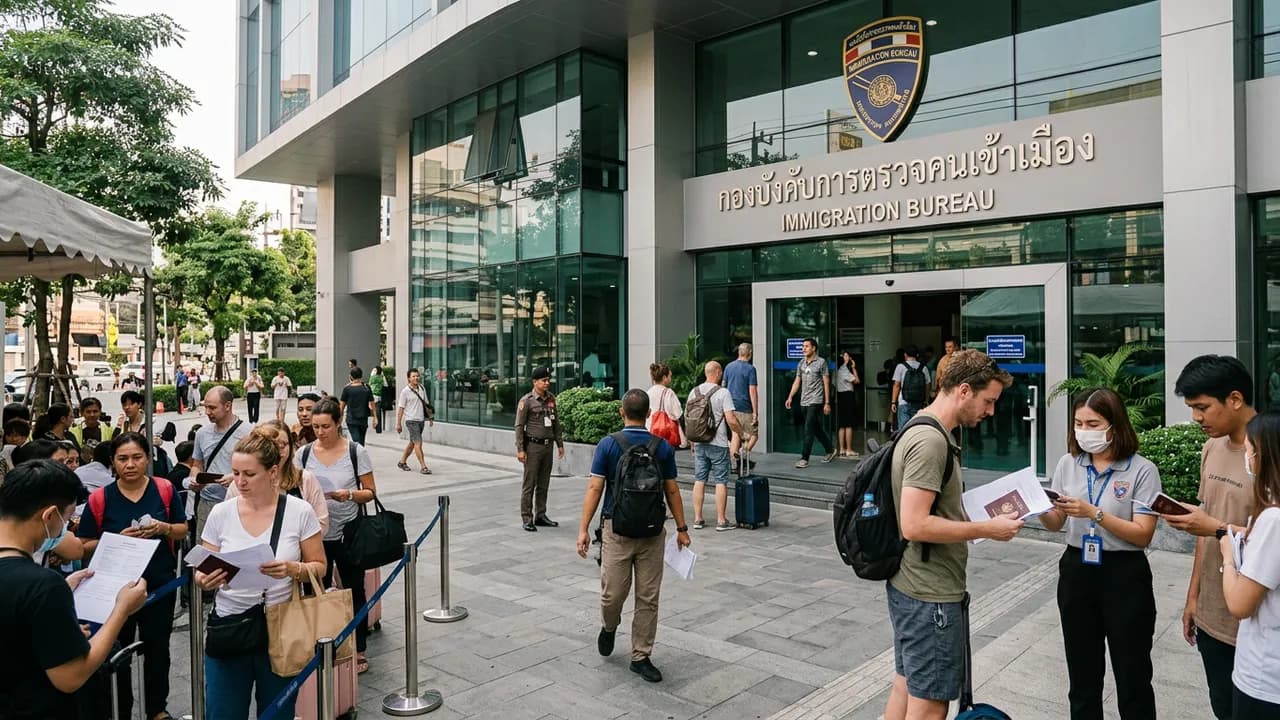
Thai police inspected 243 target companies and raided 32 suspected nominee firms on Koh Phangan between May 12 and May 14, 2026, seizing 37 land title deeds covering 51 rai and 2 ngan worth approximately 150 million THB. The operation, led by Deputy National Police Chief Pol. Gen. Samran Nualma and personally attended by Prime Minister Anutin Charnvirakul, found that nearly 68% of registered firms on Koh Phangan and Koh Samui involve foreign shareholders. This article documents what happened, what nominee structures are, why Thai law forbids them, and what foreign business owners should do now.
TL;DR — the raid in numbers
- Dates: May 12 – May 14, 2026
- Operation lead: Deputy National Police Chief Pol. Gen. Samran Nualma
- PM site visit: May 13, 2026 — Anutin Charnvirakul, also serving as Interior Minister
- Companies inspected: 243
- Firms with confirmed nominee characteristics: 32 (some reports list 34)
- Title deeds seized: 37
- Land area seized: 51 rai, 2 ngan
- Total value seized: ~150 million THB
- Total registered legal entities on Koh Phangan: 4,761
- Of those involving foreign investment: 3,213 (67.5%)
- Largest foreign investor group: Israeli nationals (followed by French, British)
- Arrest warrants issued: 3 (2 Thai suspects arrested, 1 foreign suspect at large)
- Most extreme finding: one individual linked to 80–90 company shareholdings
All figures from Nation Thailand (May 14, 2026), The Pattaya News (May 14, 2026), and Thai Enquirer (May 2026).
What happened — day-by-day timeline
The Koh Phangan operation was a three-day coordinated raid involving police, immigration, and land department officials. The chronology, verified across Bangkok Post, Nation Thailand, Khaosod English, and Pattaya News:
| Date | Event |
|---|---|
| 2026-05-12 | Operation launched; raids on luxury villa complexes in Moo 7, Ban Chalok Lam subdistrict |
| 2026-05-13 | PM Anutin Charnvirakul visits Koh Phangan; orders nationwide probe of nominee structures, per Khaosod English |
| 2026-05-13 | Raid on law office suspected of facilitating property transactions for foreign groups |
| 2026-05-14 | Final figures published: 32 firms raided, 150M THB seized |
| 2026-05-19 | Cabinet cites nominee findings as part of rationale for 30-day visa exemption rollback |
| 2026-05-20 | Anutin orders probe into Thai officials who registered the nominee firms, per Bangkok Post |
| 2026-08-31 | Visa exemption rollback published in the Royal Gazette |
| 2026-09-15 | 30-day visa exemption in force, per the TAT Newsroom |
Why Koh Phangan and Koh Samui specifically
The Thai government targeted Koh Phangan first because foreign ownership patterns there were the most extreme in the country. Thai Enquirer's probe data is the most cited figure:
- Koh Phangan total registered firms: 4,761
- With foreign investment: 3,213 (67.5%)
- Koh Samui shows similar density
The combined Koh Phangan + Koh Samui pattern shows roughly two-thirds of registered firms involving foreign shareholders. By comparison, the Bangkok average is in the low single digits and Phuket sits around 25–30%. The islands' tourism economy plus their property market made them the highest-concentration nominee zones in Thailand.
The villa complex at the centre of the raids
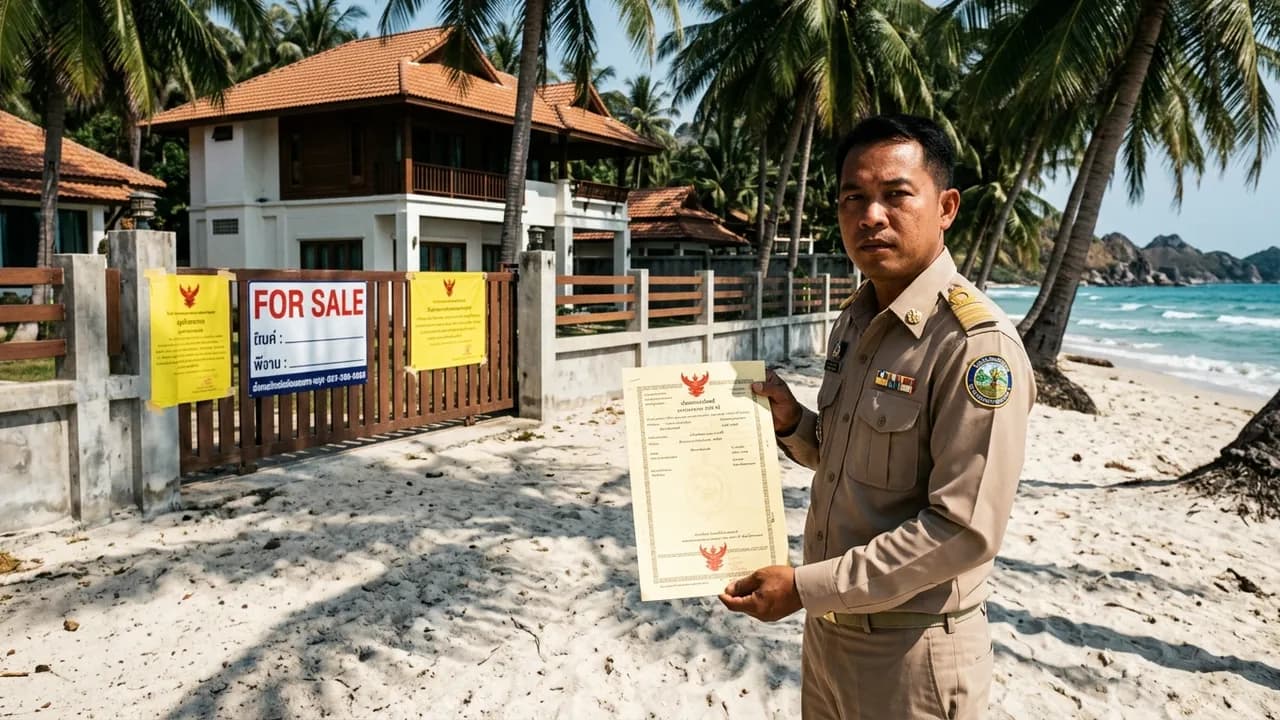
Six luxury beachfront pool villas in Moo 7, Ban Chalok Lam, Surat Thani Province were the primary target of the May 12 raid. Per Pattaya News (May 14, 2026):
- The land sat on a three-rai plot leased for 47 million THB over 30 years
- Villas rented at 30,000 THB per night, three-night minimum
- The plot was held by a Thai nominee shareholder structure linked to Israeli nationals
- The same individual was linked to 80–90 other company shareholdings — far beyond any plausible legitimate business interest
What "nominee company" actually means in Thai law
A nominee structure uses Thai citizens as paper shareholders to satisfy Thai majority-ownership requirements while the real economic control sits with a foreign owner. Two pieces of Thai law forbid this.
The Foreign Business Act, B.E. 2542 (1999)
The Foreign Business Act restricts foreign majority ownership in scheduled business categories — including most tourism, hospitality, retail, and real-estate-related activities. A company is considered "Thai" only if Thai nationals hold more than 50% of voting shares.
A nominee structure says on paper that Thai shareholders own 51%+, but in practice:
- The Thai shareholders contributed little or no capital
- The foreign owner holds preferred shares with disproportionate voting rights
- Loan agreements, side letters, or option agreements give the foreigner real control
- Dividends and capital gains flow to the foreigner
The Foreign Business Act Section 36 criminalises this. Penalties include up to 3 years imprisonment, fines up to 1 million THB, and daily fines until the structure is unwound.
The Land Code Act, B.E. 2497 (1954)
The Land Code prohibits foreign land ownership in Thailand except in narrow categories (condominium freehold up to 49% foreign quota, BOI promotion, certain investment thresholds). A foreign person who uses a Thai nominee to hold land violates the Land Code.
Penalties under the Land Code include forced sale of the land within a period set by the Minister of Interior, plus criminal liability for the Thai nominee (assisting a foreigner to acquire land in breach of the Code).
Why the structures persist anyway
Despite the legal prohibitions, nominee structures have been used for decades because:
- Enforcement was historically light. Most prosecutions stalled at the documentation stage
- Thai law firms openly facilitated the setup. The May 13 raid on a Koh Phangan law office signals this is now changing — see Pattaya Mail's analysis
- The political cost of action was high in tourist-heavy provinces where foreign capital drives local economies
- No central registry flagged the 80–90-shareholding individual until the 2026 probe pulled the data together
Implications for foreign business owners
If you own or part-own a Thai company on a nominee basis — anywhere in Thailand, not just Koh Phangan — assume you are now in scope. The Cabinet rollback of the 60-day visa exemption was explicitly tied to the nominee findings, signalling this is a multi-year enforcement priority rather than a one-week PR campaign.
Who is most at risk
- Foreign owners holding villas, guesthouses, or land via a Thai-majority company they capitalised entirely
- Structures with "ghost" Thai shareholders who do not appear at meetings, do not contribute capital, and do not receive proportionate dividends
- Companies where one individual appears as a Thai shareholder across many unrelated foreign-owned ventures
- Law firms that registered batch nominee structures with template documents
Who is generally safe
- BOI-promoted companies with genuine Thai operating partners
- Companies operating outside Foreign Business Act scheduled categories (most manufacturing, B2B services)
- LTR visa holders who structured investments under the BOI's investment categories
- Foreigners holding condominium units within the 49% foreign quota — this is legal and unaffected
- Foreigners leasing land directly (with proper 30-year lease registration) rather than holding via a nominee company
What to do this month
- Review your shareholder cap table. If your Thai shareholders contributed no capital and receive no proportionate dividends, you have nominee exposure.
- Get a Thai corporate lawyer to do a structure audit. Not the lawyer who set the structure up — an independent one. Cost: typically 30,000–80,000 THB for a full review.
- Consider BOI promotion if eligible. BOI-promoted companies can hold majority foreign ownership legally and acquire land for the promoted business.
- Consider the LTR visa investment route if your activity qualifies — see LTR visa expansion 2026.
- If you employ foreigners in your company on tourist entries — see Thailand work permit guide. The visa-free rollback and the nominee crackdown are the same enforcement wave.
What recovery options exist
For owners already inside a nominee structure, three paths exist: unwind, restructure to BOI, or exit. Each has tradeoffs.
Unwind — convert to legal lease structure
- The foreigner gives up corporate ownership of the land
- A legal 30-year lease is registered with the Land Department (renewable up to 90 years total under certain structures)
- The Thai shareholder exits or stays only as a true minority
- Tradeoff: loses corporate flexibility; lease is not freehold
Restructure — BOI promotion
- Apply for BOI promotion if the underlying business qualifies (tourism, certain hospitality categories, manufacturing, technology, etc.)
- BOI-promoted companies can hold majority foreign ownership and acquire land needed for the promoted business
- Tradeoff: application process is detailed and the business must genuinely qualify
Exit — sell to a Thai owner
- Sell the asset to a Thai buyer or a legitimate BOI-structured buyer
- Realise capital, exit the structure cleanly
- Tradeoff: Thai buyer market for nominee-held assets is now soft because of the enforcement wave
The recovery path you choose depends on whether the underlying business is genuinely valuable, whether BOI categories fit, and your time horizon in Thailand. None of these are DIY decisions — get a Thai corporate lawyer before acting.
How this connects to the visa rollback
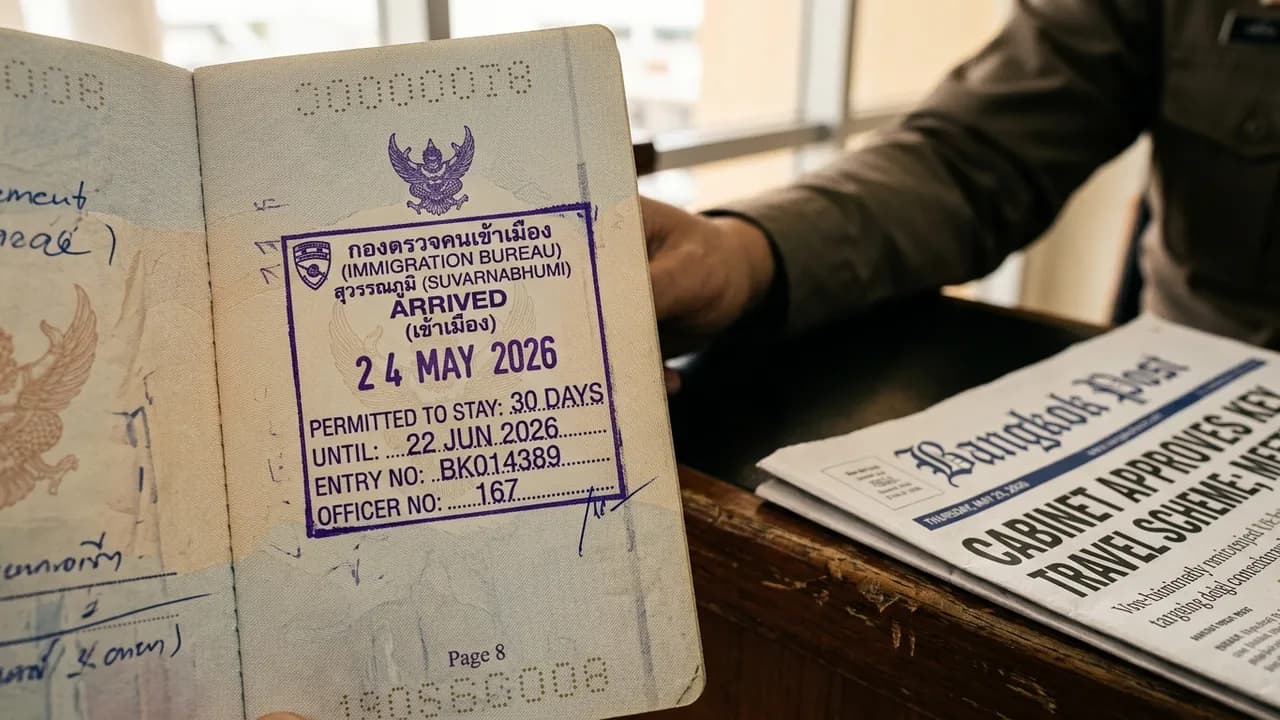
The same Cabinet meeting that ordered the Koh Phangan probe rolled back the 60-day visa exemption six days later. This is not coincidence. The Cabinet's reasoning, as quoted in Al Jazeera (May 19, 2026), was that the longer visa-free window was enabling foreigners to "establish illegal businesses, work without permits, and conduct transnational crime" — language that maps directly to the Koh Phangan findings.
The visa rollback was published in the Royal Gazette on 31 August 2026 and has been in force since 15 September 2026: 30 days visa-free for 60 countries and territories, for tourism only, per the Tourism Authority of Thailand.
The two policies form a single enforcement strategy:
- Reduce visa-free entry time so long-stay operators cannot run a business under tourist entry
- Audit existing structures to find and unwind nominees already established
Foreign owners should not treat the Koh Phangan raids as a local event. The Anutin government has explicitly framed it as a national-scope enforcement program. Expect similar operations on Phuket, Pattaya, Hua Hin, and Chiang Mai in the second half of 2026.
Frequently asked questions
Was my villa purchase via a Thai company a nominee structure?
If your Thai shareholders contributed no real capital, hold preferred shares with limited voting rights, do not appear at meetings, and do not receive proportionate dividends — yes. Get an independent Thai corporate lawyer to confirm.
What happens to assets seized in nominee raids?
The Land Department initiates a forced sale process. The proceeds, minus legal costs and any criminal fines, are returned to the registered Thai shareholder — not to the foreigner who provided the capital. This is the financial bite of the nominee enforcement.
Can foreigners legally own anything in Thailand?
Yes. Condominium freehold (within the 49% foreign quota per building), registered 30-year land leases, BOI-promoted company assets, and assets held via certain LTR/Elite structures are all legal. The nominee structure is one specific illegal pattern — not a blanket ban.
Are the Koh Phangan raids targeting any specific nationality?
Not formally. Israeli, French, and British nationals were named in the Koh Phangan villa case because they were the registered ultimate beneficiaries. The enforcement criteria is the structure, not the passport.
Will visa-free travelers be affected by this?
Indirectly. The visa rollback approved on May 19 is partly a response to the nominee findings. Since 15 September 2026, the visa exemption is 30 days and covers tourism only; business or work activity is not permitted under it. Tourists arriving for actual tourism are not the target — but anyone using tourist entry to run an unregistered business should expect immigration scrutiny.
Sources
- Nation Thailand, "Money trail exposed — Koh Phangan nominee crackdown widens" (May 14, 2026)
- Nation Thailand, "Police raid Koh Phangan villas, law office in foreign nominee crackdown" (May 13, 2026)
- The Pattaya News, "Police Raid 32 Suspected Nominee Firms Holding Land Worth 150 Million Baht on Koh Phangan" (May 14, 2026)
- Khaosod English, "Thai PM orders probe into Koh Phangan nominee firms" (May 13, 2026)
- Thai Enquirer, "Thai nominee business probe finds nearly 68% of firms on Koh Phangan, Koh Samui have foreign shareholders" (May 2026)
- Pattaya Mail, "The Koh Phangan precedent: Dismantling the business of legal subterfuge" (May 2026)
- Bangkok Post, "Anutin orders probe into officials over foreign nominee firms and land encroachment" (May 20, 2026)
- Al Jazeera, "Thailand to slash tourist visa-free stays" (May 19, 2026)
- Tourism Authority of Thailand, TAT Newsroom, "Thailand introduces new 30-day and 15-day visa exemption rules from 15 September" (September 2026)