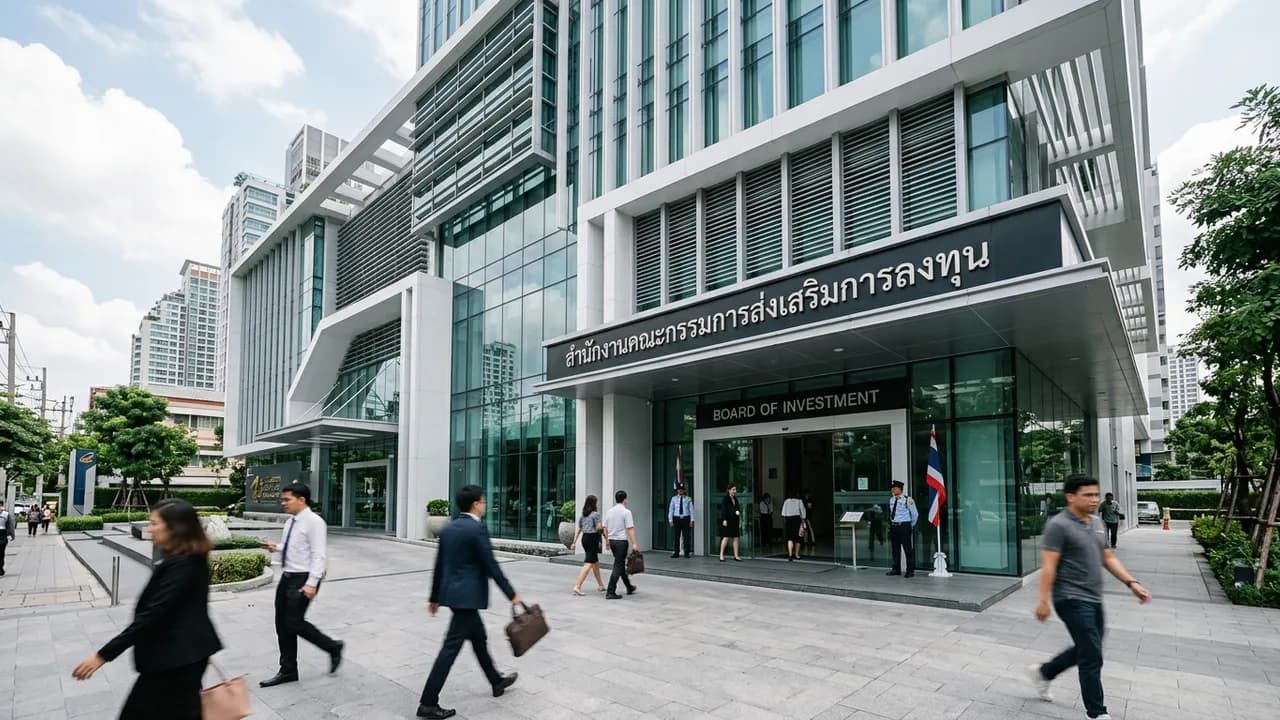
The Thailand LTR (Long-Term Resident) visa is a 10-year visa, issued as a 5+5 stamp, administered by the Board of Investment (BOI) and launched in September 2022. The government fee is 50,000 THB for the full 10 years — not per year, not per stamp. You qualify under one of four categories, broadly needing USD 80,000/year in income or USD 1,000,000 in assets (track-dependent), and in January 2025 the criteria were relaxed, which widened who can realistically get in.
If you clear the financial bar, this is the cheapest long-stay visa in Thailand per year of validity, and it comes with a digital work permit, annual reporting instead of 90-day reporting, and airport fast-track. This guide covers the categories, the real requirements, the benefits, the costs, and whether you should apply yourself or have someone handle it.
Immigration rules change — verify current requirements against the official BOI portal before you apply, and treat any third-party figure as secondary to the government source.
Thailand LTR Visa at a Glance
| Item | Detail |
|---|---|
| Validity | 10 years (issued 5 + 5) |
| Administered by | Board of Investment (BOI), via the One Stop Service Center |
| Government fee | 50,000 THB (covers the full 10 years) |
| Categories | 4 (Wealthy Global Citizen, Wealthy Pensioner, Work-from-Thailand Professional, Highly-Skilled Professional) |
| Core financial test | ~USD 80,000/yr income OR USD 1,000,000 in assets (track-dependent) |
| Reporting | Once a year (no 90-day reporting) |
| Work permit | Digital work permit included |
| Dependents | Up to 4 (spouse + children) |
| Launched | September 2022; criteria relaxed January 2025 |
What Is the Thailand LTR Visa?
The LTR visa is a renewable 10-year visa granting the holder the right to live and, in most cases, work in Thailand with minimal bureaucracy. It is run by the BOI rather than through standard immigration channels, which is why the process and the perks differ from a typical Non-Immigrant O-A or retirement extension.
The headline points:
- 10-year validity, stamped as 5 years then renewed for another 5
- One government fee of 50,000 THB covering the decade
- Digital work permit for the holder (and qualifying dependents)
- Annual reporting instead of 90-day reporting
- Multi-entry built in — no separate re-entry permit
- Airport fast-track at major international airports
- A 17% flat personal income tax rate for the Highly-Skilled category
The 4 LTR Visa Categories
You must qualify under exactly one of four categories. The financial test is track-dependent, so the right column below is the realistic baseline, not a universal number. For the full, line-by-line breakdown of thresholds, see our dedicated LTR visa cost and requirements page.
| Category | Who it targets | Core requirement | Tax benefit |
|---|---|---|---|
| Wealthy Global Citizen | High-net-worth individuals | USD 1M in assets + USD 80K/yr income + investment | Exemption on qualifying foreign income |
| Wealthy Pensioner | Retirees aged 50+ | USD 80K/yr passive income, or USD 40K/yr + investment | Exemption on qualifying foreign income |
| Work-from-Thailand Professional | Remote workers/employees | USD 80K/yr (lower with extra criteria) | Exemption on qualifying foreign income |
| Highly-Skilled Professional | Specialists working in Thailand | USD 80K/yr (lower in target industries) | 17% flat tax on Thai income |
1. Wealthy Global Citizen
For high-net-worth individuals regardless of age. The defining feature is an asset test rather than only an income test.
- Personal assets of at least USD 1 million
- Annual personal income of at least USD 80,000 over the past two years
- Investment of at least USD 500,000 in Thai government bonds, foreign direct investment, or Thai property
2. Wealthy Pensioner
For retirees aged 50 and over with stable passive income. If you fall short of these numbers, the standard retirement visa extension or a Non-Immigrant O route is usually the better fit.
- Age 50 or older at application
- Annual pension or passive income of at least USD 80,000, or USD 40,000+ combined with an investment of USD 250,000 in Thai bonds, FDI, or property
- Health insurance covering the stay (or a deposit alternative)
3. Work-from-Thailand Professional
Aimed at remote employees and contractors working for companies based outside Thailand. The January 2025 relaxation softened some of the supporting criteria, but the employer and experience tests still rule out most freelancers.
- Annual personal income of at least USD 80,000 over the past two years (lower thresholds apply with a master's degree, intellectual property, or Series A funding)
- Employed by or contracted to a foreign-established company for at least one year
- At least five years of relevant experience in the past ten
- Employer revenue benchmark (historically USD 150 million over three years, reportedly eased for some applicants since 2025)
4. Highly-Skilled Professional
For specialists employed by companies operating inside Thailand in BOI-targeted industries. This is the only category with the 17% flat tax on Thai-sourced income.
- Annual personal income of at least USD 80,000 (lower, down toward USD 40,000, in targeted fields or government/academic roles)
- Employment or service agreement with a qualifying Thai entity
- At least five years of relevant experience (waived for some government and academic positions)
Targeted industries include automotive, electronics, digital technology, biotechnology, medical and wellness, food processing, aviation, and robotics, among the BOI's promoted activities.
The January 2025 Relaxation: What Changed
In January 2025 the BOI loosened several LTR criteria to widen the pool. The practical effects, as widely reported:
- Lower or removed minimum thresholds on some supporting conditions
- More flexibility on the employer revenue benchmark for the Work-from-Thailand track
- Easier dependent allowances (commonly up to four dependents, no longer strictly limited to spouse and minor children)
- Streamlined evidence requirements for several categories
This is why the LTR went from "almost nobody qualifies" to a genuine option for senior remote professionals and well-funded retirees. The exact thresholds still shift, so confirm against the BOI portal before committing — and keep our cost and requirements spoke open as your working reference.
Benefits of the LTR Visa
Immigration benefits
- 10-year stay with no annual renewal grind
- Annual reporting instead of every 90 days
- Multi-entry included, so no separate re-entry permit
- Airport fast-track at major international airports
- Digital work permit for the holder (Highly-Skilled and Work-from-Thailand tracks)
- Up to four dependents on linked LTR visas
Tax benefits
- Highly-Skilled Professionals: a flat 17% personal income tax rate on Thai-sourced income, against the standard progressive scale up to 35%
- Other categories: exemption on qualifying foreign-sourced income under the LTR framework
Thai tax residency and remittance rules have shifted since 2024, so read the LTR tax perks alongside our Thailand tax guide for expats and confirm your position with a tax adviser before relying on a specific outcome.
How to Apply for the LTR Visa
Step 1 — Pre-qualification check
Confirm which single category you fit, then assemble income proof, bank statements, employment contracts, and asset evidence. The BOI is strict on documentation, and applying under the wrong track is the most common reason for delay.
Step 2 — Online application via BOI
Submit through the BOI LTR portal: create an account, complete the form, and upload supporting documents.
Step 3 — BOI qualification review
The BOI reviews your application. Endorsement typically takes around 20 business days, longer in busy periods.
Step 4 — Endorsement and issuance
If approved, you receive a qualification endorsement and a window to obtain the visa. You then pay the 50,000 THB government fee and collect the visa either at a Royal Thai Embassy abroad or at the One Stop Service Center in Bangkok if you are already in Thailand.
Step 5 — Digital work permit
After issuance, eligible holders apply for the digital work permit, which is issued electronically and linked to the passport.
Costs
The LTR's value is the flat fee against the validity. One number, ten years.
| Item | Cost |
|---|---|
| BOI qualification review | No separate visa fee at this stage |
| Government visa fee | 50,000 THB for the full 10 years |
| Total government cost (10 years) | 50,000 THB (~USD 1,400) |
That works out to about 5,000 THB per year of validity, which no other long-stay route matches. Compare it across options on our Thailand visa costs 2026 breakdown.
Applying With Help vs Doing It Yourself
You can absolutely apply for the LTR yourself. The BOI portal is free to use, the government fee is fixed at 50,000 THB, and a well-organised applicant with clean paperwork can get through it unaided. Most agencies will not tell you that, because their margin depends on you not knowing it.
Where help earns its keep is the qualification stage. The LTR is a BOI assessment, not a tick-box stamp: documents must map exactly to one category, financials need certifying and translating, and a mismatch sends you back to the start. If your income sits near a threshold, your employer's revenue is hard to evidence, or you're stacking dependents, having someone structure the file correctly the first time saves weeks.
Here is how we frame it, plainly. The LTR is a high-ticket, BOI-administered visa, so we handle your application end to end — we are not the government and we are not an official authority; we'll walk you through the categories, prepare the file, and deal with the BOI's queries. The government fee stays 50,000 THB. On top of that you pay a flat service fee quoted up front — no markup on the government fee, no mid-process upsell. Every other agent hides their fees and pads the bill; we publish every price and we'll tell you when you don't need us at all.
If you want a fast read on whether the LTR is even your best route, run the visa finder first, then look at what handling it costs on our services page.
LTR Visa vs Thailand Privilege Card
The two premium long-stay routes solve different problems. The LTR is a qualification-based residency with work rights and tax perks; the Thailand Privilege Card (formerly Thailand Elite) is a paid membership with no income test. Full side-by-side: Elite visa vs LTR visa.
| Feature | LTR Visa | Thailand Privilege Card |
|---|---|---|
| Validity | 10 years (5+5) | 5–20 years by tier |
| Cost | 50,000 THB government fee | 650,000–5,000,000 THB membership |
| Work permit | Yes (digital, most tracks) | No |
| Tax benefit | Yes (17% flat or foreign-income exemption) | None specific |
| Income/asset test | Yes (~USD 80K/yr or USD 1M assets) | None — qualify by paying |
| Annual reporting | Yes (no 90-day) | Privilege handles immigration formalities |
| Path to PR/citizenship | No | No |
Neither is a path to permanent residency or citizenship. If qualifying on income is impossible but budget isn't, the Privilege Card's no-test entry is the trade-off — and note its Bronze tier is scheduled to be withdrawn on 30 September 2026.
Common Mistakes to Avoid
- Treating the fee as per-year. It is 50,000 THB for the entire 10 years. Ignore anyone quoting 50,000 per stamp.
- Applying under the wrong category. The Work-from-Thailand employer and experience tests exclude most freelancers; don't assume the relaxation removed them.
- Weak documentation. The BOI wants certified, English-translated financials. Vague evidence stalls the review.
- Skipping annual reporting. It's yearly, not quarterly, but missing it still draws a fine.
- Assuming the second 5 years is automatic. You must still meet the requirements to renew into the second stamp.
Frequently Asked Questions
How much does the Thailand LTR visa cost?
The government fee is 50,000 THB and it covers the full 10 years — there is no separate 50,000 charge for the second 5-year stamp. If you use a service, that government fee is unchanged and any service fee should be quoted up front with no markup. See LTR visa cost and requirements for the full breakdown.
What is the income requirement for the LTR visa?
The core test is broadly USD 80,000/year in income or USD 1,000,000 in assets, but it is track-dependent. Wealthy Pensioners can qualify on USD 80,000/year passive income, or USD 40,000/year plus a USD 250,000 investment. Several thresholds were relaxed in January 2025, so confirm the current numbers on the BOI portal.
Can freelancers get the Work-from-Thailand LTR?
Usually not. The category requires an ongoing relationship with a foreign-established company plus five years of experience, and historically an employer revenue benchmark. Independent freelancers without a qualifying corporate contract typically can't meet it — the DTV is the more realistic remote-work route for them.
Can I buy property with an LTR visa?
The LTR doesn't grant land ownership. Foreigners can still buy condominium units within the standard foreign-quota rules. We cover the detail and the common myths on our LTR visa and property page.
Do I have to live in Thailand full-time on the LTR?
No. There is no minimum-stay requirement and the multi-entry permit is built in, so you can come and go freely across the 10 years. You only owe one annual report of your address.
Bottom Line
For anyone who clears the financial bar, the Thailand LTR visa is the best-value long-stay option in the country: one 50,000 THB government fee, ten years of validity, a digital work permit, annual reporting, and real tax advantages on the Highly-Skilled track. The January 2025 relaxation pulled more senior remote professionals and funded retirees into reach.
If your income or assets fall short, look at the Thailand Privilege Card (no income test) or the DTV. To check your fit in two minutes, use the visa finder; to see exactly what we charge to handle the LTR application end to end, with the government fee published and no upsell, see services.
Immigration rules change — verify current requirements with official sources (the BOI LTR portal and your nearest Royal Thai Embassy) before acting on anything here.