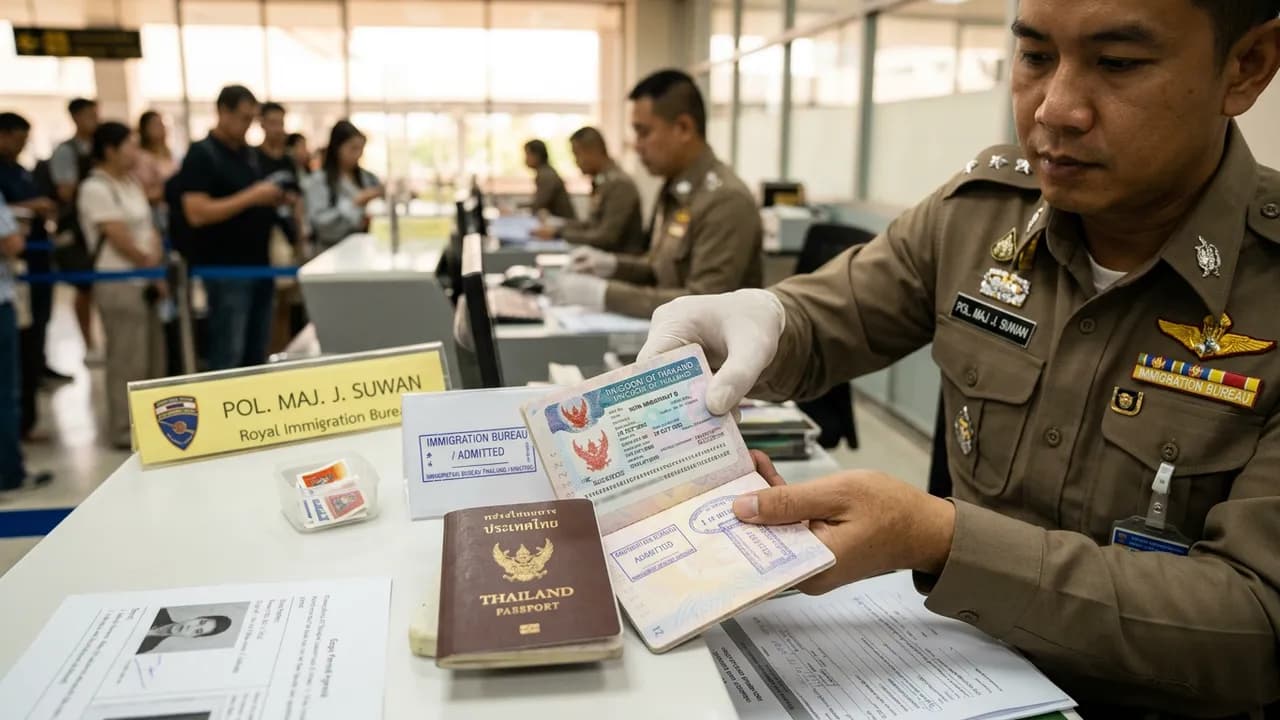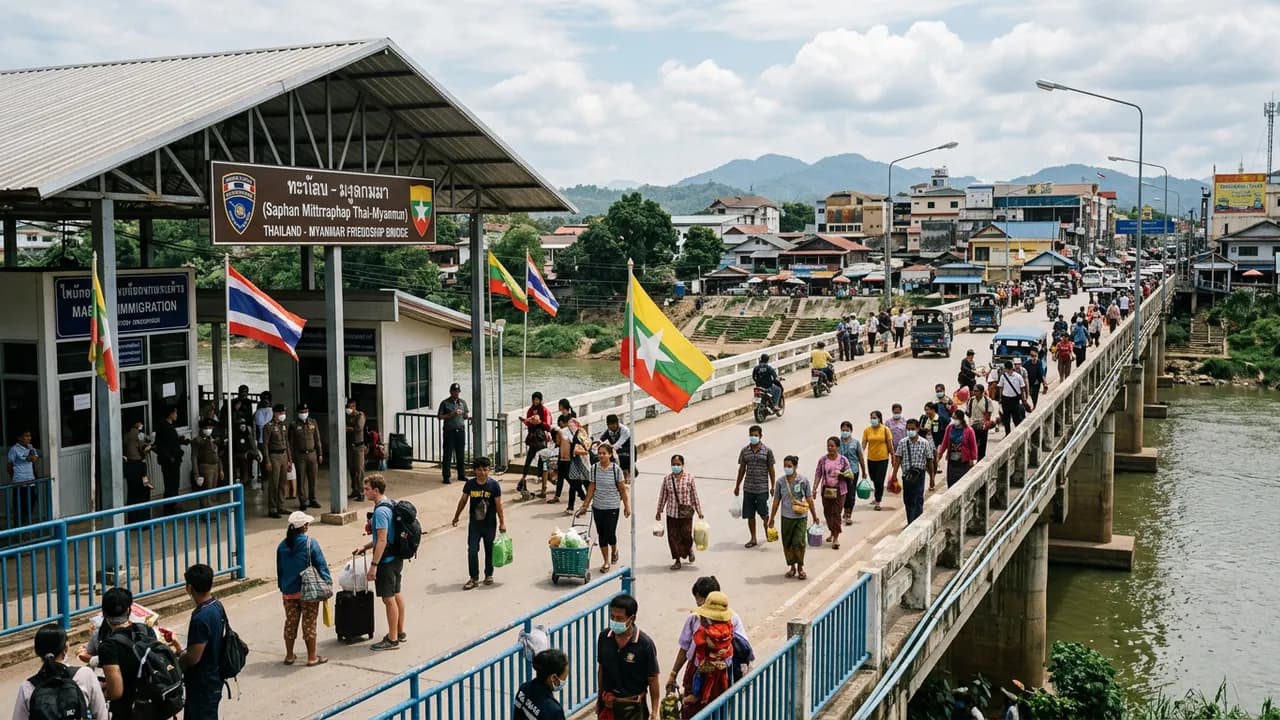
A Myanmar visa run via the Mae Sai–Tachileik border crossing in northern Thailand is one of the fastest and cheapest visa run options in the country. Located in Chiang Rai Province at Thailand's northernmost point, this crossing allows you to walk across a bridge into Myanmar's Tachileik township and return the same day with a fresh entry stamp. This guide covers everything you need to know about using this route for a visa run in 2026. For background on visa runs in general, see our what is a visa run overview.
Quick Facts
| Detail | Information |
|---|---|
| Thai border town | Mae Sai, Chiang Rai Province |
| Myanmar border town | Tachileik, Shan State |
| Border opening hours | 06:30–18:30 daily (Thai time) |
| Time needed | 1–3 hours for the border process |
| Myanmar entry fee | 500 THB or $10 USD (varies by period) |
| Thai re-entry stamp | 30 or 60 days (depends on nationality and current policy) |
| Distance from Chiang Rai city | 63 km (approximately 1.5 hours by road) |
| Distance from Chiang Mai | 270 km (approximately 5 hours by road) |
| Border status (2026) | Open for day-trip crossings; check current status before traveling |
How the Mae Sai–Tachileik Border Crossing Works
The process is straightforward and can be completed within a couple of hours on a quiet day. Here is the step-by-step procedure.
Step 1: Arrive at Mae Sai Border Checkpoint
The Thai immigration office is located at the end of Mae Sai's main road (Phahonyothin Road), near the Friendship Bridge that spans the Sai River. You will see clear signage directing you to the checkpoint building.
Step 2: Exit Thailand
Enter the Thai immigration building and proceed to the departure counters. Present your passport and any departure card (TM.6 if still required). The officer will stamp you out of Thailand. Your current permission to stay ends at this point.
Step 3: Cross the Friendship Bridge
Walk across the bridge over the Sai River. The walk takes about five minutes. Follow the pedestrian path and proceed to Myanmar immigration on the other side.
Step 4: Enter Myanmar at Tachileik
At Myanmar immigration, you have two options depending on current policy:
Day-trip entry (most common for visa runs):
- Present your passport
- Pay the entry fee (typically 500 THB or $10 USD)
- Your passport may be held at the checkpoint while you explore Tachileik, and you receive a temporary day pass
- Alternatively, in some periods, you receive a stamp directly in your passport
Longer stays:
- If you hold a Myanmar visa or e-visa, you can enter for a longer period
- This is not necessary for a standard visa run
Step 5: Spend Time in Myanmar
For a day-trip visa run, you do not need to spend long in Myanmar. Many people walk around the Tachileik market area for 30 minutes to an hour. There are shops, restaurants, and a duty-free zone near the border. You can also simply process through immigration and turn around.
Step 6: Exit Myanmar and Re-enter Thailand
Return across the bridge to Thai immigration. Present your passport at the arrival counter. The officer will stamp you into Thailand with a new permission-to-stay period.
What to Bring
Pack the following items for a smooth border crossing:
- Passport with at least 6 months validity and blank pages
- Cash — bring Thai baht (500 THB minimum for Myanmar entry fee, plus transport and food money)
- Passport photos — two 4x6cm photos (occasionally requested by Myanmar immigration; not always needed for day trips but good to carry)
- Copies of your passport information page (as a backup)
- Proof of accommodation in Thailand (hotel booking or address) — occasionally requested on re-entry
- Proof of funds — a bank statement or credit cards showing you have means to support yourself in Thailand
- Return ticket or onward travel documentation (rarely requested at this crossing but worth carrying)
- Pen — for filling out any forms at the border
Transport from Chiang Rai to Mae Sai
Public Bus (Green Bus)
The most popular budget option. Green buses run regularly from Chiang Rai Bus Terminal 1 (old bus station in the city center) to Mae Sai.
| Detail | Information |
|---|---|
| Departure point | Chiang Rai Bus Terminal 1 |
| Frequency | Every 15–30 minutes from approximately 06:00–18:00 |
| Travel time | 1.5–2 hours |
| Cost | 39–50 THB one way |
| Drop-off | Mae Sai bus station (about 1 km walk to the border) |
Minivan
Minivans operate from both Chiang Rai bus stations and are slightly faster than the bus.
| Detail | Information |
|---|---|
| Travel time | 1–1.5 hours |
| Cost | 50–80 THB one way |
| Advantage | Faster, more direct route |
Private Car or Taxi
You can hire a private car from Chiang Rai. This is the most convenient option if you are in a group.
| Detail | Information |
|---|---|
| Travel time | 1–1.5 hours |
| Cost | 800–1,500 THB one way (negotiable) |
| Advantage | Door-to-door, flexible timing |
Motorbike
If you have a rented motorbike in Chiang Rai, the ride to Mae Sai is scenic and straightforward along Route 1 (Phahonyothin Road). The road is in good condition with petrol stations along the way.
From Chiang Mai
If you are starting from Chiang Mai, take a bus or minivan to Chiang Rai first (approximately 3–3.5 hours, 150–300 THB), then transfer to a Mae Sai bus. Alternatively, the Green Bus operates a direct Chiang Mai–Mae Sai service.
Costs Breakdown
| Item | Cost (THB) |
|---|---|
| Chiang Rai to Mae Sai (bus, one way) | 39–50 |
| Chiang Rai to Mae Sai (minivan, one way) | 50–80 |
| Myanmar entry fee | 500 (or $10 USD) |
| Thai re-entry extension (if applicable at immigration) | 0 (the new stamp is free) |
| Food and drinks | 100–300 |
| Total estimated cost (from Chiang Rai, round trip) | 750–1,500 |
| Total estimated cost (from Chiang Mai, round trip) | 1,500–3,000 |
Timing Your Visa Run
Best Time to Arrive
Arrive at the border as early as possible, ideally by 07:00–08:00. The immigration offices are less crowded in the early morning, and you will have the entire day as a buffer in case of delays.
Busy Periods
Expect longer waits during:
- Thai public holidays (especially Songkran in April, New Year)
- Myanmar public holidays
- Weekends
- Any period following border reopenings after temporary closures
How Long Does It Take?
On a normal weekday with no complications:
- Thai exit: 10–20 minutes
- Walking across the bridge: 5 minutes
- Myanmar entry: 10–30 minutes
- Time spent in Tachileik: 15–60 minutes (your choice)
- Myanmar exit: 5–10 minutes
- Walking back: 5 minutes
- Thai re-entry: 10–30 minutes
- Total: 1–2.5 hours
On a busy day, the process can take 3–4 hours.
What to Do in Tachileik
While you do not need to spend long in Myanmar for a visa run, Tachileik has a few points of interest if you want to explore:
- Tachileik Market — A large market near the border selling clothes, electronics, gems, handicrafts, and local goods at bargain prices. Negotiate hard.
- Shwedagon Pagoda replica — A smaller version of Yangon's famous golden pagoda, located on a hilltop with views of both countries.
- Duty-free shops — Alcohol and cigarettes at duty-free prices.
- Local restaurants — Try Burmese and Shan cuisine. Tea leaf salad and mohinga are regional specialties.
Border Status and Recent Changes
The Mae Sai–Tachileik border has experienced periods of closure and restricted access over the years. Key points to be aware of:
COVID-Era Closures
The border was closed for an extended period during the COVID-19 pandemic (2020–2022) and reopened gradually with varying restrictions.
Myanmar Political Situation
Since the military coup in February 2021, the security situation in parts of Myanmar has been unstable. Tachileik, located in Shan State, has generally remained accessible for day-trip border crossings, but conditions can change. Conflict in other parts of Shan State occasionally affects border operations.
2025–2026 Status
As of early 2026, the Mae Sai–Tachileik crossing is open for day-trip crossings. However, this crossing has been subject to sudden temporary closures due to security concerns on the Myanmar side. Always verify the current border status before traveling. Reliable sources include:
- Thai immigration Facebook pages and announcements
- Chiang Rai immigration office (tel: 053-731008)
- Expat forums and community groups (ThaiVisa, Facebook groups for Chiang Rai/Chiang Mai expats)
- Your accommodation host in Chiang Rai or Mae Sai
Important Considerations
Officer Discretion on Re-entry
As with all Thai border crossings, the immigration officer has full discretion to grant or deny entry. If your passport shows a pattern of frequent back-to-back entries, the officer may:
- Ask questions about your purpose in Thailand
- Request proof of funds (20,000 THB equivalent for individuals)
- Ask for proof of accommodation and onward travel
- Grant a shorter stay than the standard period
- Deny entry entirely
Passport Validity
Ensure your passport has at least 6 months of validity remaining from your date of entry. Thai immigration will deny entry if your passport expires within 6 months.
Keep Your Departure Card
If you received a TM.6 departure card upon your previous entry to Thailand, bring it with you. You will need it when exiting Thailand.
Photography Restrictions
Do not photograph the immigration buildings, military installations, or uniformed personnel on either side of the border. This can cause serious problems, particularly on the Myanmar side.
Dress Appropriately
Dress neatly and conservatively for the border crossing. Avoid wearing overly casual clothing (singlets, beachwear). Officers respond better to travelers who appear respectable.
Comparison with Other Northern Thailand Visa Run Options
| Route | Distance from Chiang Mai | Time Needed | Cost | Stamp Received |
|---|---|---|---|---|
| Mae Sai–Tachileik (Myanmar) | 270 km | 1 day | 750–1,500 THB | 30–60 days |
| Chiang Khong–Huay Xai (Laos) | 280 km | 1 day | 1,000–2,000 THB | 30–60 days |
| Nong Khai–Vientiane (Laos) | 600 km | 2–3 days | 3,000–8,000 THB | 30–60 days + visa option |
| Fly to KL or Singapore | N/A (air) | 2–3 days | 3,000–10,000 THB | 60 days |
The Mae Sai route wins on speed and cost for anyone based in Northern Thailand. However, if you need to obtain a new Thai visa (not just a visa-exempt stamp), the Vientiane route is superior because of the Thai Embassy located there.
Frequently Asked Questions
Do I need a Myanmar visa for a day trip?
No. For day-trip border crossings at Mae Sai–Tachileik, you pay an entry fee (500 THB or $10 USD) and receive a day pass. A full Myanmar visa is not required for same-day return.
Can I do this visa run in one day from Chiang Rai?
Yes, easily. Leave Chiang Rai by 07:00, complete the border process by 10:00–11:00, and return to Chiang Rai by early afternoon. It is one of the fastest visa runs available in Thailand.
Can I do this from Chiang Mai in one day?
It is possible but tight. You would need to leave Chiang Mai very early (04:00–05:00) and would return late in the evening. Most people prefer to spend a night in Chiang Rai or Mae Sai to avoid the rush.
What currency should I bring?
Thai baht is widely accepted at the Tachileik border area and market. US dollars are also accepted for the Myanmar entry fee. There is no need to exchange money into Myanmar kyat for a day trip.
What happens if the border is closed when I arrive?
If the border is unexpectedly closed, you will need to find an alternative. Options include driving to the Chiang Khong–Huay Xai (Laos) crossing, taking a bus to Nong Khai for the Vientiane route, or flying out of Chiang Rai airport to an international destination.
Is it safe to cross into Tachileik?
The immediate border area and market zone in Tachileik are generally safe for day-trip visitors. Stay within the designated tourist area near the border. Do not venture deep into Myanmar without proper authorization and awareness of the current security situation.
Summary
The Mae Sai–Tachileik border crossing is the go-to visa run option for anyone based in Northern Thailand. It is fast, cheap, and can be completed in a single day from Chiang Rai. The key considerations are checking the current border status before traveling (closures do happen), arriving early to avoid crowds, bringing the right documents, and being prepared for officer discretion on re-entry to Thailand. For anyone planning to stay in Thailand long-term, this visa run buys time while you arrange a proper visa such as the DTV or a tourist visa extension, but it should not become a permanent strategy.