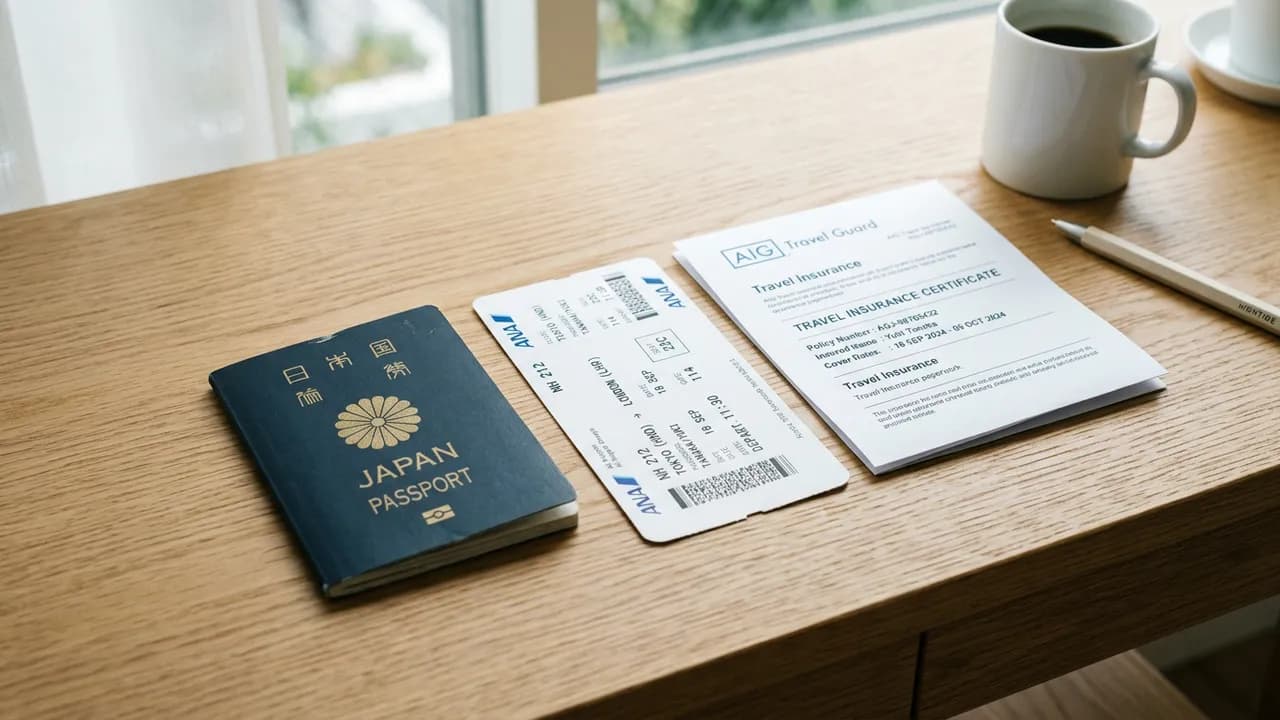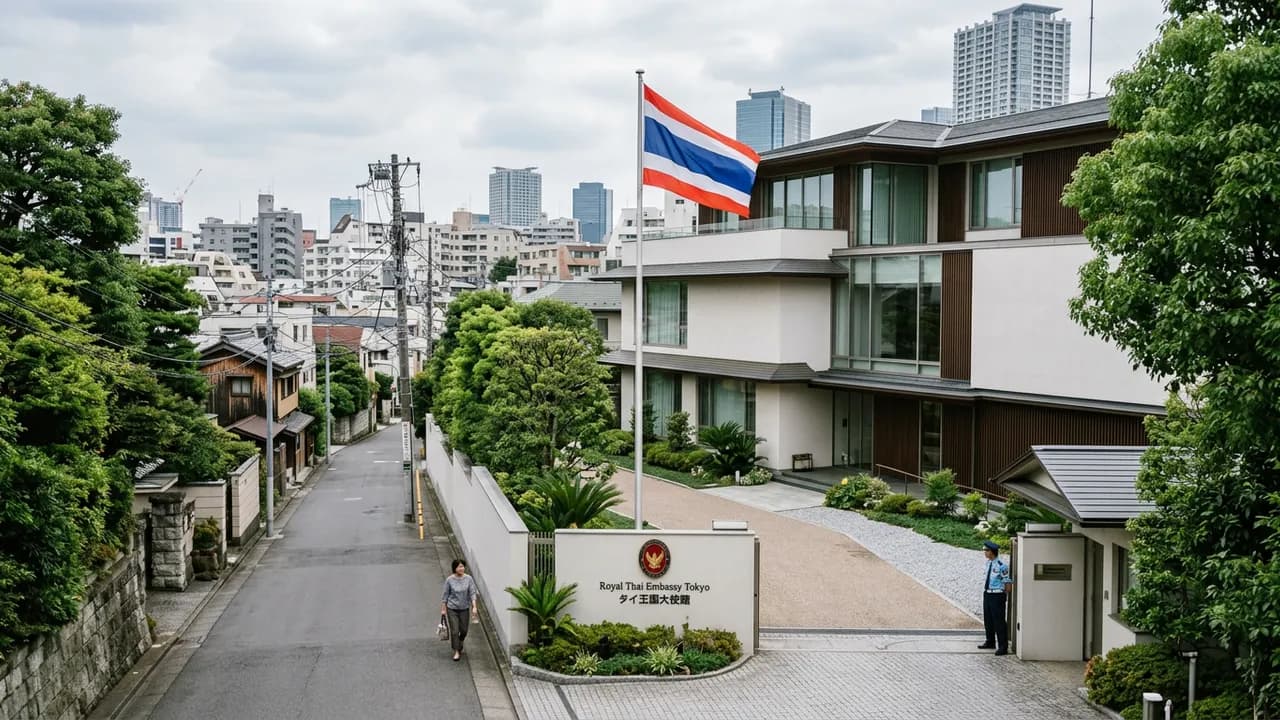
The Royal Thai Embassy in Tokyo serves as the central hub for Thai consular services in Japan. Japan and Thailand share a deep diplomatic and economic relationship, and millions of Japanese nationals travel to Thailand each year. While most Japanese tourists benefit from visa-free entry, those planning extended stays, work, retirement, or study in Thailand will need to visit the embassy. This guide provides a comprehensive overview of the embassy's services, visa types, and application procedures.
Embassy Contact Details
| Detail | Information |
|---|---|
| Official name | Royal Thai Embassy, Tokyo |
| Address | 14-6, Kami-Osaki 3-chome, Shinagawa-ku, Tokyo 141-0021 |
| Phone | +81-3-5789-2433 |
| Fax | +81-3-5789-2441 |
| [email protected] | |
| Website | tokyo.thaiembassy.org |
| Nearest Station | Meguro Station (JR Yamanote Line, Tokyu Meguro Line, Namboku Line, Mita Line) |
Visa Section Hours
| Day | Hours |
|---|---|
| Monday - Friday | Submission: 9:30 AM - 11:30 AM |
| Monday - Friday | Collection: 1:30 PM - 3:00 PM |
| Saturday - Sunday | Closed |
| Thai & Japanese public holidays | Closed |
Note: The visa section has a limited submission window. Arrive before 9:30 AM during busy periods to ensure you are processed within the morning session.
Jurisdiction
The Tokyo embassy handles visa applications for residents of the following prefectures:
- Tokyo, Kanagawa, Chiba, Saitama, Ibaraki, Tochigi, Gunma, Niigata, Nagano, Yamanashi, Shizuoka, and all prefectures in Tohoku and Hokkaido regions.
Residents of western Japan should apply at the appropriate consulate (see below).
Visa Types and Fees
| Visa Type | Purpose | Fee (JPY approx.) |
|---|---|---|
| Tourist Visa (TR) - Single Entry | Tourism, up to 60 days | JPY 4,500 |
| Tourist Visa (TR) - Multiple Entry | Tourism, 6 months validity, 60 days per entry | JPY 22,000 |
| Non-Immigrant B | Business/Employment | JPY 9,000 |
| Non-Immigrant O | Retirement, marriage, dependent | JPY 9,000 |
| Non-Immigrant O-A | Retirement (1-year, for 50+) | JPY 9,000 |
| Non-Immigrant ED | Education/Study | JPY 9,000 |
| Non-Immigrant IB | Investment/Media | JPY 9,000 |
| Destination Thailand Visa (DTV) | Remote work, events, soft power | JPY 13,500 |
| Transit Visa | Passing through Thailand | JPY 4,500 |
Fees are approximate and based on current exchange rates. The embassy typically accepts payment in cash (JPY). Confirm fees on the embassy website before your visit.
Japanese Nationals and Visa Exemption
Japanese passport holders enjoy one of the most generous entry arrangements with Thailand. Japan is on Thailand's 60-day visa exemption list, meaning Japanese tourists can enter Thailand without any advance visa application.
When You Do NOT Need to Visit the Embassy
- Short holidays up to 60 days (visa exemption at the airport)
- Extended holiday up to 90 days (60-day exemption + 30-day extension at Thai immigration for 1,900 THB)
- Brief business trips within the visa-exempt period
When You DO Need a Visa
- Stays longer than 90 days for any purpose
- Employment in Thailand (Non-Immigrant B + Work Permit)
- Retirement in Thailand (Non-Immigrant O or O-A)
- Study programs (Non-Immigrant ED)
- Long-term remote work (DTV)
- Investment or media activities (Non-Immigrant IB/IM)
- Multiple extended trips within a 6-month period (METV)
How to Apply for a Visa
Step-by-Step Process
- Determine your visa type based on the purpose and length of your stay
- Download the application form from the embassy website or complete it online through the e-visa system
- Prepare all required documents (see below for details by visa type)
- Visit the embassy during submission hours (9:30 AM - 11:30 AM)
- Submit your application and pay the visa fee in cash
- Receive a collection receipt with your pickup date
- Collect your passport on the designated date (1:30 PM - 3:00 PM)
E-Visa Option
Japan-based applicants can also use the Thai e-visa system (thaievisa.go.th) for certain visa types. The online process eliminates the need for an in-person visit for submission, though processing times may be slightly longer.
Required Documents
Tourist Visa (Single Entry)
- Completed visa application form
- Passport valid for at least 6 months with 2+ blank pages
- One recent passport photo (4.5 x 3.5 cm, white background)
- Confirmed round-trip flight booking
- Hotel reservation or proof of accommodation
- Bank statement showing sufficient funds (at least JPY 200,000)
- Visa fee
Non-Immigrant B (Business/Work)
- Completed visa application form
- Passport valid for at least 6 months
- One recent passport photo
- Invitation letter from the Thai company (original)
- Thai company registration documents (certified copies)
- Work permit approval letter or WP3 form
- Employment contract or assignment letter
- Letter from Japanese employer (if secondment)
- Visa fee
Non-Immigrant O-A (Retirement)
- Completed visa application form
- Passport valid for at least 18 months
- One recent passport photo
- Proof of age (50 or older)
- Criminal background check from the Japanese police (issued within 3 months)
- Medical certificate from a licensed physician (issued within 3 months)
- Financial proof: bank statement showing at least 800,000 THB equivalent, or pension/income proof of at least 65,000 THB/month
- Health insurance with coverage of at least 40,000 THB for outpatient and 400,000 THB for inpatient care in Thailand
- Visa fee
Destination Thailand Visa (DTV)
- Completed visa application form
- Passport valid for at least 6 months
- One recent passport photo
- Proof of remote work (employment contract, client agreements, or business registration)
- Income documentation (tax returns, bank statements showing at least JPY 500,000)
- Health insurance covering Thailand
- Visa fee
Processing Times
| Visa Type | Standard Processing |
|---|---|
| Tourist Visa (Single) | 2-3 working days |
| Tourist Visa (Multiple) | 3-5 working days |
| Non-Immigrant B | 3-5 working days |
| Non-Immigrant O/O-A | 5-7 working days |
| DTV | 5-10 working days |
| E-Visa (all types) | 7-15 working days |
Tip: The embassy tends to process applications efficiently, but apply at least 2 weeks before your intended travel date to account for any unexpected delays.
Other Thai Missions in Japan
| Mission | Jurisdiction | Location |
|---|---|---|
| Royal Thai Consulate-General, Osaka | Osaka, Kyoto, Hyogo, Nara, Shiga, Wakayama, and surrounding Kansai/Chubu prefectures | Bangkok Bank Building, 1-9-16 Kyutaro-machi, Chuo-ku, Osaka |
| Royal Thai Consulate-General, Fukuoka | Fukuoka and all Kyushu and Okinawa prefectures | 1-21-13 Yakuin, Chuo-ku, Fukuoka |
Both consulates offer the same visa types and services as the Tokyo embassy. Apply at the mission covering your registered residential prefecture.
Consular Services
Beyond visas, the Royal Thai Embassy Tokyo provides:
- Document legalization and authentication for use in Thailand
- Thai passport services for Thai nationals in Japan
- Civil registration for Thai nationals (birth, marriage, death)
- Consular protection for Thai nationals in distress
- Trade and economic affairs through the commercial section
- Cultural and educational exchanges between Japan and Thailand
Tips for Japanese Applicants
Planning Your Application
- Golden Week and year-end holidays — The embassy is closed during both Thai and Japanese national holidays. The Golden Week period (late April to early May) and year-end/New Year period create extended closures. Apply well before these periods.
- Peak Thailand travel season — December through March is the busiest period for Japanese travelers to Thailand. Submit applications early to avoid delays.
- Prepare documents in advance — Japanese applicants tend to have well-organized applications, but ensure all documents are current and properly formatted.
Practical Tips
- Take the JR Yamanote Line to Meguro — The embassy is approximately a 10-minute walk from Meguro Station's west exit. Follow Meguro-dori toward Gotanda.
- Bring cash in JPY — The embassy typically requires cash payment for visa fees. ATMs are available near Meguro Station.
- Prepare neatly — Complete the application form in block letters. Attach the photo properly. Japanese applicants often have the smoothest processing experiences due to thorough preparation.
- Bring photocopies — Have copies of your passport bio page, any existing Thai stamps, and all submitted documents.
For Long-Term Stays
- Retirement visas require health insurance — Japan's National Health Insurance does not cover you in Thailand. Purchase a Thai-compliant health insurance policy before applying for an O-A visa.
- Work permits are separate from visas — A Non-Immigrant B visa allows you to enter Thailand for work purposes, but you still need a work permit issued by the Thai Ministry of Labour after arrival.
- DTV and remote work — If you work remotely for a Japanese company while in Thailand, the DTV is the most appropriate visa. Clarify your tax obligations in both countries.
Frequently Asked Questions
Do Japanese citizens need a visa for Thailand?
For tourism stays up to 60 days, no. Japanese passport holders receive a visa-exempt entry stamp at the airport. For stays beyond 90 days (including the 30-day extension) or for work, study, or retirement, a visa is required.
How long can Japanese citizens stay in Thailand without a visa?
60 days on visa exemption, extendable by 30 days at Thai immigration (1,900 THB fee), for a total of 90 days.
Can I apply by mail?
The Tokyo embassy generally requires in-person submission, though the e-visa system offers an alternative. Check the embassy website for any postal application options.
What is the busiest time for visa applications?
November through February aligns with both Japan's winter travel season and Thailand's high season. Apply as early as possible during this period.
Can I extend my visa in Thailand?
Yes. Most visa types can be extended at a Thai immigration office. Tourist visas and visa exemptions can be extended by 30 days for 1,900 THB. See the tourist visa extension guide for the full process.
Final Thoughts
For most Japanese travelers, a trip to Thailand requires nothing more than a valid passport and a flight ticket, thanks to the generous visa exemption arrangement. However, if you are planning a longer stay for work, retirement, or study, the Royal Thai Embassy in Tokyo provides efficient and well-organized service. The embassy staff generally speak both Japanese and English, making the process accessible. Apply early, prepare your documents thoroughly, and allow adequate processing time before your departure.