The financial requirements for Thailand's retirement visa are the single most misunderstood aspect of the retirement process. Immigration rules have changed multiple times over the years, embassies in different countries have stopped issuing certain documents, and the enforcement of "seasoning" rules varies by immigration office. Confusion and conflicting information are everywhere. For the full overview of moving abroad as a retiree, see our retire in Thailand guide.
This guide cuts through the noise and explains exactly what you need financially to obtain and maintain a retirement visa in Thailand in 2026.
The Three Methods at a Glance
Thailand offers three ways to meet the financial requirement for retirement visa extensions:
| Method | Requirement | Proof |
|---|---|---|
| Bank Deposit | 800,000 THB in a Thai bank account | Bank letter and updated passbook |
| Monthly Income | 65,000 THB per month | Embassy income letter or transfer records |
| Combination | Bank deposit + annual income totaling 800,000 THB | Bank letter + income documentation |
You choose one method and must maintain compliance throughout your stay. Let us examine each in detail.
Method 1: Bank Deposit (800,000 THB)
This is the most straightforward method and the one most immigration officers prefer because it is easy to verify.
How the Bank Deposit Method Works
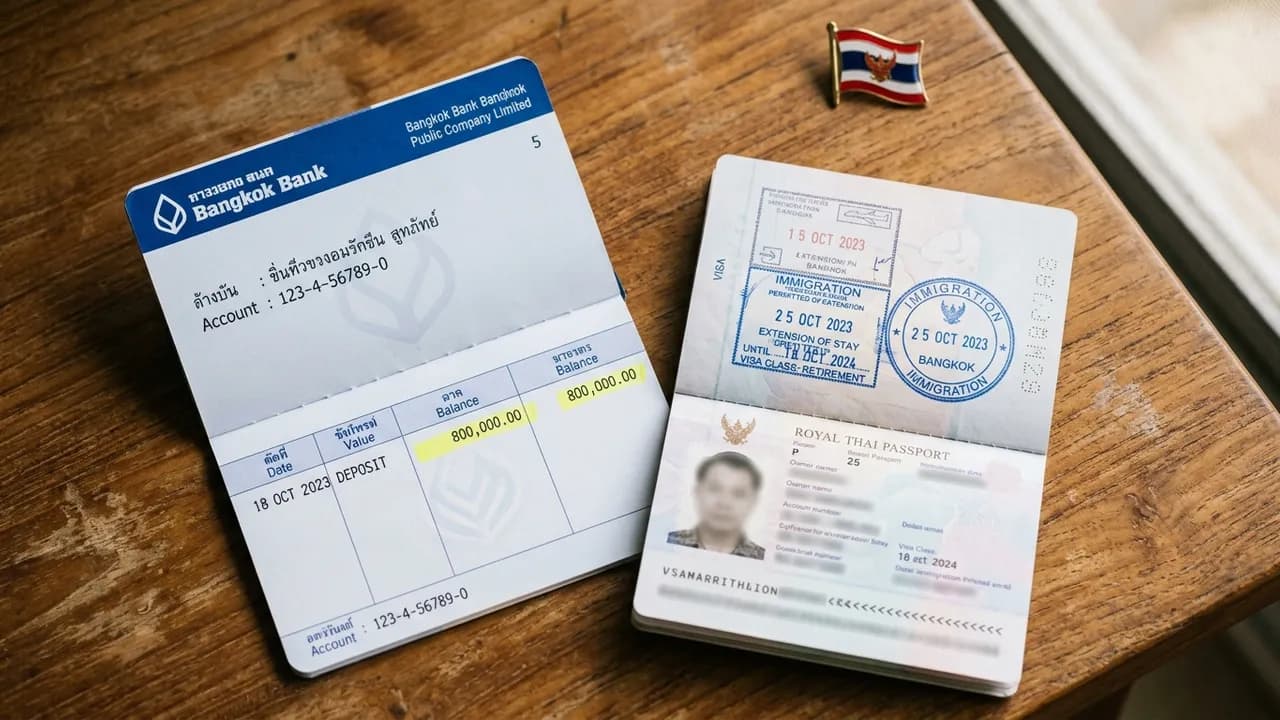
You deposit 800,000 THB (approximately $23,000 USD at current exchange rates) in a Thai bank account in your name only. The account must be a savings account or fixed deposit — not a current/checking account. The money must remain in the account and meet specific balance requirements throughout the year.
The Seasoning Rule
"Seasoning" refers to how long the money must be in your account before and after your visa extension is granted:
Before the extension application:
- The 800,000 THB must be in your account for at least 2 months before you apply for your annual visa extension
After the extension is granted:
- You must maintain at least 400,000 THB in the account for the first 3 months after the extension
- The full 800,000 THB must be back in the account at least 2 months before your next annual extension
Timeline Example
Let us say your visa extension date is September 1:
| Date | Required Balance | Notes |
|---|---|---|
| July 1 (2 months before) | 800,000 THB | Seasoning period begins |
| September 1 | 800,000 THB | Extension application submitted |
| September - November | 400,000 THB minimum | 3-month reduced requirement |
| December - June | No minimum (but risky to go below 400K) | Flexibility period |
| July 1 (2 months before next renewal) | 800,000 THB | Must be restored for next year |
Practical Implications
The seasoning rule means you can access up to 400,000 THB of the deposit for about 7 months of the year. Many retirees use this window to cover living expenses, then replenish the account before the next seasoning period.
Important warning: While the rules technically allow you to draw down to 400,000 THB after the 3-month post-extension period, immigration officers at some offices have been known to question balances that drop significantly. Maintaining a consistent balance above 400,000 THB throughout the year is the safest approach.
Opening a Thai Bank Account
To deposit the required funds, you need a Thai bank account. This can be a chicken-and-egg problem — some banks require a visa to open an account, but you need the account for the visa.
Solutions:
- Open an account with your initial visa — Enter Thailand on a 90-day Non-Immigrant O visa and open a bank account immediately
- Use an embassy letter — Some Thai embassies provide a letter that banks accept for account opening
- Bangkok Bank overseas branches — Bangkok Bank has branches in New York, London, Tokyo, and other cities where you can open an account before arriving in Thailand
- Immigration office letters — Some immigration offices will provide a letter requesting the bank to open an account for you
Recommended banks for retirees:
| Bank | Pros | Cons |
|---|---|---|
| Bangkok Bank | Most foreigner-friendly, overseas branches, English service | Mobile app less intuitive |
| Kasikorn Bank (KBank) | Excellent mobile app, wide ATM network | Some branches less foreigner-friendly |
| SCB | Good service, strong online banking | Fewer foreign-language services |
Transferring Money to Thailand
Options for transferring 800,000 THB to your Thai account:
| Method | Speed | Cost | Exchange Rate |
|---|---|---|---|
| Wise (TransferWise) | 1-2 business days | 0.5-1% | Excellent (mid-market) |
| Bank wire transfer (SWIFT) | 3-5 business days | $25-50 per transfer | Bank rate (usually poor) |
| OFX / XE | 1-3 business days | Low or zero fees | Good |
| Western Union | Same day to 2 days | Variable | Moderate |
| Carrying cash | Immediate | Currency exchange fees | Variable |
Wise is the most popular option among retirees for its transparency, low fees, and excellent exchange rates. For a transfer of 800,000 THB, the fee difference between Wise and a traditional bank wire can be $200-500 — meaningful savings.
Tip: When transferring large amounts, exchange rates matter enormously. A 1% difference on 800,000 THB is 8,000 THB ($230 USD). Time your transfer when the rate is favorable, but do not cut it close to the seasoning deadline.
Documentation for Bank Deposit Method
When applying for your visa extension, you will need:
- Bank letter (original) — Obtained from your Thai bank branch. It confirms your account number, balance, and that the balance has been maintained for the required period. Cost: typically free to 200 THB.
- Updated bank passbook — The physical passbook must be updated at the bank to show the current balance. Bring the passbook to the bank and request an update.
- Bank statements — Some immigration offices also request printouts of your bank statements showing the transaction history for the past 12 months.
Important: Get the bank letter and passbook update on the same day you apply for the extension, or no more than 1-2 days before. Immigration wants to see current figures.
Method 2: Monthly Income (65,000 THB)
If you have a regular pension, social security, or other monthly income of at least 65,000 THB (approximately $1,860 USD), you can use this method instead of the bank deposit.
How the Monthly Income Method Works
You demonstrate that you receive at least 65,000 THB per month in income from sources such as:
- Government pension
- Private pension
- Social security benefits
- Annuity payments
- Investment income (if regular and documentable)
- Rental income from properties abroad
Proof of Income: The Embassy Letter Issue
Historically, retirees proved their income through an "income affidavit" or "income letter" from their country's embassy in Bangkok. This was a sworn statement that you made at the embassy declaring your monthly income, which the embassy then notarized.
The problem: Several major embassies have stopped issuing income affidavits:
| Embassy | Status (2026) |
|---|---|
| United States | Stopped issuing income affidavits in 2018 |
| United Kingdom | Stopped issuing income affidavits in 2018 |
| Australia | Stopped issuing income affidavits in 2019 |
| Canada | Still issues statutory declarations (varies by consulate) |
| Germany | Still issues income confirmation |
| France | Still issues income certification |
| Netherlands | Still issues income confirmation |
| Scandinavian countries | Varies by country |
Alternative Income Proof
For retirees whose embassies no longer issue income letters, Thai Immigration has accepted the following alternatives (acceptance varies by office):
-
12 months of bank transfer records — Show that at least 65,000 THB per month has been transferred into your Thai bank account from abroad for the past 12 months. This is the most commonly accepted alternative.
-
Pension statement — Official statement from your pension provider showing monthly payment amount. Must be translated into English (if not already) and may need to be notarized.
-
Social security statement — Official statement from your country's social security administration showing monthly benefit amount.
-
Tax returns — Some offices accept foreign tax returns showing income. Less commonly accepted than bank transfers.
Using Bank Transfers as Income Proof
This has become the de facto standard for American, British, and Australian retirees. Here is how to make it work:
Setup:
- Set up a regular monthly transfer from your home country bank to your Thai bank
- Each transfer must be at least 65,000 THB (or the foreign currency equivalent)
- Transfers must be consistent — same amount, same source, every month
- Do this for at least 12 months before your extension application
At extension time:
- Update your bank passbook at the Thai bank
- Request a bank letter confirming regular monthly deposits
- Bring 12 months of bank statements showing the incoming transfers
- The immigration officer will review the transfer pattern
Potential issues:
- Exchange rate fluctuations may cause some months to fall below 65,000 THB. Transfer slightly more than the minimum to account for this.
- Irregular transfer dates (e.g., pension arrives on different dates) may raise questions. Consistency helps.
- Some immigration offices are stricter than others about accepting bank transfers vs. embassy letters.
Method 3: Combination Method
You can combine a bank deposit and annual income to reach the 800,000 THB threshold.
How the Calculation Works
Formula: (Monthly income x 12) + Thai bank balance = 800,000 THB or more
Examples:
| Monthly Income | Annual Income | Bank Balance Needed | Total |
|---|---|---|---|
| 65,000 THB | 780,000 THB | 20,000 THB | 800,000 THB |
| 40,000 THB | 480,000 THB | 320,000 THB | 800,000 THB |
| 20,000 THB | 240,000 THB | 560,000 THB | 800,000 THB |
| 0 THB | 0 THB | 800,000 THB | 800,000 THB (pure deposit) |
Documentation for Combination Method
You need both sets of documents:
- Bank letter and updated passbook showing the balance
- Income proof (embassy letter, bank transfers, or pension statement) showing monthly income
- The immigration officer will calculate whether the combination meets the threshold
Seasoning for Combination Method
The bank balance portion of the combination is subject to the same seasoning rules as the pure deposit method — the required bank balance must be in the account for at least 2 months before the extension application.
First-Time Extension vs. Annual Renewal
The requirements differ slightly depending on whether you are applying for your first extension or renewing:
First Extension (Initial Year)
| Requirement | Details |
|---|---|
| Financial proof | 800,000 THB deposited for 2+ months OR income proof |
| Application timing | Apply before your initial 90-day visa expires |
| Application location | Immigration office in the province where you live |
| Additional documents | Photos, TM.7 form, passport copies, rental agreement, TM.30 confirmation |
| Processing | Usually same day to 7 business days |
| Fee | 1,900 THB |
Annual Renewal (Subsequent Years)
| Requirement | Details |
|---|---|
| Financial proof | Same as first extension, maintained throughout the year |
| Application timing | Apply 30-45 days before current extension expires |
| Additional review | Immigration may review your financial history for the entire past year |
| 90-day reports | Must be current (no missed reports) |
| Tax filing | Some offices check that you have filed a Thai tax return |
Common Problems and Solutions
Problem: Exchange Rate Fluctuation
If you transfer funds from abroad, exchange rate changes can cause your balance to fall below 800,000 THB or your monthly transfers to fall below 65,000 THB.
Solution: Transfer 5-10% more than the minimum to create a buffer. For the deposit method, maintain 850,000-900,000 THB. For monthly transfers, send the equivalent of 70,000-75,000 THB.
Problem: Money Needs to Be Accessible
Having 800,000 THB locked in a Thai bank account for most of the year means that money is not available for living expenses or emergencies at home.
Solution: Use the 7-month window (months 4-10 after extension) when you can draw down to 400,000 THB. Or use the combination method with a smaller deposit supplemented by regular income.
Problem: Bank Passbook Not Updated
Immigration requires a current passbook. If your passbook is out of date or damaged, you need to visit the bank to update or replace it.
Solution: Update your passbook at the bank 1-2 days before your immigration appointment. Some banks offer this at ATMs; others require a teller.
Problem: Immigration Office Interpretation Varies
Rules that are accepted at one immigration office may be questioned at another. Bangkok Immigration may handle things differently than Chiang Mai, which may differ from Pattaya.
Solution: Research the specific requirements of your local immigration office. Online forums (Thai Visa Forum, Facebook expat groups) have detailed reports from recent applicants at each office.
Problem: Embassy Stopped Issuing Income Letters
As noted above, several major embassies no longer provide income affidavits.
Solution: Switch to the bank transfer method (12 months of 65,000+ THB transfers into your Thai account) or use the pure deposit method (800,000 THB).
Problem: Joint Bank Account Not Accepted
Thai Immigration requires the bank account to be in your name only. Joint accounts with a spouse are not accepted.
Solution: Open an individual savings account at a Thai bank. Transfer the required funds to your personal account.
Required Documents Checklist
For your visa extension appointment, bring the following:
Personal documents:
- Passport (original + copies of data page, visa page, most recent entry stamp, and departure card)
- TM.7 application form (completed and signed)
- Two recent photographs (4 x 6 cm)
- Copy of your lease agreement or house book (tabien baan)
- TM.30 notification receipt (proof your landlord registered your address)
Financial documents (Bank Deposit method):
- Bank letter (original, dated within 7 days of application)
- Updated bank passbook (original + copies of relevant pages)
- Bank statements for the past 12 months (some offices require this)
Financial documents (Income method):
- Embassy income affidavit (if available) OR
- 12 months of bank transfer records showing 65,000+ THB monthly deposits
- Pension or social security statement
- Updated bank passbook showing incoming transfers
Financial documents (Combination method):
- All documents from both methods above, as applicable
Additional documents some offices request:
- Proof of health insurance (mandatory for O-A visa holders)
- Thai tax receipt (PND 91) or proof of tax filing
- Map to your residence
- Marriage certificate (if applicable, for address verification)
Tips for a Smooth Process
-
Visit your immigration office before your appointment — Ask at the information desk for their specific document requirements. Each office can vary.
-
Make copies in advance — Immigration needs copies of many documents. Prepare 2 sets of everything. There are usually copy shops near immigration offices, but being prepared saves time.
-
Go early — Immigration offices open at 8:30 AM. The queue starts forming earlier. Going on a Monday or the day after a holiday means larger crowds.
-
Consider an agent — For 2,000-5,000 THB, a visa agent can handle the paperwork and waiting for you. They know exactly what each office requires and can prevent problems.
-
Keep a financial calendar — Mark the dates when your seasoning period begins, when you can draw down, and when you must replenish. Set multiple reminders.
-
Do not wait until the last minute — Apply for your extension 30-45 days before it expires. This gives you time to fix any problems.
-
Maintain records — Keep a file with copies of every document you submit, every bank letter, every transfer receipt. You may need to reference previous years' documents.
-
Be polite and patient — Immigration staff process hundreds of applications. A calm, respectful demeanor goes a long way, even when the process feels frustrating.
Frequently Asked Questions
Can I use a fixed deposit instead of a savings account?
Yes, a fixed deposit at a Thai bank is accepted. However, a savings account is more practical because you can access the funds during the draw-down period. Fixed deposits typically offer only marginally better interest rates.
What if my balance drops below 400,000 THB accidentally?
If this happens during the first 3 months after your extension, it could jeopardize your visa. After 3 months, the rule is less strict, but any significant shortfall could be flagged at your next renewal. Replenish the account as quickly as possible and keep records showing the shortfall was temporary and unintentional.
Can my spouse and I share the 800,000 THB?
No. Each person applying for a retirement visa extension needs their own 800,000 THB deposit (or equivalent income). A couple needs 1,600,000 THB total. There are no exceptions.
Is interest earned on the 800,000 THB taxable?
Thai bank interest is subject to a 15% withholding tax, which is deducted automatically. The after-tax interest on 800,000 THB in a savings account is minimal (approximately 2,000-8,000 THB per year depending on the bank's interest rate).
What happens if I leave Thailand and re-enter during the year?
Your financial requirements remain the same. However, you need a re-entry permit (single: 1,000 THB, multiple: 3,800 THB) to leave and return without losing your extension. Without a re-entry permit, leaving Thailand cancels your extension.
Can I use cryptocurrency holdings as proof of funds?
No. Thai Immigration requires funds in a Thai bank account. Cryptocurrency, foreign bank accounts, stock portfolios, and real estate holdings are not accepted.
What is the minimum age for the retirement visa?
50 years old at the time of application.
Conclusion
The financial requirements for Thailand's retirement visa are manageable but demand attention to detail and planning. The 800,000 THB deposit method is the simplest and most universally accepted. If you have regular pension or income of 65,000 THB per month, the income method avoids tying up a large sum. The combination method offers flexibility for those who fall between the two.
Whichever method you choose, the keys to success are: start early, maintain a buffer above minimum amounts, keep meticulous records, and understand the specific requirements of your local immigration office. The annual renewal process becomes routine after the first year, but that first year requires the most careful planning.