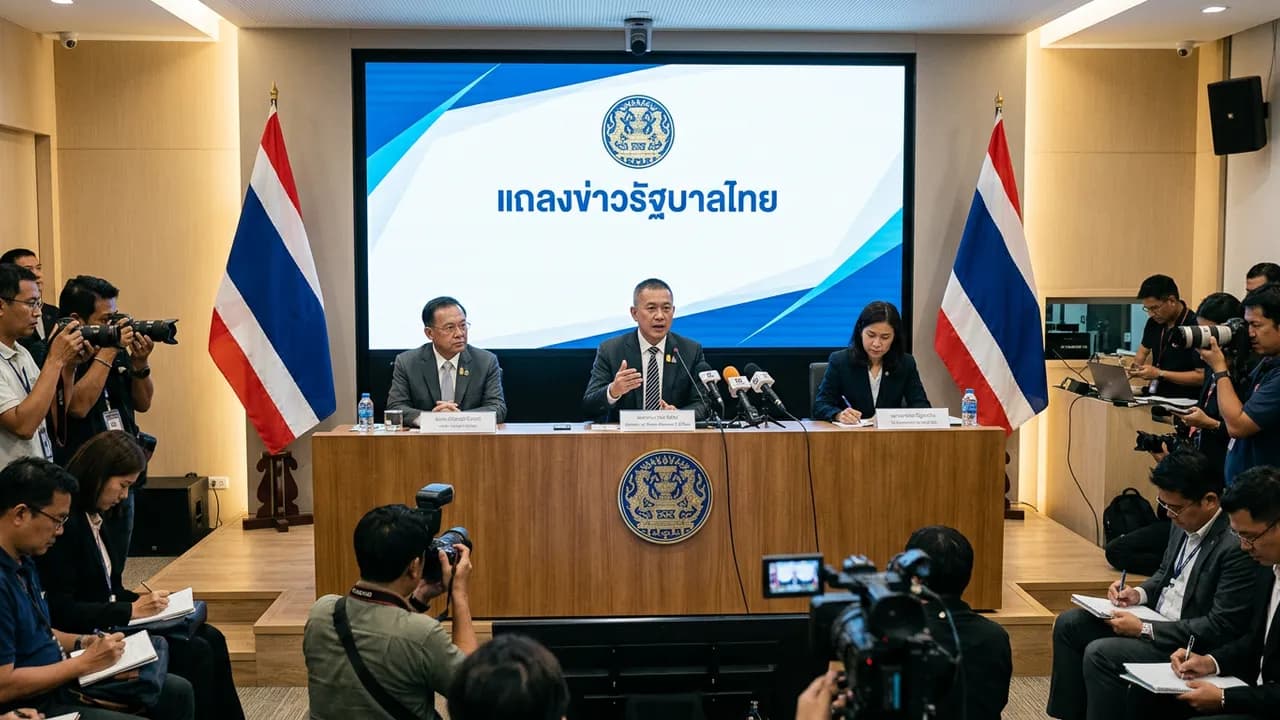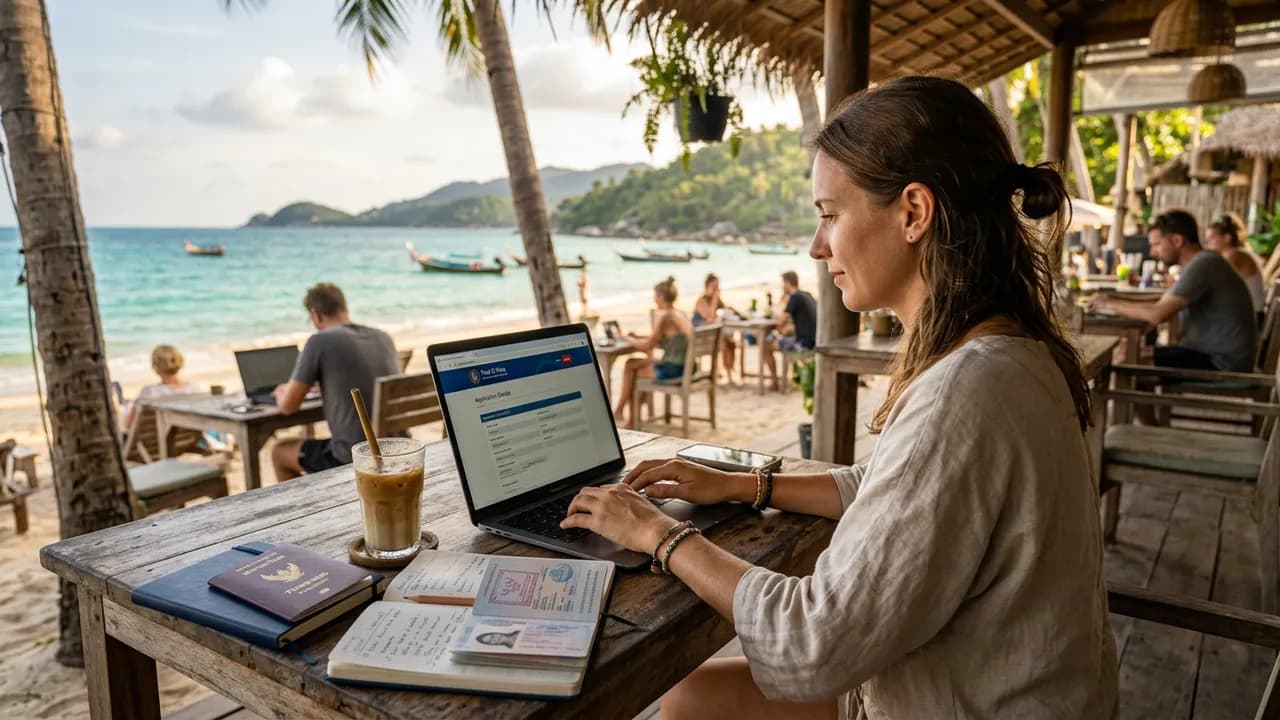
The Thailand DTV visa application opens access to the Destination Thailand Visa (DTV), Thailand's answer to the global digital nomad visa trend. Launched in June 2024, the DTV provides a legal framework for remote workers, freelancers, and other long-stay visitors who previously had no appropriate visa category. It offers a 5-year validity period with generous stay allowances, making it one of the most attractive digital nomad visas in Southeast Asia. For the full overview of remote work life in Thailand, see our digital nomad Thailand guide.
This guide walks you through the entire DTV application process, from determining your eligibility to receiving your visa and entering Thailand.
DTV Visa Overview
Before diving into the application steps, here is what the DTV offers:
| Feature | Details |
|---|---|
| Visa validity | 5 years from date of issue |
| Stay per entry | 180 days |
| Extension | One 180-day extension per entry (total 360 days per entry) |
| Entry type | Multiple entry |
| Application fee | 10,000 THB |
| Eligible dependents | Spouse and children under 20 |
| Work authorization | Permits remote work for foreign employers/clients |
| Minimum income requirement | None officially mandated (but financial evidence required) |
The DTV is not a traditional work permit. It does not authorize you to work for a Thai employer or to provide services to Thai clients/customers. It specifically covers remote work performed for entities outside Thailand.
Qualifying Activities
The DTV is designed for several categories of visitors. You must demonstrate that you fall into at least one qualifying activity:
1. Remote Workers and Digital Nomads
Working remotely for a foreign employer or as a freelancer/self-employed person with international clients. This is the primary category for digital nomads.
Evidence needed:
- Employment contract or freelance agreement with a foreign entity
- Proof of income (bank statements, pay stubs, invoices)
- Letter from employer confirming remote work arrangement
- Portfolio or website demonstrating professional activity
2. Freelancers and Content Creators
Independent professionals creating content, providing digital services, or running online businesses with clients outside Thailand.
Evidence needed:
- Client contracts or invoices
- Portfolio of work
- Website or social media profiles demonstrating activity
- Bank statements showing income
3. Muay Thai and Martial Arts Training
Individuals coming to Thailand specifically to train at registered Muay Thai camps or martial arts facilities.
Evidence needed:
- Enrollment confirmation from a registered gym/camp
- Training schedule
- Payment receipt
4. Thai Cooking and Culinary Training
Participants in Thai cooking courses or culinary programs.
Evidence needed:
- Enrollment in an accredited program
- Course schedule and duration
- Payment receipt
5. Medical and Wellness Treatment
People seeking medical treatment, wellness programs, or health-related services in Thailand.
Evidence needed:
- Appointment confirmation from a Thai hospital or wellness center
- Treatment plan
- Medical records (if applicable)
6. Seminars, Workshops, and Conferences
Attendees of educational events, workshops, or professional conferences held in Thailand.
Evidence needed:
- Event registration confirmation
- Event details (dates, location, organizer)
7. Sporting Events
Participants in or attendees of sporting events in Thailand.
Evidence needed:
- Event registration or ticket confirmation
Eligibility Requirements
To qualify for the DTV visa, you must meet these baseline requirements:
- Valid passport — At least 6 months remaining validity (12 months recommended)
- No criminal record — Clean record in your home country and Thailand
- Financial means — Demonstrable ability to support yourself during your stay. While no official minimum income is mandated, embassies generally want to see evidence of:
- Bank balance of at least 500,000 THB equivalent ($14,000+ USD)
- Or regular monthly income of at least 50,000 THB equivalent ($1,400+ USD)
- Health insurance — Coverage valid in Thailand for the duration of your stay (some embassies require this; others recommend it)
- Qualifying activity — Documentary evidence of one of the qualifying activities listed above
- Accommodation plan — Hotel booking or rental agreement for at least the initial period
Step-by-Step Application Process
Step 1: Choose Where to Apply
You can apply for the DTV at any Royal Thai Embassy or Consulate worldwide. Some considerations:
Apply in your home country:
- Generally the smoothest process
- Staff familiar with your country's documents
- Easier to provide any additional documents if requested
Apply in a third country:
- Useful if you are already traveling
- Bangkok's neighboring countries (Laos, Cambodia, Malaysia) are popular choices
- Processing may vary by embassy — check the specific embassy's requirements before traveling
Apply online (e-Visa):
- Thailand has been expanding its e-Visa system
- Not all embassies offer online DTV applications — check the specific embassy's website
- The process mirrors the in-person application but with digital document uploads
Step 2: Gather Required Documents
Prepare the following documents. Having everything ready before you begin the application prevents delays.
Personal documents:
- Passport (original + copy of data page)
- Recent passport-sized photographs (4 x 6 cm or as specified by the embassy — check requirements as sizes vary)
- Completed visa application form (download from the embassy website)
- Proof of accommodation in Thailand (hotel booking, Airbnb reservation, or rental agreement)
- Flight itinerary (round-trip or onward travel — some embassies require confirmed tickets; others accept itineraries)
Financial documents:
- Bank statements for the past 6 months
- Employment contract showing salary (if employed)
- Tax returns for the most recent year
- Freelance invoices or payment receipts (if self-employed)
- Letter from bank confirming account balance
Activity-specific documents (for remote workers):
- Employment contract or letter from employer confirming remote work arrangement
- Business registration documents (if self-employed)
- Client contracts or letters of engagement
- Professional portfolio, website, or LinkedIn profile
- Recent pay stubs or payment confirmations
Health insurance:
- Policy document showing coverage in Thailand
- Coverage period should match or exceed your intended stay
- Minimum coverage of $50,000 USD medical coverage recommended
Optional but helpful:
- Cover letter explaining your plans in Thailand, your qualifying activity, and your financial situation
- CV/resume
- Previous Thai visa stamps (if you have a history of lawful visits)
Step 3: Complete the Application Form
Download the visa application form from the specific embassy's website. Key fields include:
- Type of visa requested: Select DTV or "Destination Thailand Visa"
- Purpose of visit: Describe your qualifying activity (e.g., "Remote work for [company name] based in [country]")
- Intended duration of stay: Your planned stay length (up to 180 days per entry)
- Address in Thailand: Your accommodation address
- Employment information: Current employer or self-employment details
- Previous visits to Thailand: List prior visits if applicable
Fill in the form completely and accurately. Inconsistencies between the form and supporting documents can cause delays or rejections.
Step 4: Submit Your Application
In-person submission:
- Visit the embassy during consular hours (typically morning only — check specific hours)
- Submit your completed application form and all supporting documents
- Pay the application fee of 10,000 THB (or equivalent in local currency)
- Receive a receipt and processing timeline
- Some embassies conduct a brief interview — be prepared to explain your plans
Online submission (where available):
- Create an account on the embassy's e-Visa portal
- Upload scanned copies of all documents (PDF format, clear and legible)
- Complete the online application form
- Pay the fee via credit card or bank transfer
- Monitor your application status through the portal
Step 5: Wait for Processing
| Application Method | Typical Processing Time |
|---|---|
| In-person at home country embassy | 5-10 business days |
| In-person at third-country embassy | 3-7 business days |
| Online (e-Visa) | 5-15 business days |
| Peak season or complex cases | Up to 30 business days |
Some embassies may contact you for additional documents or clarification during processing. Keep your phone accessible and check your email regularly.
Step 6: Collect Your Visa
In-person: Return to the embassy on the specified collection date. Bring your receipt and original passport (if you did not leave it at the embassy).
Online: You will receive the e-Visa via email. Print it and carry it with you. Also keep a digital copy on your phone.
Step 7: Enter Thailand
Present your passport with the DTV visa at Thai immigration upon arrival. The immigration officer will stamp your entry and note the 180-day permitted stay.
At immigration, have ready:
- Passport with DTV visa
- Completed arrival card (TM.6 — if still required; Thailand has been phasing these out)
- Proof of accommodation
- Proof of onward travel (not always checked but good to have)
Extending Your Stay
Each DTV entry allows 180 days, extendable by another 180 days (360 days total per entry). To extend:
- Visit your local Immigration office at least 7 days before your initial 180-day stay expires
- Submit:
- Passport
- TM.7 extension application form
- Photograph (4 x 6 cm)
- Proof of continued qualifying activity
- Proof of accommodation
- Extension fee: 1,900 THB
- Processing is typically same-day
After the extended stay expires (360 days), you must leave Thailand. You can re-enter immediately on the same DTV visa for a new 180-day period.
90-Day Reporting
All foreigners staying in Thailand for more than 90 consecutive days must report their address to Immigration every 90 days. This applies to DTV holders.
Methods:
- Online: Via the Immigration Bureau website (tm47.immigration.go.th) — free, convenient, but the system can be unreliable
- In person: At your local Immigration office — bring passport and TM.30 receipt
- By post: Mail the notification form to Immigration — allow 7-10 business days
Penalty for late reporting: 2,000 THB fine. Repeated failures can cause problems with future visa extensions. See our detailed 90-day reporting guide for tips on submitting online.
Dependents: Spouse and Children
DTV visa holders can include their spouse and children under 20 years of age. Dependents apply for their own DTV visa using the primary applicant's approval as a basis.
Additional documents for dependents:
- Marriage certificate (for spouse) — apostilled and translated
- Birth certificates (for children) — apostilled and translated
- Primary applicant's DTV visa copy
- Proof that the primary applicant can financially support dependents
Dependents receive the same visa terms as the primary holder. Spouses do not receive separate work authorization — they may work remotely under the same conditions as the primary holder if they can demonstrate their own qualifying activity.
Common Mistakes and How to Avoid Them
Mistake 1: Insufficient Financial Documentation
Submitting only a single bank statement showing a current balance is not enough. Embassies want to see a pattern of income and financial stability.
Solution: Provide 6 months of bank statements, employment contracts, tax returns, and invoices. The more comprehensive your financial picture, the better.
Mistake 2: Vague Activity Description
Writing "I work online" on the application form is too vague. The embassy needs to understand what you do and for whom.
Solution: Be specific. "I am a software developer employed by [Company Name] in [Country], working remotely. My employer has approved remote work from Thailand. See attached employment contract and employer letter."
Mistake 3: Applying at the Wrong Embassy
Some embassies have specific rules about who can apply. For example, some only process applications from residents of the country where the embassy is located.
Solution: Check the specific embassy's website for eligibility rules before planning your application.
Mistake 4: Incomplete Document Set
Missing even one required document can delay processing by weeks.
Solution: Use the checklist above and double-check every item before submitting. When in doubt, include more documentation rather than less.
Mistake 5: Not Having Health Insurance
While not all embassies strictly require health insurance, many do, and having it strengthens your application.
Solution: Purchase international health insurance valid in Thailand before applying. SafetyWing, World Nomads, Cigna, and BUPA are popular options for nomads.
Mistake 6: Applying Too Late
Processing times can be unpredictable, especially during peak travel seasons.
Solution: Apply at least 4-6 weeks before your intended travel date. Earlier is better.
DTV Visa vs. Other Options
DTV vs. Tourist Visa
| Factor | DTV | Tourist Visa |
|---|---|---|
| Cost | 10,000 THB | 1,000 THB |
| Stay duration | 180 days (+180 extension) | 60 days (+30 extension) |
| Validity | 5 years | 3-6 months |
| Remote work | Legal | Not permitted |
| Entries | Multiple | Single or double |
| Application complexity | Moderate | Simple |
Verdict: If you plan to spend more than 60-90 days in Thailand or visit multiple times over 5 years, the DTV is worth the higher fee.
DTV vs. Thailand Elite Visa
| Factor | DTV | Thailand Elite |
|---|---|---|
| Cost | 10,000 THB | 600,000+ THB |
| Stay duration | 180 +180 days per entry | 1 year per entry (auto-renewed) |
| Validity | 5 years | 5-20 years |
| Remote work | Explicitly permitted | Not explicitly addressed |
| VIP services | None | Airport fast-track, concierge, lounge |
| Application complexity | Moderate | Simple (but expensive) |
Verdict: The DTV offers far better value for most digital nomads. The Elite visa is for people who want premium convenience and have the budget for it.
DTV vs. Non-Immigrant B Visa + Work Permit
| Factor | DTV | Non-B + Work Permit |
|---|---|---|
| Cost | 10,000 THB | 2,000 THB + 3,000 THB + agent fees |
| Employer required | No | Yes (Thai employer) |
| Type of work | Remote for foreign entities | Work for Thai employer |
| Thai tax obligations | Depends on days in Thailand | Yes, mandatory |
| Application complexity | Moderate | High |
Verdict: These serve different purposes. The DTV is for remote workers with foreign clients/employers. The Non-B + work permit is for people employed by Thai companies.
Frequently Asked Questions
Can I apply for a DTV from inside Thailand?
Generally, no. The DTV must be obtained from a Royal Thai Embassy or Consulate outside Thailand. If you are currently in Thailand on another visa type, you would need to leave the country to apply. Some embassies in neighboring countries (Vientiane, Phnom Penh, Kuala Lumpur) are popular for this purpose.
Can I work for Thai clients on a DTV?
No. The DTV authorizes remote work for foreign employers and clients. If you want to provide services to Thai businesses or individuals, you need a Non-Immigrant B visa and work permit.
Is there a minimum stay requirement per entry?
No. You can enter for a few days and leave. The 180-day limit is a maximum, not a minimum.
Can I re-enter Thailand multiple times on the same DTV?
Yes. The DTV is a multiple-entry visa valid for 5 years. You can enter and exit Thailand as many times as you want during the validity period. Each entry grants a new 180-day stay.
What if my DTV application is rejected?
You can reapply with stronger documentation. The fee may or may not be refunded depending on the embassy's policy — most do not refund visa fees for rejected applications.
Do I need to show proof of income every time I enter Thailand?
Immigration officers at the airport can technically ask for proof of funds, but in practice, this is rare for DTV holders. Carry evidence of your financial situation just in case.
Can I open a Thai bank account with a DTV?
Yes. The DTV is a long-term visa that most banks will accept. Bring your passport, DTV visa, proof of Thai address, and a minimum deposit. Kasikorn Bank (KBank) and Bangkok Bank are generally the most foreigner-friendly.
What happens if I overstay my DTV?
Overstaying any Thai visa results in a fine of 500 THB per day (maximum 20,000 THB), possible detention, and a potential re-entry ban depending on the overstay duration:
- Under 90 days overstay: 1-year ban
- 90 days to 1 year: 3-year ban
- 1 to 3 years: 5-year ban
- Over 5 years: 10-year ban
Do I need to leave Thailand every 180 days?
Not if you extend. You can stay up to 360 days continuously (180 initial + 180 extension). After that, you must exit and re-enter.
Conclusion
The DTV visa has made Thailand a straightforward destination for digital nomads who want to live and work legally. The application process requires preparation — gathering financial documents, employer letters, and activity evidence — but is manageable for anyone with stable remote work. At 10,000 THB for 5 years of multiple-entry access, it is excellent value compared to digital nomad visas offered by other countries. Start your application well in advance of your travel date, provide comprehensive documentation, and you will be well-positioned for approval.