The Thai visa for remote workers has expanded as Thailand has become one of the most popular destinations for remote workers, freelancers, and digital nomads. The combination of affordable living, reliable internet, warm weather, and a thriving co-working scene makes it an obvious choice. But the legal landscape around working remotely in Thailand has historically been complicated. This FAQ addresses the most common questions about visas, legality, and practical considerations for remote workers in 2026. For the broader set of visa questions, see our Thailand visa FAQ.
Quick Facts
| Detail | Information |
|---|---|
| Best Visa Option | Destination Thailand Visa (DTV) |
| DTV Stay | Up to 180 days, extendable by 180 days |
| DTV Cost | 10,000 THB |
| Can You Work on a Tourist Visa? | Legally, no — remote work falls into a gray area |
| Work Permit Required? | Not for DTV holders doing remote work for foreign employers |
| Tax Residency Trigger | 180+ days in a calendar year |
| Popular Co-Working Cities | Bangkok, Chiang Mai, Phuket, Koh Phangan, Koh Samui |
Is it legal to work remotely in Thailand?
This is the most common question and the answer has evolved significantly. Historically, any form of work in Thailand — including working on a laptop for a foreign employer — technically required a Thai work permit. However, enforcement against remote workers who do not interact with the Thai economy (no Thai employer, no Thai clients, no Thai income) has been virtually nonexistent.
In 2024, Thailand introduced the Destination Thailand Visa (DTV), which explicitly accommodates remote workers. The DTV provides a legal framework for digital nomads to live and work remotely in Thailand without a separate work permit, as long as the work is performed for a foreign employer or your own foreign-registered business.
The Practical Reality
- If you are on a tourist visa and quietly working on your laptop in a cafe, you are unlikely to face any issues. Thai authorities have never conducted enforcement actions against this type of activity.
- If you want full legal certainty, the DTV is the correct visa.
- If you are working for a Thai company or serving Thai clients, you need a Non-Immigrant B visa and a work permit, regardless of whether the work is "remote."
What is the Destination Thailand Visa (DTV)?
The DTV was launched in mid-2024 as Thailand's answer to the global rise of digital nomad visas. It is designed for remote workers, freelancers, and people attending events, training, or wellness retreats in Thailand.
DTV Key Details
| Feature | Details |
|---|---|
| Validity | 5 years (multiple entry) |
| Stay Per Entry | 180 days |
| Extension | One 180-day extension per entry (total 360 days per entry) |
| Cost | 10,000 THB (approximately $280 USD) |
| Work Permit | Not required for remote work for foreign employers |
| Application | Thai embassies/consulates abroad, or e-Visa system |
| Dependents | Spouse and children can apply on the same visa |
Who Qualifies for the DTV?
You can apply under one of several categories:
- Remote workers / digital nomads — working for a foreign employer or own foreign-registered business
- Freelancers — earning income from foreign clients
- Attendees of seminars, workshops, training, music festivals, or sports events in Thailand
- Wellness and medical tourism participants
- Muay Thai or cooking course participants at certified schools
Required Documents for DTV (Remote Worker Category)
- Valid passport with at least 6 months validity
- Completed visa application form
- Passport-sized photo (4x6 cm)
- Proof of employment or business ownership (employment contract, company registration, client contracts)
- Evidence of remote work arrangement (letter from employer confirming remote work permission)
- Proof of financial means (bank statements showing equivalent of at least 500,000 THB)
- Health insurance covering Thailand
- Accommodation details in Thailand (hotel booking or rental agreement)
Can I work on a tourist visa in Thailand?
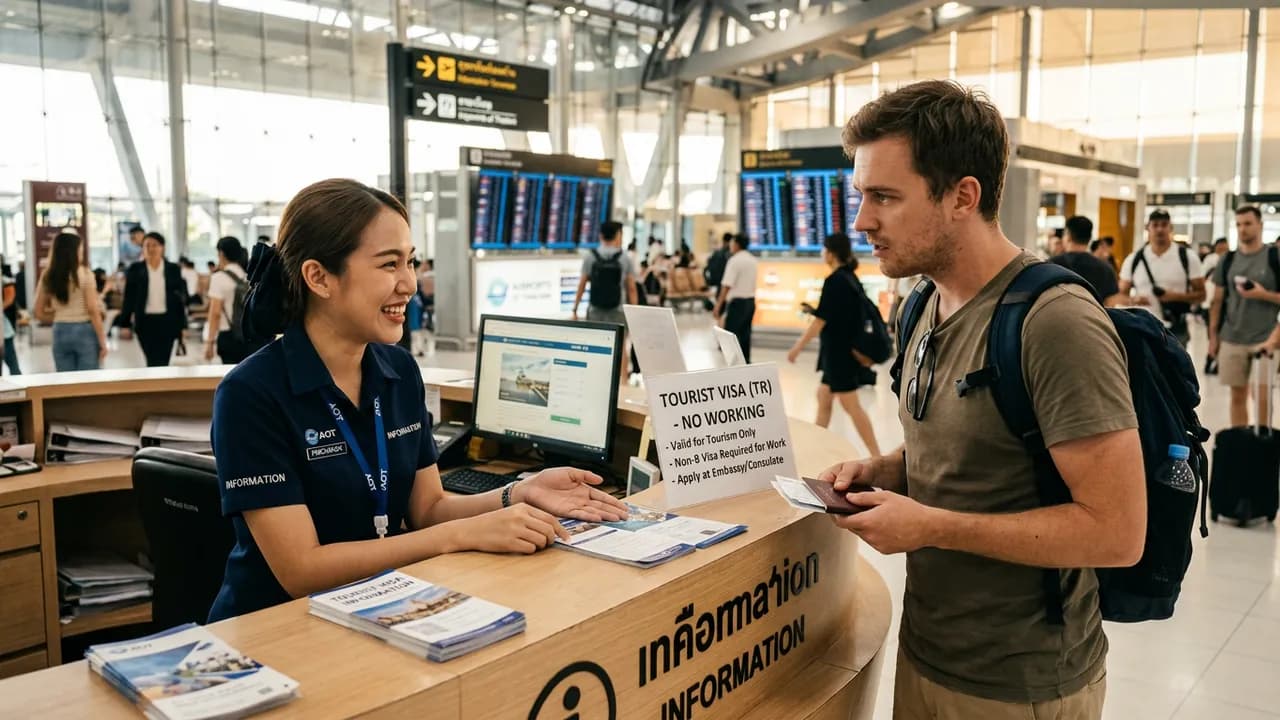
Legally, no. The Thailand Tourist Visa (TR) and visa exemption are issued for tourism purposes only. Working — including remote work for a foreign company — is not permitted under the terms of these visas.
In practice, thousands of remote workers use tourist visas and visa exemptions while working on their laptops in Thailand. Thai immigration does not actively investigate or enforce against remote workers who are not employed by Thai companies. There are no known cases of a remote worker being arrested, fined, or deported for working on a laptop in a co-working space while on a tourist visa.
That said, relying on a tourist visa for remote work carries risks:
- Your legal status is technically in violation
- If questioned, you have no legal defense
- Frequent tourist visa entries may trigger scrutiny from immigration officers who suspect you are living and working in Thailand long-term
- You have no recourse if something goes wrong
The DTV eliminates these risks for a modest fee.
What about the LTR visa for remote workers?
The Long-Term Resident (LTR) visa is a premium option introduced for high-income professionals. It provides a 10-year visa with significant tax benefits.
LTR Visa for Remote Workers (WFT Category)
| Feature | Details |
|---|---|
| Visa Duration | 10 years (renewable) |
| Stay | No 90-day reporting; annual check-in only |
| Income Requirement | At least $80,000 USD/year for the past 2 years |
| Tax Benefit | 17% flat tax on Thai-sourced income |
| Work Permit | Digital work permit included |
| Cost | 50,000 THB (approximately $1,400 USD) |
The LTR is ideal for high-earning professionals but is out of reach for most freelancers and typical digital nomads due to the income requirement.
What are the tax implications of working remotely in Thailand?
This is an area that has seen major changes. As of January 2024, Thailand updated its tax rules for foreign-sourced income:
The 180-Day Rule
If you spend 180 days or more in Thailand within a single calendar year, you become a Thai tax resident. Previously, foreign income was only taxed if remitted to Thailand in the same year it was earned. The updated rules now require Thai tax residents to pay tax on foreign-sourced income remitted to Thailand, regardless of when it was earned.
What This Means for Remote Workers
- If you stay fewer than 180 days per calendar year, you are not a Thai tax resident and owe no Thai tax on foreign income
- If you stay 180+ days and transfer your salary or freelance income into a Thai bank account, that income may be subject to Thai income tax
- Thailand has double tax agreements (DTAs) with many countries, which may reduce or eliminate double taxation
- DTV and LTR visa holders should consult a tax professional regarding their specific obligations
Thai Income Tax Rates (2026)
| Taxable Income (THB) | Rate |
|---|---|
| 0 – 150,000 | Exempt |
| 150,001 – 300,000 | 5% |
| 300,001 – 500,000 | 10% |
| 500,001 – 750,000 | 15% |
| 750,001 – 1,000,000 | 20% |
| 1,000,001 – 2,000,000 | 25% |
| 2,000,001 – 5,000,000 | 30% |
| Over 5,000,000 | 35% |
Practical Advice
- Keep records of all income and transfers
- Consider timing your transfers to optimize your tax position
- Consult a Thai tax advisor or international tax specialist if you plan to stay long-term
- LTR visa holders benefit from a flat 17% rate on Thai-sourced income, which may be advantageous
What is the best visa for remote workers in Thailand?
The best visa depends on your situation:
Short Stays (Under 90 Days)
Visa Exemption or Tourist Visa (TR) — If you are staying for a few weeks to a couple of months and working quietly on your laptop, the visa exemption (60 days + 30-day extension) is the simplest option. It is not technically legal for work, but enforcement is nonexistent for this type of activity.
Medium Stays (3–12 Months)
Destination Thailand Visa (DTV) — This is the clear winner for most remote workers. Up to 360 days per entry (180 + 180 extension), multiple-entry validity for 5 years, and explicit legal permission for remote work. At 10,000 THB, it is excellent value.
Long-Term Stays (1+ Years, High Income)
LTR Visa — If you earn $80,000+ USD annually and want a long-term base in Thailand, the LTR provides a 10-year visa, reduced tax obligations, and a streamlined work permit.
Working for a Thai Company
Non-Immigrant B Visa + Work Permit — If you are employed by or contracting for a Thai entity, there is no shortcut. You need a proper business visa and work permit.
Can I open a Thai bank account as a remote worker?
Yes, but it has become more difficult in recent years. Requirements vary by bank and branch:
- Easiest with: A long-term visa (DTV, LTR, Non-Immigrant B or O). Some banks accept tourist visas but many do not.
- Common requirements: Passport, visa, proof of Thai address (rental contract or utility bill), Thai phone number
- Recommended banks: Bangkok Bank and Kasikorn Bank are generally the most foreigner-friendly
- Tip: Bring a Thai-speaking friend or use a branch in a tourist area where staff speak English
What about co-working spaces?
Thailand has a mature co-working ecosystem. Membership is straightforward and does not require any specific visa type.
Top Cities for Co-Working
Bangkok: The largest selection, ranging from budget options (200–500 THB/day) to premium spaces. Popular areas include Silom, Sathorn, Ari, and Ekkamai.
Chiang Mai: The original digital nomad hub in Thailand. Very affordable (3,000–6,000 THB/month for unlimited access). The Nimmanhaemin area has the highest concentration of spaces. See our guide to the best cities for digital nomads for more.
Phuket: Growing co-working scene, especially in Rawai and Chalong. Slightly more expensive than Chiang Mai.
Koh Phangan: A unique island co-working scene focused on wellness and community. Beachside options available.
Most co-working spaces provide high-speed internet (50–200 Mbps), air conditioning, meeting rooms, printing services, and community events.
Do I need health insurance as a remote worker in Thailand?
Health insurance is required for the DTV application and strongly recommended regardless of visa type. Thailand has excellent private hospitals but costs can be significant without insurance.
Insurance Options
- International health insurance (Cigna, AXA, Allianz) — comprehensive but more expensive
- Digital nomad insurance (SafetyWing, World Nomads) — affordable plans designed for remote workers, starting from $40–80 USD/month
- Thai local insurance — available for long-term residents, very affordable but may require a Non-Immigrant visa
A basic inpatient plan is the minimum recommended coverage. Outpatient coverage adds convenience for routine doctor visits.
Can my family join me in Thailand?
Yes. The DTV visa allows your spouse and children under 20 to apply under the same visa category. Each family member submits their own application but can reference the primary applicant's documentation.
For LTR visa holders, dependents can also apply for their own LTR visas.
On tourist visas, family members simply enter on their own visa exemptions or tourist visas independently.
Summary
Thailand offers viable legal pathways for remote workers in 2026. The DTV visa is the standout option for most digital nomads — affordable, flexible, and legally clear. For short visits, tourist visas remain practical despite the technical gray area. High earners should consider the LTR visa for its long-term benefits and tax advantages.
Whatever your situation, plan your visa choice around the length of stay, income level, and desire for legal certainty. And always keep an eye on Thai tax residency rules if you plan to stay more than 180 days in a calendar year.