The Thailand visa for South Koreans is one of the most generous arrangements available, with citizens enjoying a 90-day visa exemption for tourism. With a 90-day visa exemption for tourism, South Koreans can spend up to three months in Thailand without applying for any visa in advance. This makes Thailand one of the easiest international destinations for Korean travelers to visit.
South Korea is not on the lists in Thailand's new visa exemption rules, which were published in the Royal Gazette on 31 August 2026 and have been in force since 15 September 2026 (TAT Newsroom). Korean visitors are covered by a separate bilateral agreement instead. Thai missions list the Republic of Korea among the bilateral agreement countries whose ordinary passport holders can visit for up to 90 days (Royal Thai Embassy, Doha). The Royal Thai Embassy in Seoul had not published guidance on the September 2026 change when this page was updated, so check the current stay length with the embassy before you travel.
This guide covers the visa exemption details, extension options, longer-stay visa types, the Thai embassy in Seoul, costs in KRW, and practical advice for Korean visitors.
Quick Facts for South Korean Citizens
| Detail | Information |
|---|---|
| Visa exemption | Yes, 90 days (bilateral agreement) |
| Visa on arrival | Not available (since 15 September 2026, VOA covers only Azerbaijan, Belarus and Serbia) |
| Tourist visa (TR) | Available but rarely needed |
| Passport validity required | At least 6 months |
| Proof of funds required | 20,000 THB per person / 40,000 THB per family, if the officer asks |
| Return ticket required | Yes |
| e-Visa available | Yes |
| Thai embassy in South Korea | Seoul |
The 90-Day Visa Exemption
South Korea is one of a select group of countries whose citizens receive a 90-day visa exemption for Thailand. This is significantly longer than the 30 days most other visa-exempt nationalities have received since 15 September 2026 (it was 60 days from July 2024 until 14 September 2026), reflecting the strong bilateral relationship between the two countries.
Key Rules
- Duration: Up to 90 days per entry. The Ministry of Foreign Affairs lists Korea (ROK) in the 90-day group of bilateral agreement countries (MFA list, 24 February 2025).
- Purpose: Tourism. Thai missions describe the 90-day bilateral exemption as being for tourism purposes (Royal Thai Embassy, Doha). If you are travelling for business, check with the Royal Thai Embassy in Seoul first.
- Entry points: The MFA's bilateral list restricts only Myanmar nationals to international airports and sets no port restriction for Korea. The 2026 twice-per-year land-border cap is written for the 30-day and 15-day exemption categories; whether it applies to bilateral entries hasn't been published. Check before planning repeated land crossings.
- Extensions: Extensions of bilateral-exemption stays are decided by Thai Immigration. Its published tourism-extension criteria cover visa-exempt stays of up to 30 days, not 90-day entries (Immigration Division 1). Confirm eligibility at your local immigration office before relying on one.
- Maximum stay: Plan on 90 days per entry.
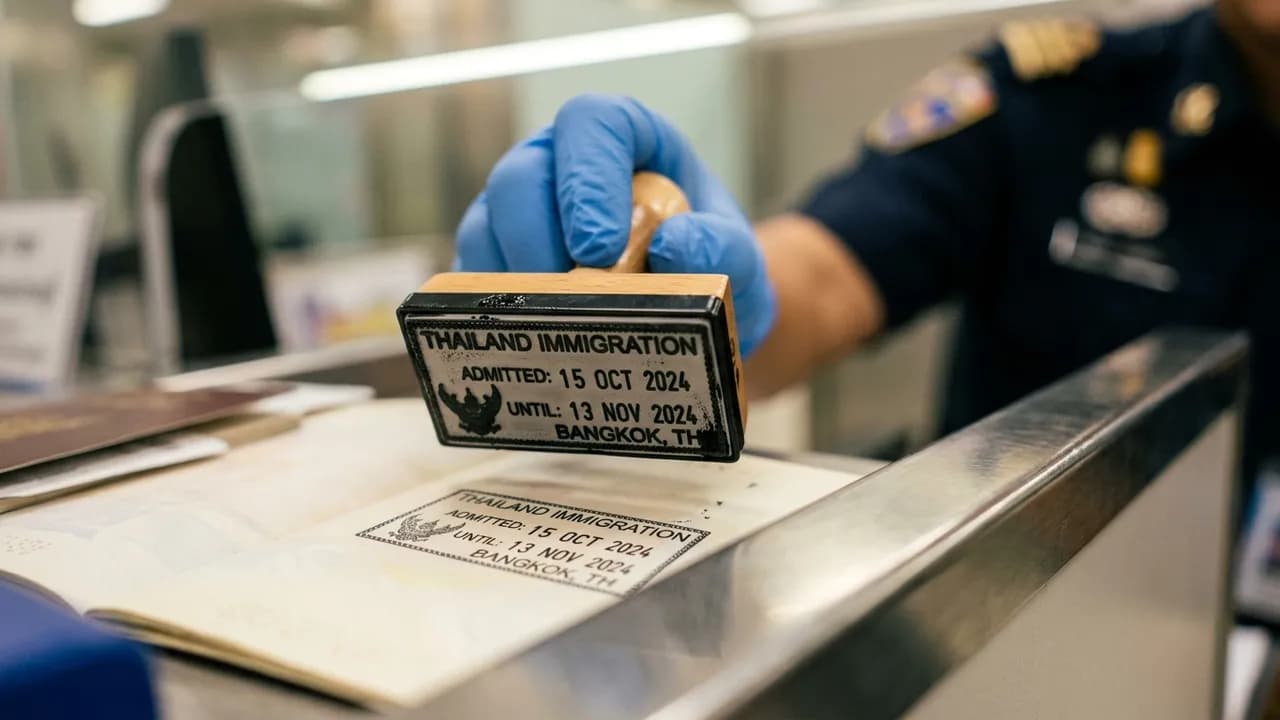
- No advance application: Arrive with your passport and receive an entry stamp.
What You Need at Immigration
- South Korean passport valid for at least 6 months beyond your arrival date.
- Thailand Digital Arrival Card (TDAC), filed online at tdac.immigration.go.th before arrival. It replaced the paper T.M.6 card.
- Proof of onward travel — return flight or ticket to a third country within 90 days.
- Proof of accommodation — hotel booking, Airbnb confirmation, or host details.
- Proof of funds — 20,000 THB per person (approximately 760,000 KRW) or 40,000 THB per family. Thai missions state this requirement for visa-exempt entry generally, not specifically for the bilateral exemption, and officers may ask to see it (Royal Thai Embassy, London; Royal Thai Embassy, Washington D.C.).
Why 90 Days?
The extended visa exemption period between Thailand and South Korea is the result of a bilateral agreement that recognizes the significant tourism and business flows between the two countries. South Korea is consistently among the top source markets for tourism to Thailand.
Do You Need a Tourist Visa?
In most cases, no. The 90-day visa exemption is sufficient for the vast majority of South Korean visitors. A single-entry Tourist Visa (TR) gives 60 days, and Thai Immigration can extend a Tourist Visa stay once by no more than 30 days (Immigration Division 1). That is 90 days at most (60 + 30), no longer than the exemption.
When a Tourist Visa Might Be Useful
- You want a pre-approved visa in your passport before you travel.
- You want a Multiple Entry Tourist Visa (METV) for repeated visits over a 6-month period, each allowing up to 60 days plus a 30-day extension.
Tourist Visa Details
| Feature | Single Entry | Multiple Entry (METV) |
|---|---|---|
| Stay per entry | 60 days | 60 days per entry |
| Extensions | +30 days at immigration | +30 days per entry |
| Validity | 3 months | 6 months |
| Fee | Approximately 35,000 KRW | Approximately 175,000 KRW |
Extending Your Stay
Asking for an Extension
If 90 days is not enough, visit a Thai Immigration office well before your exemption expires and ask whether you can extend. Extensions of bilateral-exemption stays are decided by Thai Immigration. Its published tourism-extension criteria cover visa-exempt stays of up to 30 days, and do not mention 90-day bilateral entries (Immigration Division 1). Confirm eligibility at your local immigration office before relying on one.
What an extension application usually needs:
- Passport with the entry stamp showing your current permission to stay.
- Completed TM.7 application form.
- One passport-sized photo (4x6 cm).
- 1,900 THB in cash (approximately 72,000 KRW).
Processing: Usually completed within a few hours on the same day.
Major Immigration offices:
- Bangkok: Immigration Bureau, Chaeng Watthana Government Complex.
- Chiang Mai: Near Promenada Mall.
- Phuket: Phuket Town.
- Pattaya: Jomtien area.
What If You Need More Than 90 Days?
If your plans require a stay beyond 90 days, you should consider:
- Leaving Thailand briefly and re-entering for a new 90-day exemption period (though frequent entries may raise questions).
- Applying for a Non-Immigrant visa appropriate to your purpose of stay.
- Applying for a Destination Thailand Visa (DTV) for remote workers.
Thai Embassy in South Korea
| Detail | Information |
|---|---|
| Location | Royal Thai Embassy, Seoul |
| Address | Itaewon-dong, Yongsan-gu, Seoul |
| Services | Visa applications, consular services, legalization |
| Application hours | Typically morning hours on weekdays |
| Processing time | 3 to 5 working days |
Since most South Korean visitors do not need to apply for a visa, the embassy primarily handles Non-Immigrant visa applications, document legalization, and consular services. During peak travel seasons, expect higher volumes.
Costs Summary in KRW
| Item | Approximate Cost (KRW) |
|---|---|
| Visa exemption (90 days) | Free |
| Single-entry Tourist Visa | 35,000 KRW |
| Multiple-entry Tourist Visa (METV) | 175,000 KRW |
| Extension of stay at Thai Immigration (if granted) | 72,000 KRW (1,900 THB) |
| Non-Immigrant B (Business) Visa | 70,000 KRW |
| Non-Immigrant O Visa | 70,000 KRW |
| e-Visa processing fee | Additional fee applies |
Note: KRW amounts are approximate based on prevailing exchange rates. Thai immigration fees are fixed in THB.
Other Visa Types for South Korean Citizens
Non-Immigrant B (Business/Work)
Required if you plan to work in Thailand or conduct extended business activities. A work permit must be obtained separately after arrival.
Non-Immigrant ED (Education)
For studying Thai language, enrolling in a university program, or training at a Thai institution such as a Muay Thai camp.
Non-Immigrant O-A (Retirement)
For South Korean citizens aged 50 and above who wish to retire in Thailand. Requires proof of financial means (800,000 THB in a Thai bank account or monthly income of at least 65,000 THB) and health insurance.
Non-Immigrant O (Family)
For those married to a Thai national or with Thai children. Allows long-term residence with annual renewals.
Destination Thailand Visa (DTV)
A newer category for remote workers and digital nomads. Allows stays of up to 180 days. Suitable for Korean professionals working remotely for Korean companies.
Popular Activities for Korean Visitors
Thailand is one of the top international destinations for South Korean travelers. Popular activities and destinations include:
- Bangkok: Shopping at Siam Paragon and Terminal 21, street food tours, temple visits, Korean restaurants in Sukhumvit.
- Phuket and Krabi: Beach holidays, island hopping, scuba diving, and luxury resorts.
- Chiang Mai: Temple tours, trekking, night bazaars, and cooking classes.
- Pattaya: Beach resorts, water sports, and nightlife.
- Medical tourism: Dental work, cosmetic procedures, and health checkups at internationally accredited hospitals.
- Golf: Thailand has world-class golf courses at a fraction of Korean prices.
Korean Community in Thailand
Bangkok has a well-established Korean community, particularly in the Sukhumvit area (around Soi 12 and Korea Town near Ratchathewi). You will find Korean restaurants, grocery stores, churches, and businesses throughout the area.
Practical Tips for South Korean Citizens
Before Departure
- Passport check: Ensure your passport has at least 6 months of validity remaining. Korean passport renewal takes about 1 to 2 weeks at a passport office.
- Flight options: Direct flights from Incheon (ICN) to Bangkok (BKK and DMK) are operated by Korean Air, Asiana, Thai Airways, and budget carriers like T'way, Jin Air, and Thai AirAsia X. Flight time is approximately 5.5 hours.
- Currency exchange: Exchange KRW to THB at Bangkok airports or in the Pratunam/Siam area for better rates. SuperRich exchange offices typically offer the best rates.
- Insurance: Purchase comprehensive travel insurance before departure. Korean insurers offer Thailand-specific packages.
At the Airport
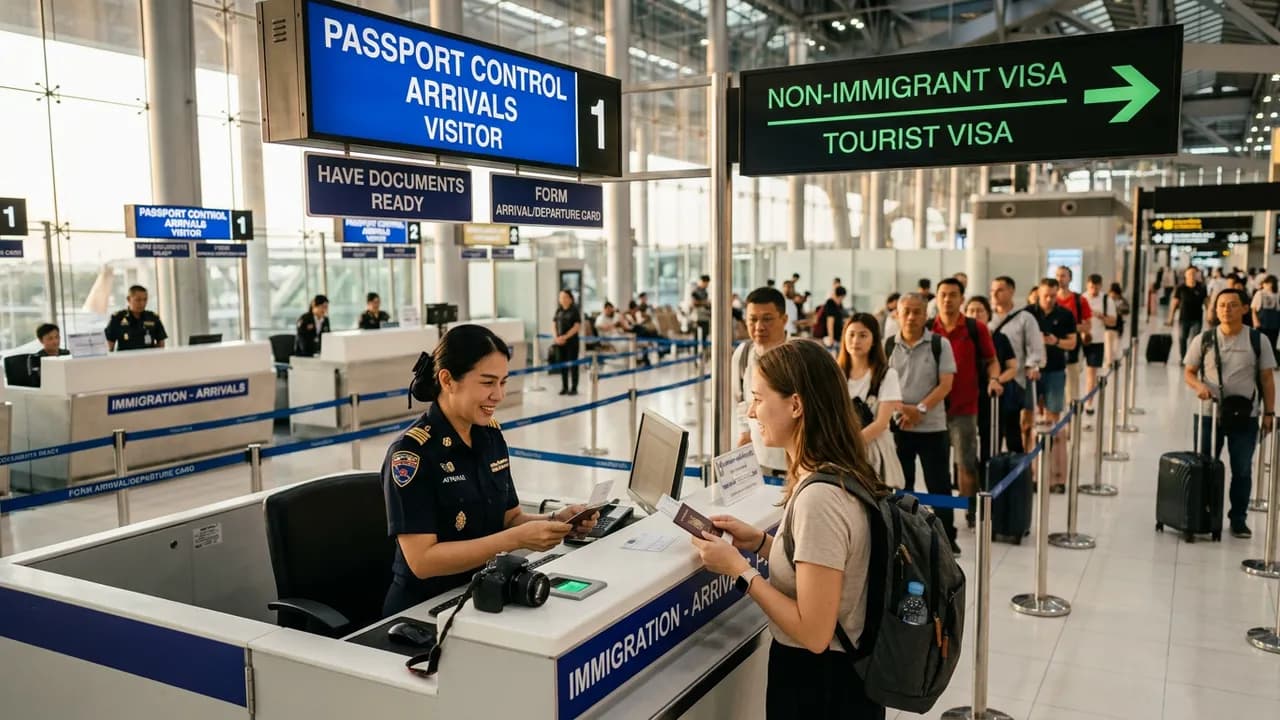
- Immigration lanes: Use the "Visa Exemption" or "Foreign Passport" counters. Do not queue at the Visa on Arrival counter.
- Arrival card: File the Thailand Digital Arrival Card (TDAC) at tdac.immigration.go.th before you fly. The paper T.M.6 card is no longer used.
- SIM cards: Purchase a Thai SIM card at the airport. Tourist SIM packages from AIS, DTAC, or TrueMove offer affordable data for 7 to 30 days.
During Your Stay
- Overstay penalties: Thailand enforces strict overstay penalties — 500 THB per day, up to a maximum of 20,000 THB. Overstays beyond 90 days result in entry bans. Even with a generous 90-day exemption, track your departure deadline carefully.
- Re-entry permits: If you leave Thailand and wish to return on the same entry stamp, you need a re-entry permit (1,000 THB for single, 3,800 THB for multiple). Without it, your permission to stay is cancelled upon departure.
- Driving: A Korean driver's license is not valid in Thailand. Obtain an International Driving Permit before leaving Korea.
- Emergency assistance: The Korean Embassy in Bangkok provides consular assistance for Korean nationals. Save the emergency contact number before traveling.
Money and Payments
- ATMs: Thai ATMs charge 220 THB per withdrawal for foreign cards. Withdraw larger amounts to minimize fees.
- Credit cards: Widely accepted at hotels, malls, and larger restaurants. Smaller vendors and street food stalls typically accept cash only.
- Mobile payments: Some Thai merchants accept Korean mobile payment platforms, but cash and card remain the most reliable methods.
Frequently Asked Questions
Can I stay 90 days, leave, and come back for another 90 days?
Technically yes. However, immigration officers may question frequent back-to-back entries. If you plan to spend extended periods in Thailand, apply for an appropriate long-term visa.
Is the 90-day exemption available at land borders?
The MFA's list of bilateral agreement countries restricts only Myanmar nationals to international airports and sets no port restriction for Korea (MFA list). The 2026 twice-per-year land-border cap is written for the 30-day and 15-day exemption categories; whether it applies to bilateral entries hasn't been published. Check with the Royal Thai Embassy in Seoul before planning repeated land crossings.
Can I study Thai language during my 90-day exemption?
Short informal courses are generally fine on a visa exemption. For formal, long-term study, an Education Visa (Non-Immigrant ED) is required.
Do I need vaccinations to enter Thailand?
No specific vaccinations are required for South Korean citizens entering Thailand, unless you are arriving from a yellow fever endemic area. However, standard travel vaccinations (Hepatitis A, Typhoid) are recommended.
Can I open a Thai bank account on a visa exemption?
This is increasingly difficult. Most Thai banks require a Non-Immigrant visa or work permit to open an account. Some branches may accommodate tourists, but this is not guaranteed.