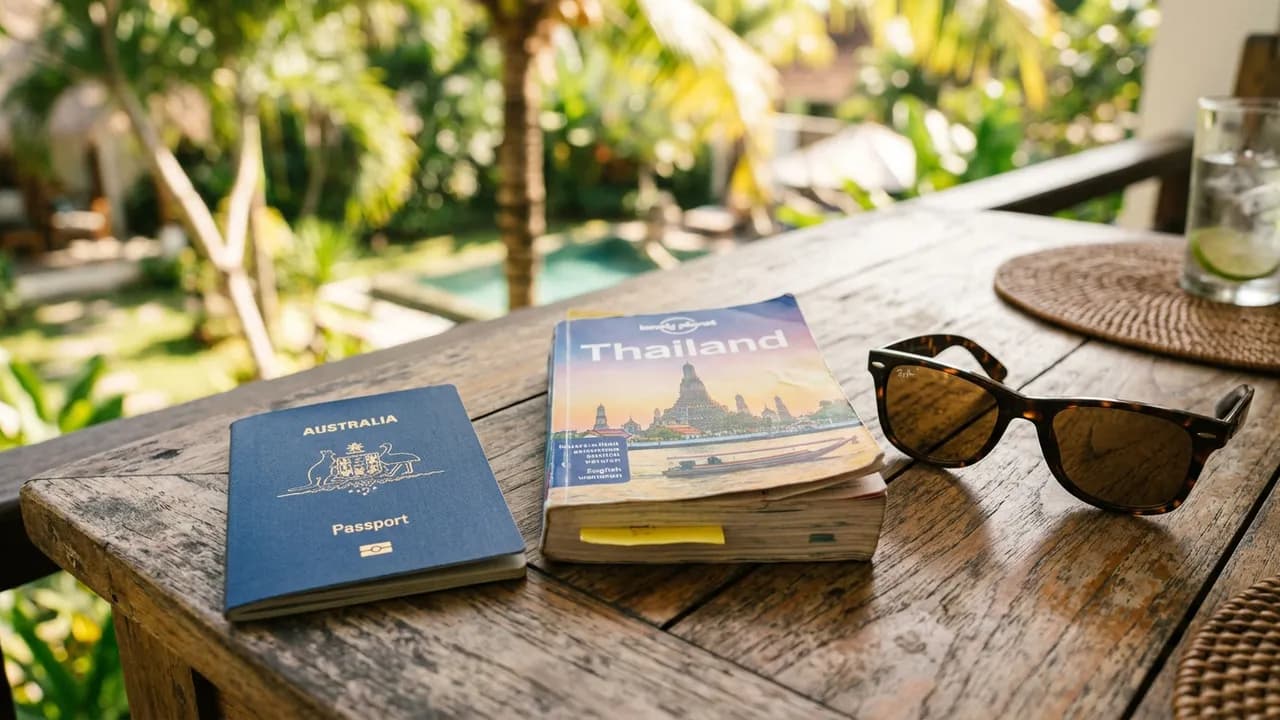
The Thailand visa for Australians supports one of the most popular overseas destinations for Australian travelers, from short Bangkok holidays to long-term retirement in Chiang Mai. Whether you are heading to Bangkok for a short holiday, island-hopping through the south, or planning a long-term retirement in Chiang Mai, understanding your visa options is essential. This guide covers everything Australian passport holders need to know about entering and staying in Thailand.
Quick Facts for Australians
| Detail | Information |
|---|---|
| Visa exemption | Yes — 60 days on arrival |
| Extension available | 30 additional days at immigration (1,900 THB / ~AUD 85) |
| Passport validity required | At least 6 months from date of entry |
| Blank passport pages | At least 1 required |
| Thai Embassy in Australia | Canberra (main), Sydney, Melbourne |
| e-Visa available | Yes, via thaievisa.go.th |
| Currency for visa fees | AUD at embassy; THB for extensions in Thailand |
| COVID vaccination required | No (as of 2026) |
| Proof of onward travel | Technically required; sometimes checked by airlines |
| Proof of funds | 20,000 THB (~AUD 900) per person or 40,000 THB (~AUD 1,800) per family |
Visa Exemption: 60 Days Without Applying
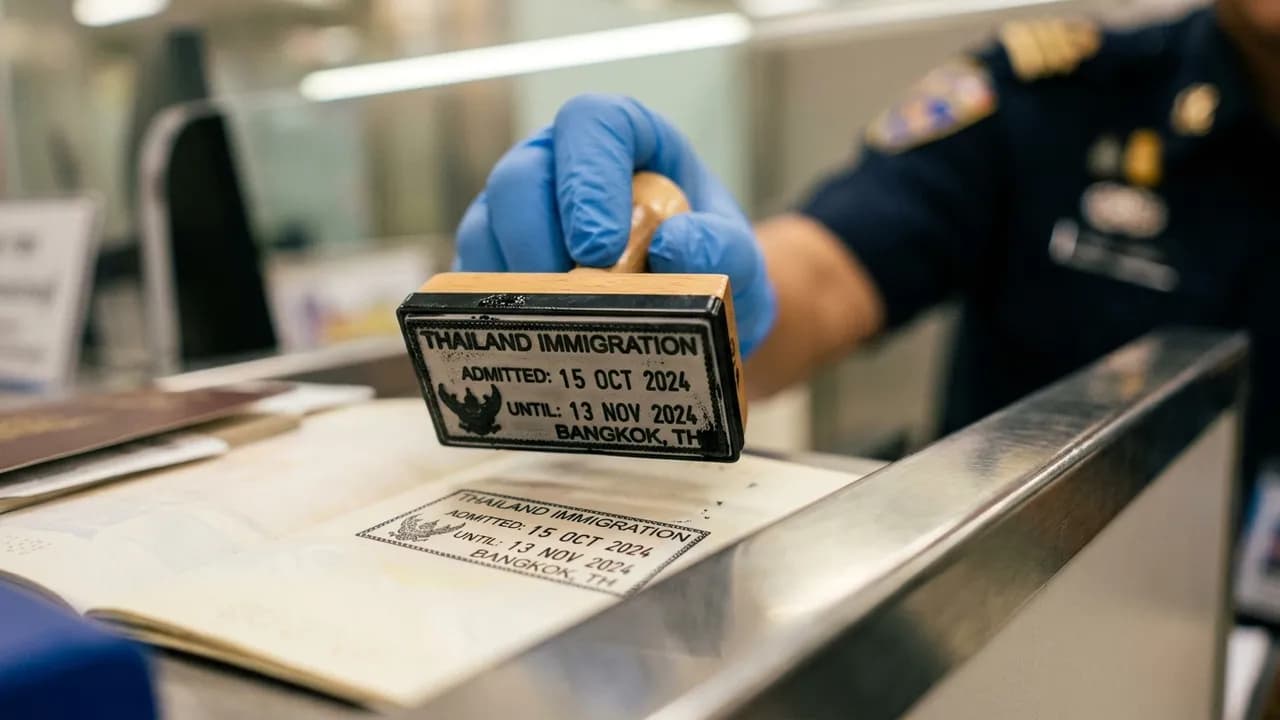
Australian citizens qualify for Thailand's visa exemption scheme. This means you can fly to Thailand without applying for any visa in advance. At the airport, you will receive a stamp allowing you to stay for 60 days.
What You Need at the Border
- A valid Australian passport with at least 6 months of remaining validity
- A completed arrival card (usually handed out on the plane or available at immigration)
- Proof of onward travel (a return or onward flight ticket)
- Proof of sufficient funds if requested (20,000 THB per person)
Extending Your Stay by 30 Days
If 60 days is not enough, you can extend your visa exemption by an additional 30 days at any Thai Immigration office. The fee is 1,900 THB (approximately AUD 85). You will need:
- Your passport
- A completed TM.7 application form
- One passport-sized photo (4x6 cm)
- A copy of your passport photo page and current entry stamp
- The 1,900 THB fee
This gives you a total of 90 days in Thailand without needing to apply for a visa before your trip.
Tourist Visa (TR): For Longer Stays
If you know in advance that you want to stay longer than 60 days, or if you prefer having a visa arranged before departure, you can apply for a Tourist Visa (TR).
Single Entry Tourist Visa
- Validity: 3 months from date of issue
- Stay permitted: 60 days per entry
- Cost: AUD 55
- Extendable: Yes, by 30 days at Thai Immigration (1,900 THB)
Multiple Entry Tourist Visa (METV)
- Validity: 6 months from date of issue
- Stay permitted: 60 days per entry (multiple entries allowed)
- Cost: AUD 275
- Extendable: Each entry can be extended by 30 days
The METV is particularly useful for Australians who want to travel in and out of Thailand over a six-month period, combining trips to neighbouring countries like Laos, Cambodia, or Vietnam.
e-Visa: Apply Online
Thailand's e-Visa system allows Australians to apply for most visa types online through thaievisa.go.th. The process eliminates the need to visit an embassy or consulate in person.
How the e-Visa Process Works
- Create an account on thaievisa.go.th
- Select the visa type you need
- Upload required documents (passport scan, photo, flight itinerary, accommodation proof)
- Pay the visa fee online (credit card accepted)
- Wait for processing (typically 5-10 business days)
- Receive your e-Visa approval via email
- Print the approval letter and present it at check-in and Thai immigration
The e-Visa is the most convenient option for Australians in regional areas far from the Canberra embassy or the Sydney and Melbourne consulates.
All Visa Types Available to Australians
Non-Immigrant B Visa (Business/Work)
For Australians taking up employment or conducting business in Thailand. You will also need a Work Permit after arrival.
- Cost: AUD 110 (single entry) / AUD 275 (multiple entry)
- Stay: 90 days per entry
- Required: Invitation letter from Thai employer, company documents
Non-Immigrant ED Visa (Education)
For studying Thai language, Muay Thai, cooking courses, or university programmes.
- Cost: AUD 110
- Stay: 90 days, renewable based on course duration
Non-Immigrant O Visa (Family/Retirement)
For Australians who are married to a Thai national, have Thai children, or are visiting family. Also used as a pathway for retirement.
- Cost: AUD 110
- Stay: 90 days, extendable to 1 year
Non-Immigrant O-A Visa (Long Stay / Retirement)
This is the dedicated retirement visa and is extremely popular with Australians.
- Cost: AUD 110
- Stay: 1 year, renewable
- Age requirement: 50 years or older
- Financial requirement: 800,000 THB (~AUD 36,000) in a Thai bank account, or monthly income of 65,000 THB (~AUD 2,900), or a combination totalling 800,000 THB
- Health insurance: Mandatory — must cover at least 40,000 THB outpatient and 400,000 THB inpatient (see health insurance requirements)
Destination Thailand Visa (DTV)
Introduced for digital nomads, remote workers, and those attending events, courses, or medical treatment.
- Cost: AUD 140
- Stay: 180 days, extendable by another 180 days
- Key benefit: Allows remote work for a non-Thai employer
Transit Visa
For Australians passing through Thailand en route to another country.
- Cost: AUD 45
- Stay: 30 days
Retirement in Thailand: A Popular Option for Australians
Thailand is one of the top retirement destinations for Australians, thanks to the affordable cost of living, warm climate, excellent healthcare, and established expat communities in places like Chiang Mai, Hua Hin, Pattaya, and Bangkok.
Steps to Retire in Thailand
- Apply for a Non-Immigrant O-A visa at the Thai Embassy in Canberra or consulates in Sydney/Melbourne before departing Australia
- Obtain a medical certificate and police clearance from Australia (required for O-A applications)
- Arrange health insurance that meets Thailand's minimum coverage requirements
- Transfer funds — deposit 800,000 THB into a Thai bank account, or demonstrate qualifying monthly income
- Complete 90-day reporting at Thai Immigration every 90 days (can be done online)
- Renew annually at your local immigration office in Thailand
Tips for Australian Retirees
- Open a Thai bank account as early as possible — Bangkok Bank and Kasikorn Bank are expat-friendly
- Your Australian age pension can be paid into a Thai bank account; contact Services Australia for overseas payment arrangements
- Consider the tax implications — Australia and Thailand have a Double Taxation Agreement (DTA)
- Join Australian expat groups in your chosen city for practical advice and social connections
- Medicare does not cover you in Thailand; private health insurance is essential
Thai Embassy and Consulate Locations in Australia
Royal Thai Embassy, Canberra (Main Embassy)
- Address: 111 Empire Circuit, Yarralumla, ACT 2600
- Phone: (02) 6206 0100
- Services: Full consular and visa services
- Hours: Monday to Friday, 9:00 AM – 12:00 PM (visa submissions), 2:00 PM – 3:30 PM (visa collection)
Royal Thai Consulate-General, Sydney
- Address: Level 8, 131 Macquarie Street, Sydney, NSW 2000
- Phone: (02) 9241 2542
- Services: Full visa services
Royal Thai Consulate-General, Melbourne
- Address: Suite 301, 566 St Kilda Road, Melbourne, VIC 3004
- Phone: (03) 9533 3901
- Services: Full visa services
No Consulate in Your State?
Australians in Queensland, Western Australia, South Australia, Tasmania, or the Northern Territory can use the e-Visa system or mail their applications to the Canberra embassy. The e-Visa option is strongly recommended for anyone not within easy travel distance of the three offices above.
Application Process: Step by Step
Applying at an Embassy or Consulate
- Download the visa application form from the embassy website or collect it in person
- Gather supporting documents (passport, photos, flight bookings, accommodation details, financial evidence)
- Submit your application in person during morning hours
- Pay the visa fee in AUD (cash or card depending on the office)
- Collect your passport with the visa stamped inside (usually 2-3 business days)
Applying via e-Visa
- Visit thaievisa.go.th and register
- Select your visa category
- Complete the online form and upload scanned documents
- Pay the fee via credit card
- Monitor your application status online
- Print your e-Visa approval letter once approved
Costs Summary in AUD
| Visa Type | Cost (AUD) |
|---|---|
| Visa exemption | Free |
| Tourist Visa (single entry) | $55 |
| Tourist Visa (METV) | $275 |
| Non-Immigrant B (single) | $110 |
| Non-Immigrant B (multiple) | $275 |
| Non-Immigrant ED | $110 |
| Non-Immigrant O / O-A | $110 |
| Destination Thailand Visa (DTV) | $140 |
| Transit Visa | $45 |
| 30-day extension (in Thailand) | ~$85 (1,900 THB) |
Fees are approximate and subject to change. Check the Thai Embassy Canberra website for the latest schedule.
Tips for Australian Travellers
- Book a return flight — even though visa exemption does not technically require one, airlines departing Australia frequently check for proof of onward travel before boarding.
- Carry AUD 900 in equivalent currency — Thai immigration can ask for proof of funds. A bank statement on your phone or cash in THB, AUD, or USD will satisfy this.
- Register with Smartraveller — the Australian Government's travel advisory service. Registration is free and ensures you receive updates about safety and entry requirement changes.
- Check your passport expiry early — Australian passport renewals can take several weeks. Ensure you have at least 6 months validity before booking flights.
- Travel insurance is not optional — Medicare provides zero coverage in Thailand. Take out comprehensive travel insurance that covers medical evacuation.
- Be aware of overstay penalties — Thailand charges 500 THB per day for overstaying (capped at 20,000 THB), and serious overstays can result in entry bans ranging from 1 to 10 years.
- Use the 90-day extension strategy — for a short-term stay beyond 60 days, the visa exemption plus 30-day extension is simpler and cheaper than applying for a Tourist Visa.
- Download the Thai Immigration app — useful for 90-day reporting if you are on a long-stay visa.
Common Mistakes Australians Make
- Assuming 30-day entry — some Australians confuse the old 30-day rule with the current 60-day visa exemption. You get 60 days, not 30.
- Not having proof of onward travel — budget airlines departing Australian airports are strict about this. A booked onward flight or even a refundable ticket will prevent issues at check-in.
- Forgetting travel insurance — Thailand has excellent hospitals, but bills can be enormous. Without insurance, a serious medical event could cost tens of thousands of AUD.
- Overstaying by "just a day or two" — even a single day of overstay goes on your record and can cause problems with future entries.
- Applying for the wrong retirement visa — the O-A visa (applied from Australia) is different from the O visa (applied in Thailand or at a consulate abroad). Each has different requirements for insurance and financial proof.
- Not checking embassy hours — visa submission windows at the Canberra embassy are limited to mornings. Arriving in the afternoon means a wasted trip.
Frequently Asked Questions
Can I work in Thailand on a visa exemption?
No. The visa exemption is strictly for tourism. Working without a valid work permit is illegal and carries serious penalties including fines and deportation.
Can I enter Thailand by land from Malaysia or Cambodia?
Yes. Australians can enter Thailand at land border checkpoints and receive the same 60-day visa exemption stamp. There is no difference between air and land entries for visa exemption holders.
How many times can I enter Thailand per year?
There is no hard legal limit for visa exemption entries, but immigration officers may question frequent short entries. If you plan to spend extended periods in Thailand, applying for an appropriate long-stay visa is the better approach.
This guide is current as of March 2026. Visa rules, fees, and requirements can change. Always verify details with the Royal Thai Embassy in Canberra or the official Thai e-Visa portal before making travel plans.