The Thailand visa for US citizens is simple for short trips. Since 15 September 2026, Americans get a 30-day visa exemption on arrival, down from 60 days, per the TAT Newsroom. You can still explore the Land of Smiles without applying for a visa in advance. This guide covers everything US passport holders need to know about entering and staying in Thailand.
Quick Facts for US Citizens
| Detail | Information |
|---|---|
| Visa Exemption | Yes - 30 days on arrival (60 days until 14 Sep 2026) |
| Passport Validity | Minimum 6 months beyond entry date |
| Extension Available | 30 additional days at immigration office |
| Maximum Stay (No Visa) | 60 days (30 + 30 extension) |
| ESTA Required | No - ESTA is for US entry only |
| E-Visa Available | Yes, via thaievisa.go.th |
| Tourist Visa (TR) Cost | $40 USD (single entry) |
| Currency | Thai Baht (THB); ~35 THB = $1 USD |
| US Embassy in Bangkok | Yes, fully operational |
Visa Exemption for US Citizens
American passport holders are granted 30 days visa-free entry to Thailand. The United States is on the 30-day list in the Ministry of Interior announcements published in the Royal Gazette on 31 August 2026 and in force since 15 September 2026. From July 2024 until 14 September 2026, the exemption was 60 days. If you entered before 15 September 2026, you keep the stay you were granted. The exemption covers tourism only.
How the Visa Exemption Works
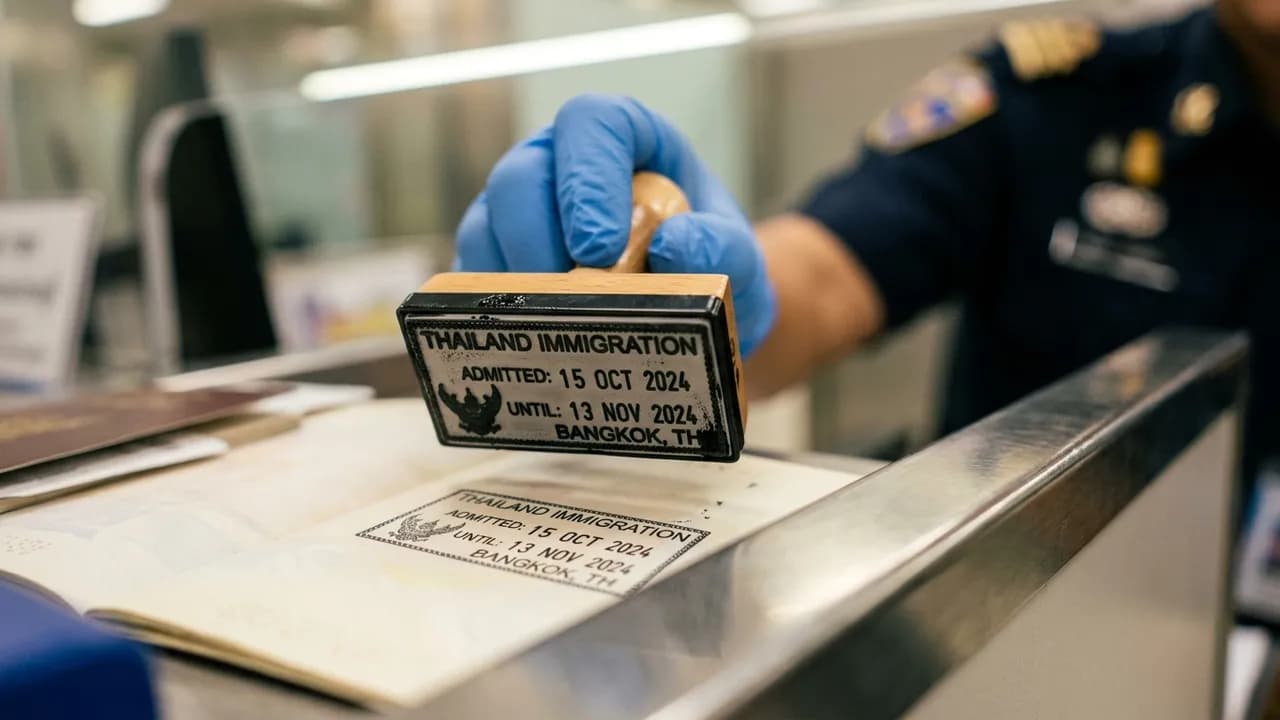
When you arrive at any international airport or land border crossing in Thailand, present your US passport to the immigration officer. You will receive a 30-day entry stamp automatically. No advance application, no fees, no paperwork beyond your digital arrival card (TDAC).
Requirements for Visa-Free Entry
- Valid US passport with at least 6 months of remaining validity
- Proof of onward travel - a return or onward flight ticket leaving within 30 days of arrival (not always checked, but technically required)
- Proof of funds - 20,000 THB (
$570 USD) per person or 40,000 THB ($1,140 USD) per family, per the Royal Thai Embassy in Washington. Immigration officers may ask to see it at their discretion, so carry proof - Thailand Digital Arrival Card (TDAC) - filed online at tdac.immigration.go.th before arrival; it replaced the paper TM.6
- One blank passport page for the entry stamp
Extending Your Visa Exemption
You can extend your 30-day visa-free stay once by up to 30 days at any Thai Immigration office, for about 60 days in total. The extension fee is 1,900 THB (~$54 USD). Bring your passport, a passport-sized photo, a completed TM.7 form, and a copy of your passport's data page and current entry stamp. See the visa exemption extension guide for the full process.
All Visa Types Available to US Citizens
Tourist Visa (TR)
If you plan to stay longer than 60 days or want a longer initial stay than the 30-day exemption, apply for a Tourist Visa before traveling.
- Single Entry: $40 USD - valid for 60 days, extendable by 30 days
- Multiple Entry (METV): $200 USD - valid for 6 months, 60-day stays per entry
- Processing Time: 3-5 business days at a consulate; 5-10 days via e-Visa
Non-Immigrant Visa B (Business)
For Americans working in Thailand, attending business meetings, or establishing a business. The visa exemption covers tourism only and does not permit business activity.
- Cost: $80 USD (single entry) / $200 USD (multiple entry)
- Validity: 90 days per entry
- Requirements: Invitation letter from a Thai company, business registration documents
Non-Immigrant Visa O (Family/Retirement)
Popular among American retirees and those married to Thai nationals.
- Retirement: Must be 50 years or older with 800,000 THB (
$22,860 USD) in a Thai bank account or monthly income of 65,000 THB ($1,860 USD) - Marriage: Must be married to a Thai national with 400,000 THB (~$11,430 USD) in a Thai bank account
- Cost: $80 USD (single entry)
Non-Immigrant Visa ED (Education)
For Americans studying Thai language, martial arts, cooking, or enrolled in a degree program.
- Cost: $80 USD (single entry)
- Requirements: Acceptance letter from a Thai educational institution
Smart Visa
Designed for highly skilled professionals, investors, and startup founders in targeted industries.
- Validity: Up to 4 years
- No work permit required for activities within the scope of the visa
Long-Term Resident (LTR) Visa
A newer option for wealthy global citizens, retirees, remote workers, and highly skilled professionals.
- Validity: 10 years
- Requirements vary by category - wealthy individuals must have $1 million USD in assets
E-Visa Application for US Citizens
Thailand's e-Visa system allows Americans to apply for visas online through thaievisa.go.th without visiting a consulate in person.
E-Visa Process
- Create an account on the Thai e-Visa portal
- Select the visa type and the Thai mission that covers your state of residence
- Upload required documents (passport scan, photo, flight itinerary, hotel booking, financial proof)
- Pay the visa fee online (credit card accepted)
- Track your application status online
- Receive your e-Visa approval via email
- Print the approval letter and present it at check-in and immigration
E-Visa Processing Times
- Standard processing: 5-10 business days
- Peak season (November-February): May take up to 15 business days
- Apply at least 3 weeks before travel to be safe
Royal Thai Embassy and Consulate Locations in the US
Four Thai missions issue visas in the US, and each covers a fixed set of states. The e-Visa portal routes your application to the mission for your state of residence. Look up your state on our US consular jurisdiction page. There is no Thai Consulate-General in San Francisco.
Royal Thai Embassy - Washington, D.C.
- Address: 1024 Wisconsin Ave NW, Suite 401, Washington, DC 20007 (consular section: 2300 Kalorama Road NW, Washington, DC 20008)
- Phone: (202) 944-3600
- Jurisdiction: AL, DE, FL, GA, LA, MD, MS, NC, SC, TN, TX, VA, WV, plus DC and Puerto Rico
Royal Thai Consulate-General - Los Angeles
- Address: 611 N. Larchmont Blvd, 2nd Floor, Los Angeles, CA 90004
- Phone: (323) 962-9574
- Jurisdiction: AK, AZ, CA, CO, HI, ID, MT, NM, NV, OR, UT, WA, WY, plus the US Pacific territories (Guam, American Samoa, Northern Mariana Islands)
Royal Thai Consulate-General - Chicago
- Address: 700 N. Rush Street, Chicago, IL 60611
- Phone: (312) 664-3129
- Jurisdiction: AR, IA, IL, IN, KS, KY, MI, MN, MO, ND, NE, OK, SD, WI
Royal Thai Consulate-General - New York
- Address: 351 E. 52nd Street, New York, NY 10022
- Phone: (212) 754-1770
- Jurisdiction: CT, MA, ME, NH, NJ, NY, OH, PA, RI, VT
Costs Summary for US Citizens (USD)
| Service | Cost (USD) |
|---|---|
| Visa exemption entry | Free |
| 30-day extension of exemption | $54 (1,900 THB) |
| Tourist Visa - Single Entry | $40 |
| Tourist Visa - Multiple Entry | $200 |
| Non-Immigrant Visa (Single) | $80 |
| Non-Immigrant Visa (Multiple) | $200 |
| 90-Day Report | Free |
| Re-entry Permit (Single) | $29 (1,000 THB) |
| Re-entry Permit (Multiple) | $109 (3,800 THB) |
Tips for US Citizens Traveling to Thailand
Before You Go
- ESTA is not needed for Thailand. ESTA is exclusively for entering the US under the Visa Waiver Program. It has nothing to do with traveling to Thailand.
- Register with the US Embassy in Bangkok via the Smart Traveler Enrollment Program (STEP) at step.state.gov for safety alerts and emergency assistance.
- Check your passport expiration well in advance. Thailand requires 6 months of validity. US passport renewal can take 6-8 weeks.
- No vaccination certificate is required for direct flights from the US, though COVID-era policies should be verified before travel.
At the Airport
- Use the Foreign Passport immigration lanes at Suvarnabhumi (BKK) or Don Mueang (DMK) airports.
- Have your return ticket confirmation accessible on your phone or printed out.
- The immigration officer may ask about your hotel or accommodation - have an address ready.
- Processing typically takes 5-15 minutes in the immigration queue.
During Your Stay
- Carry your passport or a copy at all times. Thai law requires foreigners to carry identification.
- If staying at a hotel, they handle TM.30 registration for you. If renting privately, your landlord must file TM.30 within 24 hours.
- Do not overstay your visa. Overstay fines are 500 THB per day (max 20,000 THB), and serious overstays can result in bans from re-entering Thailand.
- For stays over 90 days, you must file 90-day reports at immigration or online.
Common Mistakes by US Travelers
- Assuming the visa exemption is still 60 days - it was cut to 30 days on 15 September 2026; many outdated sources still say 60.
- Not having proof of onward travel - budget airlines and immigration occasionally require this.
- Doing visa runs too frequently - immigration may deny entry if they see a pattern of repeated short stays.
- Working on a tourist visa or visa exemption - this is illegal and can result in detention, fines, and deportation.
- Forgetting to get a re-entry permit before leaving Thailand on a Non-Immigrant visa - your visa will be cancelled without one.
- Not checking passport validity - being turned away at check-in because your passport expires within 6 months is avoidable.
Frequently Asked Questions
Can I work in Thailand on a visa exemption?
No. The visa exemption and tourist visa are strictly for tourism. Working in Thailand without a work permit is illegal. To work legally, you need a Non-Immigrant B visa and a work permit. See can you work on a tourist visa in Thailand for the rules and penalties.
Can I enter Thailand by land from neighboring countries?
Yes. US citizens receive the same 30-day visa exemption at land borders as at airports. Entries on the exemption via land borders are capped at twice per calendar year.
How many times can I enter Thailand visa-free per year?
Land-border entries on the visa exemption are capped at twice per calendar year. Immigration officers also have discretion. If you spend more time in Thailand than your home country, expect questions. Having a valid visa rather than relying on repeated exemptions is advisable for extended stays.
Do I need travel insurance?
Travel insurance is not a visa requirement for US citizens, but it is strongly recommended. Medical care in Thailand is affordable by US standards, but a serious emergency can still be costly. Your US health insurance likely does not cover you abroad.